01 The document
Dirk van Hogendorp, the Batavian Republic’s envoy in Russia, sent the dispatch from St Petersburg to Maarten van der Goes, the Batavian agent for foreign relations. The clear address names both men and the first leaf carries the dispatch number. The rest is in numerical code groups, mostly of one to three digits, distinguished by bars, ticks, dots and wave-like marks above the figures.
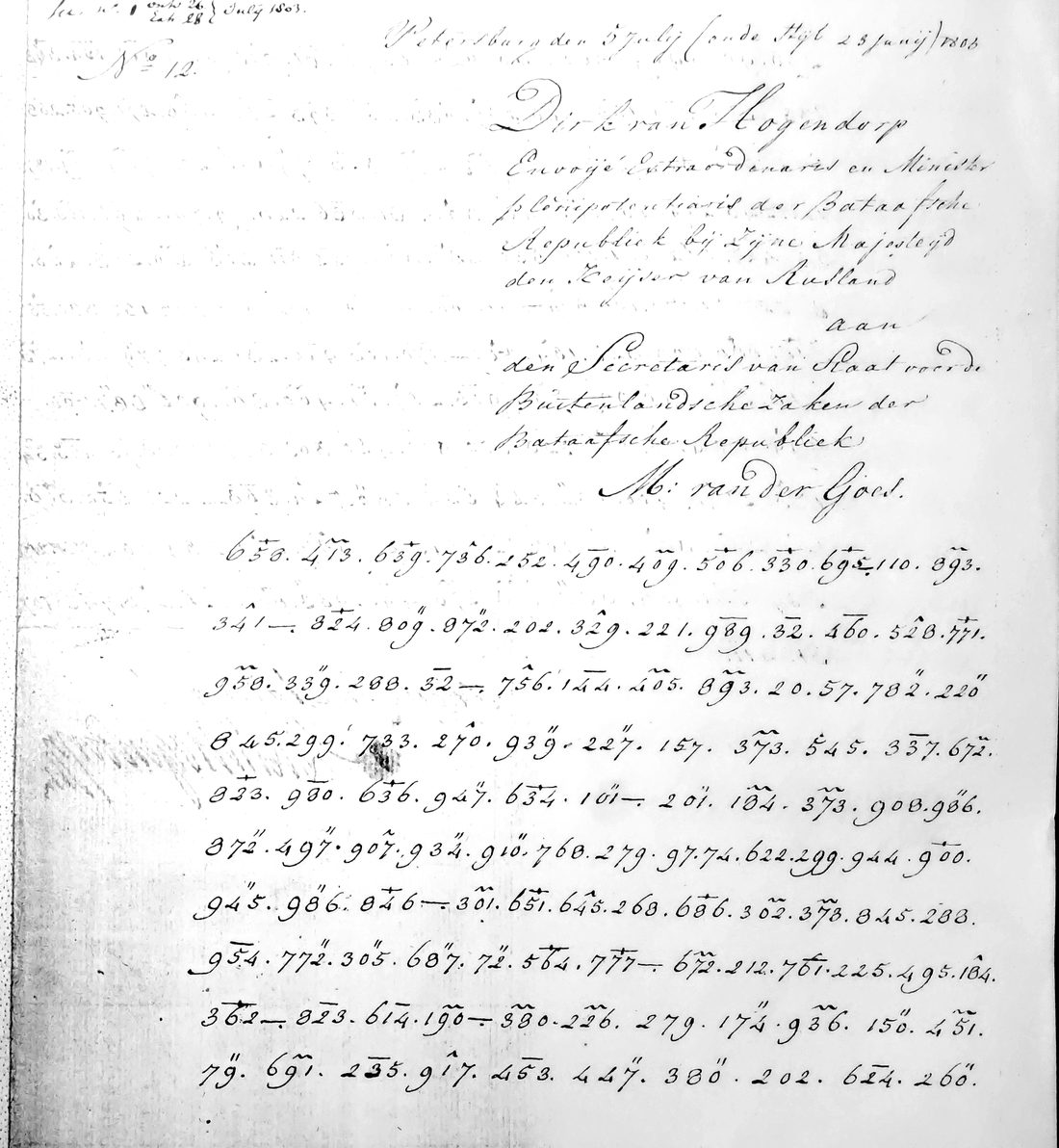
The numeric-only transcription has 286 groups and 218 distinct bare values. That count ignores the marks, although 73 with a bar and 73 with a wave are different codebook entries. A transcription with the marks exists in draft; the pale marks still need a second check against the scans.
02 Sillem’s account, 1890
J. A. Sillem narrates Hogendorp’s first approaches in St Petersburg on pp. 151–153 of his biography. Dispatch no. 10 of 5 July supplied the argument for a Russo-Batavian commercial treaty: Russia should have an immediate interest in the Batavian Republic’s continued existence as an independent state, and concluding the treaty would demonstrate that interest.
Vorontsov was not persuaded. Sillem continues:
Hogendorp vond zijne houding althans “zo wonderlijk” dat hij naar andere kanalen zocht om den Keizer onze belangen voor te dragen. Hij meende een gelukkigen greep gedaan te hebben door de tusschenkomst in te roepen van den Generaal van Suchtelen, Nederlander van geboorte, die in russischen dienst tot Opperbevelhebber der genie was opgeklommen, en het volste vertrouwen genoot van Czaar Alexander, met wien hij dagelijks omging.
The footnote attached to that passage reads: “Rijksarchief. Dep. van denzelfden dag No. 12 gecijferd.” In English: “National Archives. Dispatch of the same day, no. 12, ciphered.” The manuscript supplies No. 12; Sillem supplies the content; and his preceding note fixes “the same day” as 5 July 1803.
03 The content of the dispatch
What is established is the subject and the argument. Vorontsov’s attitude and answer struck Hogendorp as so strange that he sought another route to the emperor. He chose Van Suchtelen because the general’s Dutch origin, senior position and daily access to Alexander made him a plausible intermediary. The object was to place the Batavian Republic’s interests (in context, its independent survival and the desired commercial treaty) before the emperor by a channel outside the chancellor.
A concise English reconstruction is:
Chancellor Vorontsov’s attitude and answer appeared so strange to me that I sought another way to bring our interests to the emperor’s attention. I believe I have found it in General Van Suchtelen, Dutch by birth, commander of the engineers in Russian service, who enjoys Emperor Alexander’s full confidence and sees him daily.
This is an editorial paraphrase of Sillem’s account. It is not a quotation from a decoded text. Connectives, spelling, the exact request made of Van Suchtelen and any material Sillem omitted remain unknown.
04 The matching codebook
DECODE R1035 is catalogued as Legatie Rusland, inv. nr. 228, codebook, 1803. Its twenty images show the same system used in R1942: numerical entries extended by superposed marks, with values for letters, syllables, word parts, whole words, names and phrases. DECODE’s downloadable partial transcription contains 1,849 distinct entries.
It places the letter in the documented 1803 Russian-legation system and is the route to an exact decoding. It does not by itself decode the dispatch: the CSV is partial, and the letter’s marks must be transcribed accurately before the corresponding rows can be selected.
05 Evidence for the identification
- Number. The leaf itself says No. 12.
- Date. The docket and DECODE record give 5 July 1803.
- Source citation. Sillem assigns the Van Suchtelen paragraph to the ciphered no. 12 of that same day.
- Separation from no. 10. His preceding footnote names no. 10 as the source for the commercial-treaty exchange with Vorontsov. The two dispatches cannot be conflated.
- System. The 1803 Russian-legation codebook R1035 matches the manuscript’s marked numerical format.
The identification needs no cryptanalysis. It rests on a contemporary archive number, visible on the cipher sheet, that a printed account repeats while stating what the dispatch reported.
06 What remains
- Exact marks. Every bar, tick, dot and wave over the 286 groups needs independent visual verification. The current transcription of the marks is preliminary.
- Exact plaintext. R1035 must be applied group by group, with its images consulted wherever the downloadable CSV has no entry. Until then, no wording of the original is claimed or graded (H, C, M or I).
- Sillem’s omissions. His paragraph may compress, modernise or omit part of the dispatch. Only a complete alignment can show how much.
- Related traffic. Dispatch no. 10 of the same day and no. 21 of 19 August frame the approach: proposal, attempted alternative channel, then Vorontsov’s definitive refusal. Comparing their code groups may settle doubtful marks.
07 Sources
- Nationaal Archief, 2.01.08, Ministerie van Buitenlandse Zaken 1796–1810, inv. 318; DECODE R1942.
- Nationaal Archief, 1.02.13, Legatie Rusland, inv. 228; DECODE R1035, codebook of 1803.
- J. A. Sillem, Dirk van Hogendorp (1761–1822) (Amsterdam, 1890), pp. 151–153: Internet Archive scan; p. 153 on Google Books.
- Nationaal Archief, inventory 1.02.13, Legatie Rusland.
The scans, numeric and marked transcriptions, partial R1035 table, evidence note and machine-readable profile are in the repository folder R1942/. The modern reconstruction is editorial and must not be cited as Hogendorp’s verbatim plaintext.