At a glanceExisting decipherment · complete
- The letter
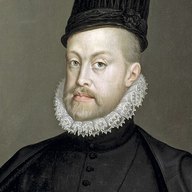
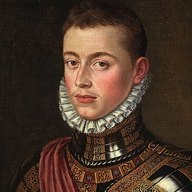
- Philip II to his half-brother Don Juan of Austria, “mi Capitan General de la Mar”, Madrid, 28 August 1574, signed by the King and countersigned by Antonio Pérez.
- Where
- Koninklijk Huisarchief, The Hague, Collectie Handschriften 2e serie, G016-A0204, two pieces, 6 scans on koninklijkeverzamelingen.nl. Catalogued as a letter in cipher to Don Juan “stadhouder van de Nederlanden”; in 1574 he was not yet governor there.
- The cipher
- Letters on one- and two-digit numbers in near-alphabetical order, with vowels added as marks on the preceding sign (a cross for e, a dot for i), a few code groups, and numbers written in clear.
- How it was checked
- The second piece is a clear version of the cipher. The key was rebuilt by aligning the two and then read back against the cipher line by line.
- What it says
- The King sends Don Juan the ransomed ensign Diego de Esquivia and, through him, letters encouraging Hürrem Bey, the Sultan’s chief interpreter, and a Milanese renegade engineer in Uluç Ali’s fleet to keep serving Spain.
- Still open
- Two code groups read only from context; about half the cipher lines not compared sign by sign.
01 The two pieces
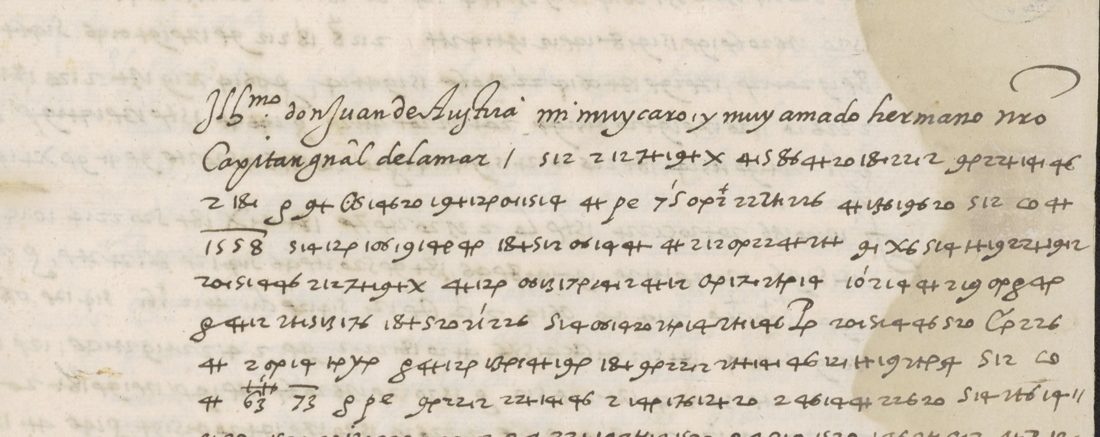
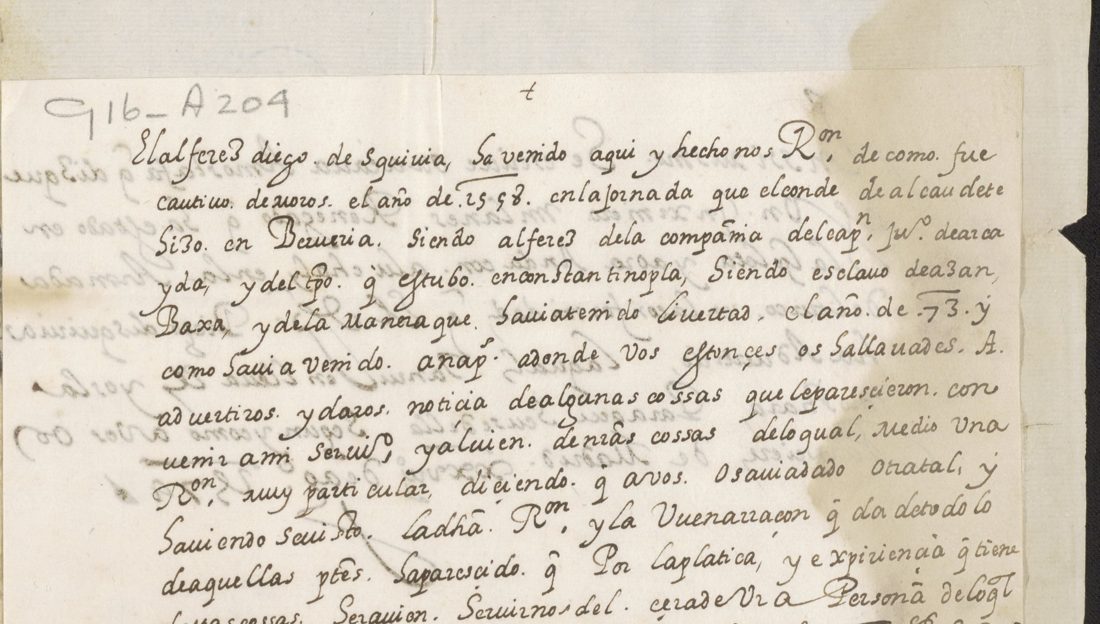
The item holds the King’s original and a single sheet in another hand. The original opens in clear, Ill.mo don Juan de Austria mi muy caro y muy amado hermano mio Capitan general de la mar, and then runs into some thirty lines of figures, with one clear phrase in the middle (de lo qual los he querido avisar). It is signed Yo el Rey and Ant. Perez and dated Madrid xxviij de agosto 1574; the address leaf and seal survive. The sheet gives the cipher passages in plain Spanish. Nothing on either says how the letter came into the house archive of Orange-Nassau.
02 The key
At first sight the figures look like a code of two-digit groups. They are a letter cipher. Each consonant has a number close to its place in the alphabet counted with j and k (d 4, j 10, l 12, m 13, n 14, r 19, s 20, t 21, v 22; c 0, g 8, h 9, p 17, qu 18). The vowels have small numbers (a 2 or a looped sign, e 5, i 1, o 6 or 15) or are written as a mark after a consonant: a cross adds e, a dot adds i, a stroke above adds u. So 4+ is de, 18· is qui, and siendo alferez is 20 1 5 14 4 6 2 12 7+ 19+ X. X serves for both x and z, y is written g, and a few groups stand for whole words: pe como, co año, Lo carta. Years are left in clear with an overline (1558, 73). The full table is in key.md.
03 What the letter says
The ensign Diego de Esquivia, captured by the Moors in 1558 on the Count of Alcaudete’s expedition to Mostaganem, had spent years in Constantinople as a slave of Hasan Pasha, been freed in 1573 and gone to Naples to brief Don Juan. The King, having read his report, assigns him 15 escudos a month to serve near Don Juan’s person and asks Don Juan to employ him.
Esquivia had also brought a letter from Hürrem Bey, interprete principal del turco, the Porte’s chief dragoman. The King answers it, animandole a la continuacion de nuestro servicio and promising him refuge in Spain if he has to flee; a second letter goes to Mostafa, ingeniero milanes renegado, who had been at La Goleta and now sailed with Uluç Ali in the Ottoman fleet. Esquivia carries both, and Don Juan is to decide how they are used. The letter is dated two weeks before La Goleta fell to that fleet.
The clear text is in clear_version.md and an English translation in translation.md.
04 The clear version checked against the cipher
About fourteen of the thirty-odd cipher lines, from the opening, the middle and both paragraphs, were deciphered with the rebuilt key and compared word by word. They agree, with two exceptions:
- The first paragraph ends que lo podra hazer in the cipher (9 ρ X+ 19); the clear version has saber.
- The interpreter’s name, which the clear version gives as [?]oran vey, is spelled in the cipher 15 19 ρ 13+ g, “Oram bey”: Hürrem Bey, chief dragoman of the Porte, who is known from other sources to have kept up contacts with Philip II’s agents.
The clear version repeats de lo qual os he querido avisar; so does the original, once in clear and once in cipher.
05 What remains open
- Two code groups have one context each: 161 (turco) and g 90 (Porque).
- About sixteen cipher lines on scan 1 and the end of the cipher on scan 2 were not compared sign by sign; the clear version covers them.
- No other letter in this cipher has been found yet; the Philip II–Don Juan correspondence at Simancas would be the place to look.
Full texts
The transcription and the decryption of every document on this page, so that the reading can be used and checked. Short files are shown here; all are in the repository.
Philip II to Don Juan of Austria, Madrid, 28 Aug 1574 (KHA G016-A0204)
Philip II recommends the alférez Diego de Esquivia, a former captive of Hasan Pasha, to serve near Don Juan at 15 escudos a month, and sends through him answers to Hürrem Bey, the Sultan's chief interpreter, and to Mostafa, a Milanese renegade engineer with Uluç Ali's fleet, both encouraged to keep serving Spain.
Transcription: none of the cipher. The cipher passages were read from the separate clear version of the time (clear_version.md, shown under Decryption), checked against the cipher with the key; they were not transcribed sign by sign.
Decryption
# The clear version (KHA G016-A0204, scan 2 right and scan 3 left)

A separate sheet in another hand, headed "G16-A204" (modern pencil), with the text of the cipher passages of
the King's letter. Abbreviations expanded in [brackets]; spelling as written. Paragraph 1 = the cipher block on
scan 1 up to "de lo qual los he querido avisar"; paragraph 2 = the block after it.

## Paragraph 1 (scan 2 right)

El alferez diego de squivia ha venido aqui y hecho nos r[elaci]on de como fue cautivo de moros el año de 1558
en la jornada que el conde de alcaudete hizo en berveria siendo alferez de la compañia del cap[ita]n ju[a]n de
arcayda y del t[iem]po q[ue] estuvo en constantinopla siendo esclavo de azan baxa y de la manera que havia
tenido liuertad el año de 73 y como havia venido a nap[oles] adonde vos entonces os hallavades a advertiros y
daros noticia de algunas cossas que le parescieron convenir a mi servi[ci]o y al bien de n[uest]ras cossas de lo
qual me dio una r[elaci]on muy particular diciendo q[ue] a vos os havia dado otra tal y haviendo se visto la
dicha r[elaci]on y la buena narracion q[ue] da de todo lo de aquellas p[ar]tes ha parescido q[ue] por la platica
y experiencia q[ue] tiene destas cossas sera bien serviros del cerca de v[uest]ra persona de lo q[ua]l os he
querido avisar y para ello le avemos señalado 15 v[eint]e de entretenimi[ent]o al mes cerca de v[uest]ra
persona de lo qual os e querido avisar para que lo tengays entendido y rogaros y encargaros mucho como lo hago
q[ue] pues le conoceys y teneis noticia del le empleys y os sirvays del en lo que conforme a su qualidad y
platica vieredes q[ue] lo podra saber

## Paragraph 2 (scan 2 right, continued)

Porque el dicho Di[ego] desquivia nos truxo una carta de [?]oran vey (cipher: 15 19ρ 13+ g, "Oram bey" = Hürrem Bey, chief dragoman of the Porte) q[ue] dizque es interprete principal
del turco y ha advertido que sera muy conveniente responderle a ella animandole a la continuacion de
n[uest]ro servi[ci]o y offresciendole q[ue] si por esta caussa le fuere forcosso acudir a n[uest]ros reynos
sera recogido y entretenido en ellos se le scrive en esta misma conformidad la carta q[ue] el d[ic]ho diego
desquivia os mostrara originalmente al qual ha parescido entregarsela para que con v[uest]ra orden y conforme
a lo que a vos os paresciere se sirva della y no de otra manera y assi sera bien q[ue] vos le ordeneys lo que en
esto ha de hazer

## Paragraph 3 (scan 3 left)

Anssi mismo se escrive otra carta a Mostafa q[ue] dizque es un ingeniero milanes renegado q[ue] ha estado en la
goleta y aora anda con aluchaly en la armada del turco en la conformidad q[ue] el d[ic]ho diego desquivia ha
advertido la qual tambien lleva el y os la mostrara para que se use della segun y como a vos os paresciere de
madrid xxviij de ag[ost]o 1574
Translation
# Translation of the cipher passages (from the clear version, corrected against the cipher)

The ensign Diego de Esquivia has come here and told us how he was taken captive by the Moors in 1558 on the
expedition the Count of Alcaudete made into Barbary, being ensign of the company of Captain Juan de Arcayda; of
the time he spent in Constantinople as a slave of Hasan Pasha; how he gained his freedom in [15]73; and how he came
to Naples, where you then were, to warn you and inform you of some things he thought fitting to my service and the
good of our affairs. He gave me a very detailed account of it, saying he had given you another like it. Having seen
that account and the good report he gives of everything in those parts, it has seemed that, for the practice and
experience he has of these matters, it will be well for you to make use of him near your person, of which I have
wished to inform you; and for this we have assigned him 15 escudos a month of allowance near your person. I have
wished to tell you this so that you know it, and to ask and charge you earnestly, as I do, that since you know him
and have knowledge of him, you employ him and make use of him in whatever, according to his quality and
experience, you see he can do.

Because the said Diego de Esquivia brought us a letter from Oram Bey [Hürrem Bey], who they say is the Turk's
chief interpreter, and has advised that it would be very fitting to answer it, encouraging him to continue in our
service and offering him that, if for this reason he were forced to come to our kingdoms, he would be received and
maintained in them, he is written to in this same sense by the letter that the said Diego de Esquivia will show you
in the original; it has seemed best to hand it to him so that he uses it by your order and as you think fit, and in
no other way; so it will be well for you to order him what he is to do in this.

Likewise another letter is written to Mostafa, who they say is a Milanese engineer, a renegade, who was at La
Goleta and now goes with Uluç Ali in the Turk's fleet, in the sense the said Diego de Esquivia has advised; he also
carries it and will show it to you, so that it is used as you think fit. Madrid, 28 August 1574.
Key: key.md
06 Sources
- Koninklijk Huisarchief, The Hague, Collectie Handschriften 2e serie, G016-A0204 (6 scans), koninklijkeverzamelingen.nl.
- Found by the project’s sweep of Dutch archive catalogues (
research/nationaal_archief/, KHA lead K1).
Files: targets/philip1574/.