
01 The document
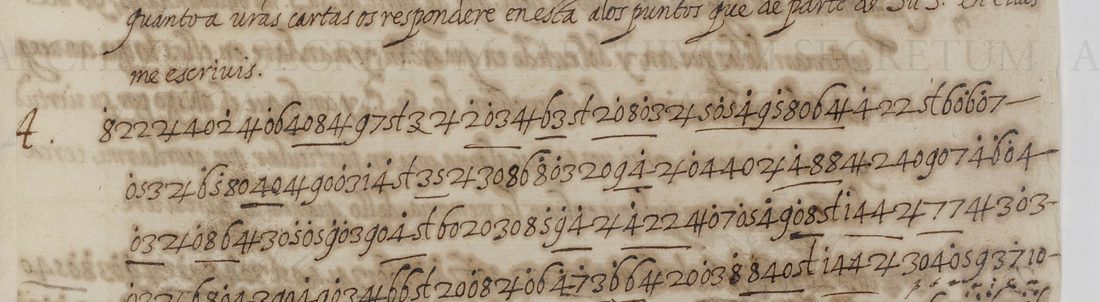
f. 303r gives the King’s titles and the address to the bishop of Padua. He has received the nuncio’s letters but could not answer them sooner “por mi indispusicion, de que al presente (gracias á Dios) quedo bueno y levantado”. The nuncio may write this to His Holiness by the courier now leaving for Italy, and thank God for him. The King will answer the points raised on the Pope’s behalf. Passage A follows. An Italian slip pasted over the heading reads Della sanità ragguagliata del Re.
f. 304r has three numbered clear answers. (1) Jurisdiction: the King has written to Don Juan de Zúñiga, his ambassador in Rome, and refers to that. (2) The order for dividing the Turkish slaves held in Rome has been sent. (3) He will look into the affairs of the bishop of Liège that the Pope recommends. Passage B follows, marked “B.”. The Roman summary at the head lists only the three clear points.
The address leaf reads All’Ill.mo et R.mo S.r mio Col.mo Mons.r Ill.mo Cardinal di Como · à Roma · Per servitio di N. S.re, with the docket 73 / a 17 Junii. The ciphered passages are what the King or the nuncio kept out of the clear copy.
02 The cipher

- 1,098 digits in 23 lines, from DECODE’s 2020 transcription, spot-checked against the images: A 756 symbols, B 568.
- Dots over digits are frequent: 0̇ 148 times, 4̇ 46, 5̇ 36. A cross-stroke follows 2 (74 times), 4 (59) and 5 (51), rarely anything else.
- There is no word division and no pair structure: the parity of every second digit is 60/40 at both offsets, line by line.
- Over 31 distinct symbols the index of coincidence is 0.055. That is too low for plain substitution into Italian or Spanish.
03 Keys tried
- Spain nunciature 1568, Lasry’s polyphonic key (one digit stands for two letters, 0 null), which deciphers the Alessandrino letters. It gives nonsense here.
- Crivelli, nuncio in Spain 1561 (Meister, p. 259): polyphonic, with codes ending in 9, 3 or 5. Nonsense.
- “Cifra col cardinal di Como” (Meister VI.1, pp. 262–264, from Ottob. 3208–09). Its Spain nomenclator includes secretaries Zayas and Idiáquez, Cardinal Deza, Antonio Pérez and the Cruzada, and it marks codes by crossing or hooking the second digit, much like the stroke here. Letters with an odd second digit do not parse. Idiáquez and Deza date it to Sega’s nunciature after 1578.
- Meister VI.2 and VI.3. VI.2 comes with the rules of “la cifra ordinaria di mons. nuntio di Spagna”: null 8 at the end of every word, a dot over the codes for che, chi, qua, que, qui, et, mente. Its letters do not parse. VI.3 (nuncio in Spain to nuncio in Flanders) uses only even digits, and this text has 330 odd ones.
04 Ciphertext-only attacks and their controls
- Homophonic substitution over three symbol sets (digit; digit with dot and underline; dotted 0 and the stroke joined to the digit), solved by simulated annealing against Italian and Spanish 4-gram language models with a letter-frequency penalty. The same solver largely recovers an Italian control text of the same length with 28 symbols. On R116 no meaningful text comes out in any setting.
- Polyphonic “one digit, two letters”, the 1568 family, with the pairs fitted by annealing and each digit’s value chosen by a Viterbi pass. On 1,100 digits of an Alessandrino letter it recovers 7 of Lasry’s 9 pairs at −2.18 per letter. On R116 it scores −2.30 to −2.47, and five restarts give five different keys, in either language, and again with 1 as a null.
- A first quadgram solver failed its own control (it preferred repetitive strings to the true text), so its results were discarded. Only runs that recovered their control text are counted above.
05 What would move it
- The Rome decifrato of this despatch, which may be elsewhere in Spagna 7 or in the nunciature registers.
- The King’s minute, in AGS Estado (Roma, 1573), if the passages were enciphered in Madrid. PARES describes only Ormanetto items of 1575.
- Carini, Mons. Niccolò Ormaneto … nunzio apostolico alla corte di Filippo II (Rome 1894), which prints nunciature documents. It was not found online.
- The table of the Spain nuncio’s ordinary cipher of 1572–77, of which Meister prints only the rules. With the system known, R116 and R118 together (about 1,500 digits) are long enough for a second attack.
06 Sources
- Archivio Apostolico Vaticano, Segr. Stato, Spagna 7: DECODE R116 (two page images, address leaf, transcription by KL 2020). Images require a DECODE login.
- A. Meister, Die Geheimschrift im Dienste der päpstlichen Kurie (Paderborn 1906), pp. 259, 262–265 (archive.org).
- G. Lasry, reconstructed key of ASV Spagna 6 (1568), on DECODE R93–R102; see Alessandrino 1568.
- Sibling record: Ormanetto and Clementino 1576–77 (R118, same system).
Notes, ciphertext and the solvers: ormanetto1573/.