
At a glanceKey from adjacent plaintext · complete
- The letter
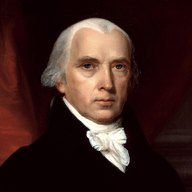
- William Vans Murray, US minister to the Batavian Republic, sent to Paris to exchange the ratifications of the Convention of 1800, to Secretary of State James Madison: despatch No. 5, Paris, 26 June 1801, the duplicate sent via Bordeaux.
- Where
- National Archives, RG 59, Diplomatic Despatches, Netherlands, vol. 4, on microfilm M42 reel 5, frames 0397–0398 (catalog NAID 188770447). Abstract in The Papers of James Madison, Secretary of State Series 1:353 (Founders Online 02-01-02-0456), where no decipherment is given. Catalogue no. 481.
- The cipher
- Murray’s legation code of 1797–1801: numbers up to about 1,600 for words and syllables, joined by dots inside the clear text. The postscript has six groups.
- How it was deciphered
- No key sheet survives. Murray’s 1797–98 despatches to Pickering in the same volume series carry a clerk’s decode between the lines, and every one of the six groups is decoded there, 406 as arm three times (armies, alarmed, arming).
- What it says
- “P.S. As to the armed neutrality not a Word has yet been said”: in the Paris conferences the French had not raised the League of Armed Neutrality of the northern powers.
- Still open
- Nothing in the postscript. The original copy, sent via Le Havre, was not found.
01 The letter
Murray had been minister at The Hague since 1797 and one of the three American envoys who signed the Convention of Mortefontaine with France on 30 September 1800. The Senate ratified it in February 1801 on condition that Article 2, which put off the old treaties and the indemnities for spoliations, be struck out, and Murray went to Paris in May 1801 to exchange the ratifications. His despatch No. 5 of 26 June reports a conference with Fleurieu and Rœderer the day before: the French ministers are “unanimous in refusing to accede to the Suppression of the Second Article”, and Talleyrand has asked whether Murray could exchange ratifications if theirs were conditional.
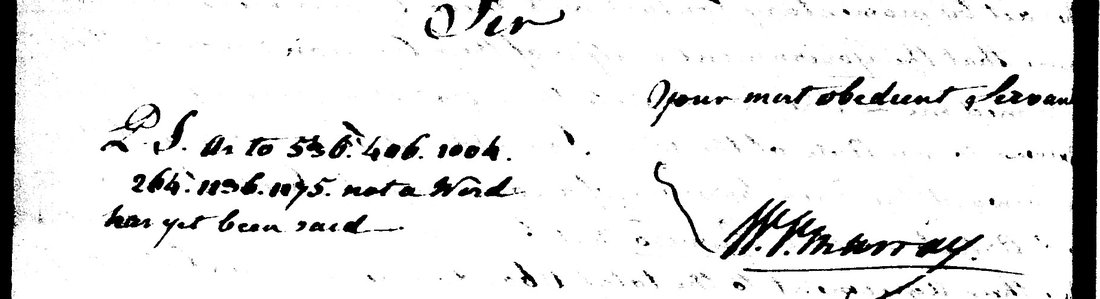
The body is in a clerk’s hand. Below his signature Murray added a three-line postscript in his own hand, partly in code. The Madison editors abstract the letter (PJM-SS 1:353) and say of it: “Partially encoded postscript…not deciphered (key not found)”. The copy on the film is the duplicate, marked “Via Bordeaux / Sent 27 june 1801”. The original went via Le Havre in the hope of reaching Captain Rodgers before he sailed; it is not in the France despatches for 1800–01 (M34 reel 9) and was not found.
02 Murray’s code and where the values come from
The six groups are 536, 406, 1004, 264, 1136, 1175. The last was transcribed 1075 at first; at four times enlargement it is 1175, with the same narrow “11” that opens 1136 on the same line. The code is not one of the State Department codes already rebuilt in this project: the Pinckney code at Madrid has the = 1651, Armstrong’s Paris code 972, John Quincy Adams’s 1810 code 1385. Here the is 536.
No key sheet is known, but Murray wrote many coded passages from The Hague, and in the Department someone wrote the meaning over the numbers:
- The sibling named in the catalogue. The postscript of 18 May 1801 to his No. 132 (same volume, frame 0372), decoded between the lines by Jacob Wagner: 1285.1181 Gaudin, 712.621.1161 Tribunate, 536 the, 247 Consuls. The group 536 shows the 1801 postscripts use the code of the 1790s.
- The 1797–98 despatches to Pickering. Diplomatic Despatches, Netherlands, vol. 3 (M42 reel 4, NAID 188770022) holds Murray’s despatches from his arrival at The Hague, with long coded passages on the Batavian revolution and the Directory, most of them decoded by a clerk. About 150 word and syllable pairs were taken from them.
Every group of the postscript is decoded somewhere in those letters. Five matched at once; the sixth, 406, was predicted from the sense and then found:
| Group | Value | Decoded in the siblings (M42 reel 4 unless stated) | Grade |
|---|---|---|---|
| 536 | the | reel 5 frame 0372 (Wagner, 1801), and throughout the 1797–98 decodes | C |
| 406 | arm | frame 0224R: 406.1503s armies and 1086.406.1004 alarmed; frame 0257L: 406.517 arming | C |
| 1004 | -ed | frame 0167R: 948.164.1004 intended; frame 0170L: 1369.1004 worked; frame 0224R: alarmed | C |
| 264 | neutral | frame 0039R: 264.88 neutral ministers | C |
| 1136 | -i- | frames 0093L and 0167R: 279.1136.1175 majority; frame 0170L: 1167.1136.834 written | C |
| 1175 | -ty, -y | frames 0093L and 0167R: majority; frame 0134R: apology; frame 0167R: speedy | C |
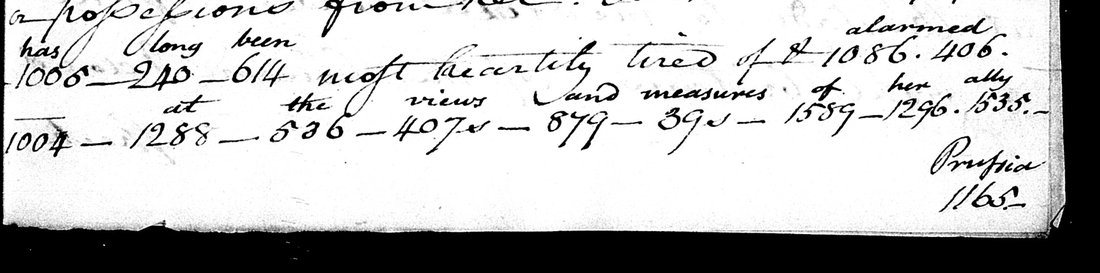
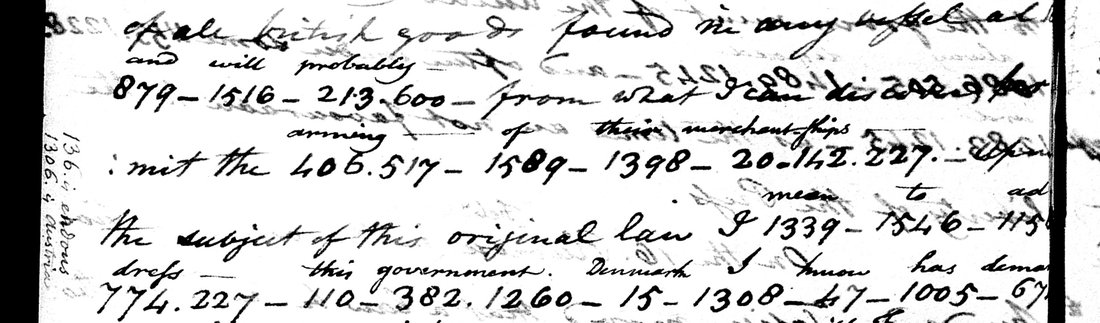
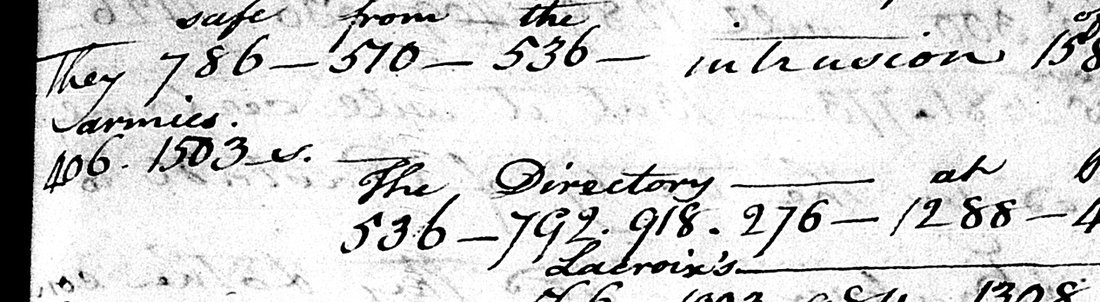
Murray also wrote 406.1004 for armed himself in his No. 44 of 28 May 1798 (frame 0365, right page), “those ships to be armed”, where no decode was written but the clear text around it is about arming merchant ships. The neighbouring numbers 405 (half) and 407 (views) are decoded too, so 406 is not a misread of either.
03 The reading
| Cipher | 536 | 406 | 1004 | 264 | 1136 | 1175 |
|---|---|---|---|---|---|---|
| Value | the | arm | -ed | neutral | -i- | -ty |
P.S. As to the armed neutrality not a Word has yet been said—
The armed neutrality is the League of Armed Neutrality the northern powers (Russia, Sweden, Denmark and Prussia) formed in December 1800 against British search of neutral ships. By June 1801 it was coming apart: Paul I was murdered in March, the Danish fleet was beaten at Copenhagen in April, and Murray’s own despatch of 7 May describes the coalition’s weaknesses. Murray tells Madison, in code, that the French had said nothing about it in the conferences on the Convention.
04 How it was done
- The Founders abstract and the 26 Murray–Madison letters of 1801 were checked: only the 7 May despatch (with its 18 May postscript) is coded and decoded. The letter is dated Paris, not The Hague as the catalogue entry had it.
- Vol. 4 of the Netherlands despatches was located on the National Archives catalogue (NAID 188770447) and its 433 frames downloaded. The 26 June letter is frames 0397–0398; there is no second copy in the volume.
- The postscript was transcribed and the 18 May decode read: 536 is the in both.
- Vol. 3 (M42 reel 4) was scanned frame by frame for coded passages, with subagents transcribing the groups and the clerk’s decodes. The pairs gave 1004 = -ed, 264 = neutral, 1136 = -i-, 1175 = -ty: “the [406]-ed neutrality”.
- That predicted 406 = arm. A search of the rest of vol. 3 for the group 406 found it decoded as armies, alarmed and arming. The attestations for 264, 1136, 1175, 1004 and 406 were checked on the frames.
The method is a key recovered from adjacent plaintext: the contemporary decodes of other letters in the same file series, not a key sheet or a decoded copy of this letter. The statistical test is not applicable to six groups (verdict “too short”); the check is that every value is decoded in the siblings.
05 What remains
- Nothing in the postscript: all six groups are graded C, read from contemporary decodes of the same code.
- The original of No. 5, sent via Le Havre, was not found, so there is no second copy to compare.
- Murray’s whole code was not rebuilt. The ~150 sibling pairs are kept as working notes in the folder; only the six used here were checked on the images.
Full texts
The transcription and the decryption of every document on this page, so that the reading can be used and checked. Short files are shown here; all are in the repository.
Postscript of No. 5, 26 June 1801
Murray, in Paris to exchange the ratifications of the Convention of 1800, tells Madison that in the conferences with the French ministers nothing has yet been said about the armed neutrality, the northern powers' league of 1800-01.
Transcription
# William Vans Murray to James Madison, Paris, 26 June 1801 (No. 5), duplicate
# NARA RG 59, Diplomatic Despatches, Netherlands, vol. 4 = microfilm M42 reel 5, frames 0397-0398
# (catalogue naId 188770447; frame image M42-05-0398.jpg, left page). Body in a clerk's hand, postscript
# and signature in Murray's hand. The postscript is the only coded passage in the letter.
# Code groups are separated by dots in the original; '?' marks an uncertain digit.

f.0398 left, ll. 1-3 (postscript, below the signature block):
P.S. As to 536 . 406 . 1004 .
264 . 1136 . 1175 . not a Word
has yet been said —

# tokens: 536 406 1004 264 1136 1175   (6 code groups)
# reading notes: the last group was first read 1075; at 4x it is 1175: its first two strokes are the same
# narrow '11' as at the start of 1136 on the same line. A grave-shaped stroke above the dot between 536 and
# 406 and another after 264 are pen flourishes on the separators, not part of the numbers.
Decryption
P.S. As to 536[the] 406[arm] 1004[ed] 264[neutral] 1136[i] 1175[ty] not a Word has yet been said —
Key: pairs.tsv
06 Sources
- National Archives, RG 59, Despatches from US Ministers to the Netherlands, vol. 4 (26 June 1798–2 September 1801), microfilm M42 reel 5, frames 0372 and 0397–0398: catalog.archives.gov/id/188770447.
- Same series, vol. 3 (9 June 1797–17 June 1798), microfilm M42 reel 4, frames 0039, 0093, 0134, 0167, 0170, 0224, 0257, 0365: catalog.archives.gov/id/188770022.
- The Papers of James Madison, Secretary of State Series, vol. 1, ed. R. J. Brugger et al. (Charlottesville, 1986), pp. 145–146 and 353; Founders Online 02-01-02-0456 and 02-01-02-0199.
- R. E. Weber, Masked Dispatches: Cryptograms and Cryptology in American History, 1775–1900 (NSA, 2013), ch. 12, on Murray’s correspondence with King and John Quincy Adams.
Transcription, the six values with their evidence, the reading file and the work log: targets/murray1801/.