01 The letter and the key
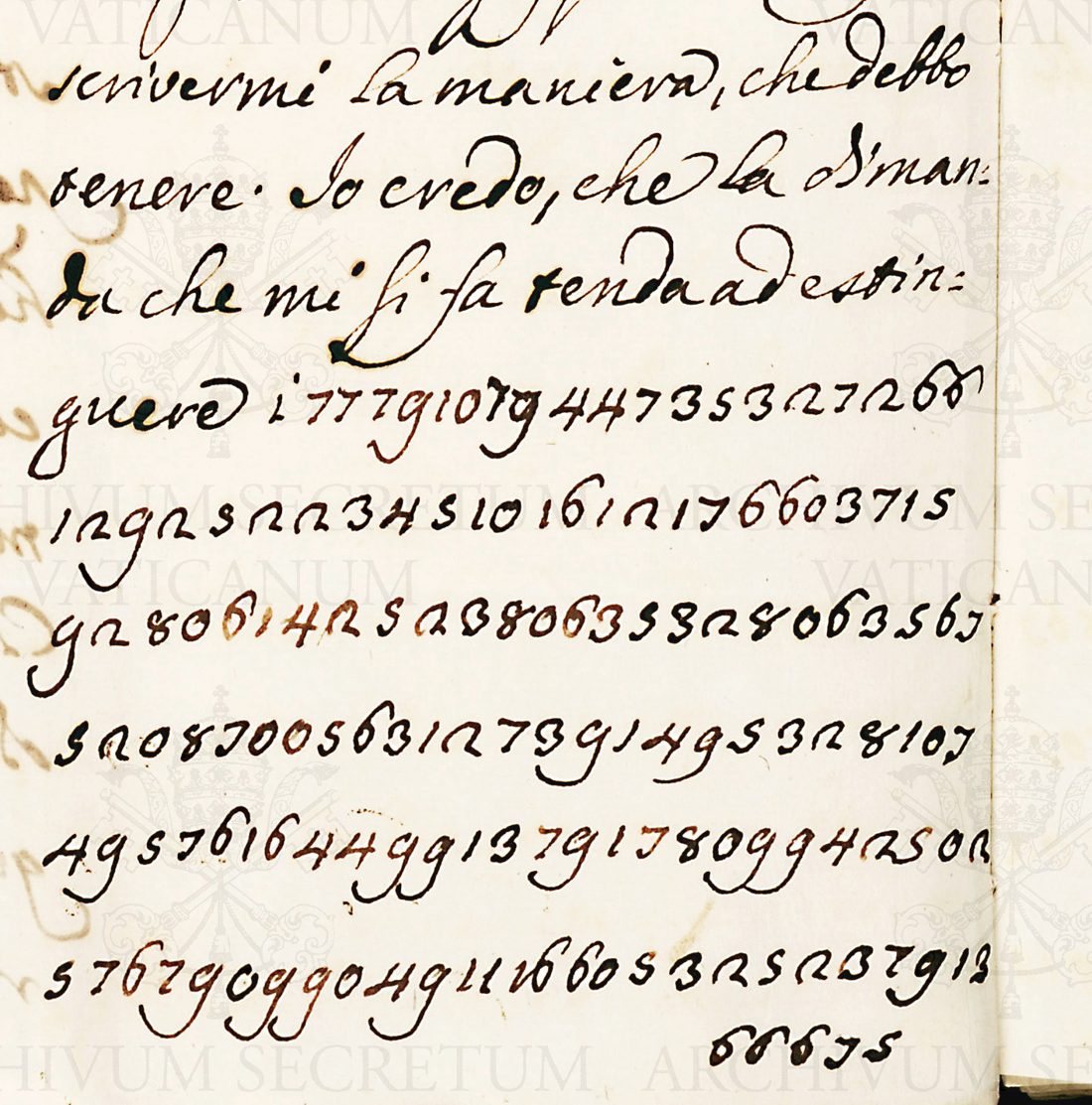
Spagna 304 is the second volume of the Madrid nunciature’s original letters and ciphers for June–December 1767. DECODE imaged four pages of it as R120 and one leaf, f. 485 (December 1767), as R121. R120 was transcribed by MEG in June 2020, R121 by EHum in 2017. On 24 October 2020 Lasry posted a reconstructed key and a decryption of R121. He attached both to R120 as well, which may be why R120 is marked “partially decrypted”.
The key is a small nunciature cipher: fixed-length two-digit homophones for letters and common syllables (a 17|71, e 13|49, i 42|92, che 02, non 61, del 22, la 34), the digit 5 as a null, and four-digit nomenclator codes that all begin with 8. No two-digit element begins with 5, so a lone 5 is always the null and the figures divide into units without ambiguity.
02 The ciphered sentence
The 152 figures divide into 82 tokens. Decrypted group by group:
77 79 10 79 44 73 5 32 72 66 12 92 5 22 34 5 10 16 12 17 66 03 71 5 92 8061 42 5 23 8063 5 32 8063 5 67 5
t  u  m  u  l  ti _ in te r  n  i  _ del la _ m  o  n  a  r  chi a  _ i  qual i  _ di quando_ in quando_ si _
20 8700 5 63 12 73 91 49 5 32 8107 49 5 76 16 44 99 13 79 17 8099 42 5 02 5 76 79 09 90 49 11 16 60 5 32 5 23 79 13 66 67 5
f  anno _ se n  ti r  e  _ in [?]  e  _ s  o  l  l  e  v  a  zion i  _ che_ s  u  c  c  e  d  o  no _ in _ di v  e  r  si _
Io credo, che la dimanda che mi si fa tenda ad estinguere i tumulti interni della monarchia, i quali di quando in quando si fanno sentire in [8107] e sollevazioni che succedono in diversi […]
“I believe the request made to me aims at putting down the internal disturbances of the monarchy, which from time to time make themselves felt in [8107], and the risings that break out in various [places] …”
Changes to the key and transcription:
- Transcription. MEG’s first line has
3 2 3 2 6 6. The image has3 2 7 2 6 6, which gives in-te-r-n-i. Her other figures agree with the image. - 63 = se, not di. Here it gives se-n-ti-r-e, sentire. The same change mends two places in Lasry’s R121 text: “perche 63 gli fa credere” (perché se gli fa credere) and “cades 63 in un mal cronico” (cadesse). di is 23, which occurs in the same sentence (in di-v-e-r-si).
- 03 = chi: monar-03-a, monarchia. The key has no h.
- 8061 = qual: i quali. The code falls between 8046 perche and 8063 quando in the key’s alphabetical run.
- 8099 = zion: sollev-a-zion-i, near the end of the first alphabetical block.
- 8700 = anno: si f-anno. The 87xx block has 8706 giorni and 8720 pasante.
03 What the clear part says
Right after Cardinal Pallavicini, Lucini’s predecessor, had left, the Marqués de Grimaldi, Secretary of State, sent the nuncio a note, which is enclosed with the letter. In the king’s name it asked for the renewal of the licence that Pallavicini had granted on 1 July 1766: the power to make churchmen submit to examination and give evidence before lay judges in cases of lèse-majesté. The king wanted it indefinita ed illimitata, and extended from the regular clergy to the secular clergy.
Lucini first took the licence for a special faculty given to his predecessor “in occasione della nota sollevazione”, the Madrid riots of 1766, which had lapsed with him. Then he read the printed cedula Grimaldi had enclosed and saw that Pallavicini had made the faculty pass to his successors. So he offered the king a renewal with his predecessor’s cautions, which the Pope had approved (letter of 7 August 1766). For the secular clergy he would subdelegate to the bishops, as Pallavicini had done for the diocese of Cuenca (approved 4 September 1766). He does not know whether the king will accept a time-limited renewal, and asks for instructions. The cipher then gives his private view of Madrid’s motive. This was six months after the expulsion of the Jesuits from Spain in April 1767.
04 What remains open
- 8107, a place or noun after si fanno sentire in. It lies between the end of the first alphabetical block (8099) and 8140 Camera, so it probably starts with A–Ca: America (the Mexican risings of 1767), Andalusia and Aragona would all fit. This is a guess and is not used in the decryption.
- The rest of the sentence and of the letter are on the next leaf, which DECODE did not image.
- The clear text follows MEG’s transcription, and a few of her doubtful words were settled from the sense. The full text is in the repository’s
READING.md.
05 Sources
- Archivio Apostolico Vaticano, Segreteria di Stato, Spagna 304, via DECODE R120 (4 images, MEG’s transcription) and R121 (f. 485).
- George Lasry, reconstructed key “ASV – S304” and decryption of R121, DECODE, 24 October 2020.
- No edition of Lucini’s 1767 despatches was found (web search, 21 September 2026).
Working files, the corrected figures, the parser and the full reading are in lucini1767/.