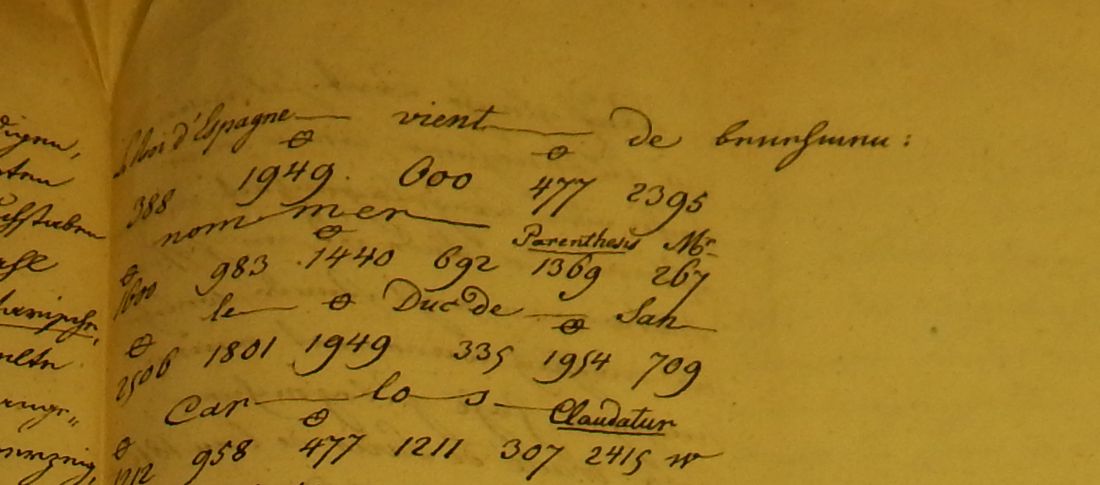
01 The document
The eleven openings contain one continuous memorandum in a single clerical hand. After the heading, each paragraph cites a place in the instruction it amends: "Seite 2, Spalte 2, Zeile 3 von Unten", "Seite 9, Spalte 2, Zeile 5", "Seite 10, Spalte 2", "Seite 23, nach der Zahl 1918", "Seite 32", "Seite 33, Linie 2 von Unten". It closes with an appendix, Beilage: Ueber den Gebrauch der Doppel- (Supplementar-) Zahlen. The last page carries the date and the signature, W. Loeschner. DECODE's "Loeschnen?" misreads the final letter. Among the topics:
- the misleading name "Ziffernkabinett", which the author wants dropped from an instruction meant for Austria's diplomats;
- entering new words in the Déchiffrant (the deciphering half of the key) as well as the Chiffrant. The author cites a despatch of Prince Kaunitz that added supplements 16–17 to a key;
- the range of numbers from 3 to 6000, and the supplementary figures (Ergänzungszahlen);
- how to cipher proper names, the envelope of a ciphered despatch, and the Parenthesis and Claudatur signs.
02 Why there is nothing to decipher
The figures occur only inside examples. On opening 9 the plaintext le Roi d'Espagne vient de nommer (Parenthesis) M. le Duc de San Carlos (Claudatur) son Amb.r &c is written directly above its code groups, 388 1949 600 477 2395 1800 983 1440 692 1369 267 2506 1801 1949 335 1954 709 1212 958 477 1211 307 2415, with ⊖ marks for the word divisions. Opening 5 has a short table of the same kind (A, B and syllables against four-digit numbers). Opening 3 shows syllable splits such as "Com-pa-ra-tion". Every one of these examples comes with its plaintext. The memorandum describes a key but does not contain one, and it hides no message.
03 What stays open
Nothing on the cipher side. The memorandum was not transcribed in full. It is a useful source for Austrian cipher-office practice around 1816, and the numeric examples could be checked against the Staatskanzlei keys of that period on DECODE. For DECODE, the queued correction asks for the author to be changed to W. Loeschner, the record to be described as an instruction memorandum, and its decryption status to be set to not applicable.
04 Sources
- DECODE record R2227, images P1–P11 (not public domain; the crop above is shown for identification only).
- Österreichisches Staatsarchiv, HHStA, Staatskanzlei Interiora, Chiffrenschlüssel Kt. 20.
Notes and profile: targets/loeschnen1816/.