At a glanceExisting decipherment · complete
- The telegram
- General Joseph E. Johnston, commanding in Mississippi, to the Confederate Secretary of War James A. Seddon, Jackson, 16 June 1863. Clear text with five words in cipher.
- Where
- National Archives, RG 109, Telegrams Received by the Confederate Secretary of War, item naId 3854726 (three images). Catalogue entry 629.
- The cipher
- Vigenère on the standard table. The key runs on from one cipher word to the next and advances by the length of each plaintext word.
- How it was deciphered
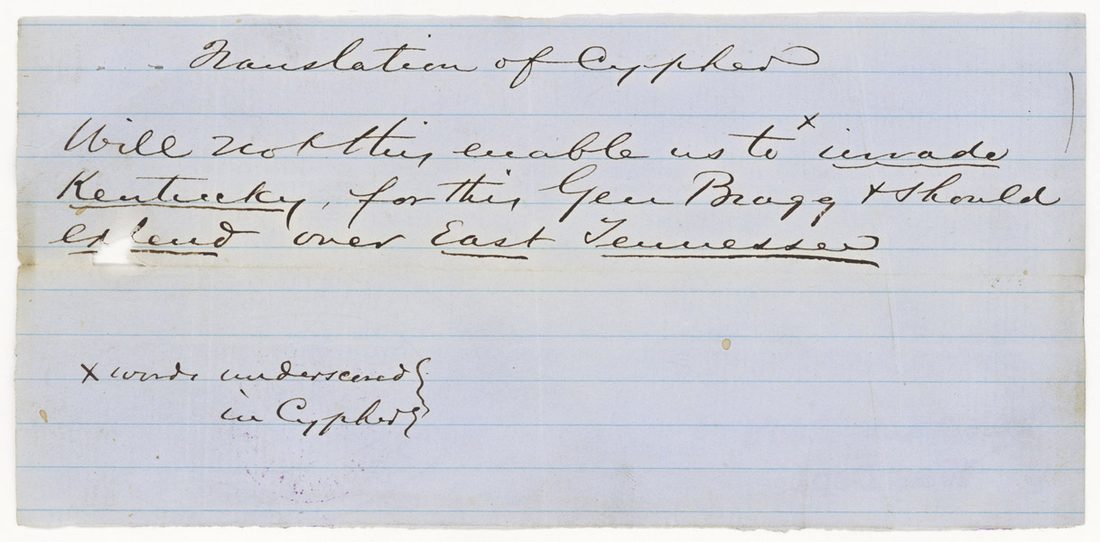
- A leaf headed “Translation of Cypher” (image 3) gives the five words in clear: invade Kentucky, extend, East Tennessee. Subtracting them from the cipher gives the key stream MANCHESTERBLUFF, 26 of 33 positions; the other seven are the clerk’s slips.
- What it says
- Part of the Union 9th and 23rd Corps has gone to reinforce Grant: “Will not this enable us to invade Kentucky?”
- Still open
- Nothing in the text. Whether the fourth letter of UNIEK is an E or a hasty C is not certain; it does not change the reading.
- Credit
- Transcription, the key match and the controls by WAINUT (pull request #100, 27 October 2026), done with AI language-model agents. The decipherment is the Confederate War Department’s of 1863.
01 The telegram
The telegram is a single leaf headed “By Telegraph”, dated “Jackson 16th June 1863” and addressed to “Hon J A Seddon”. It is the telegraph office’s written copy: the cipher words are in spaced capitals, as a clerk copies groups he cannot read. Image 2 is the docket (“1705. Genl Johnston, Jackson Miss. June 16. 1863”) and image 3 a separate leaf, “Translation of Cypher”, with the note “words underscored in Cypher”.
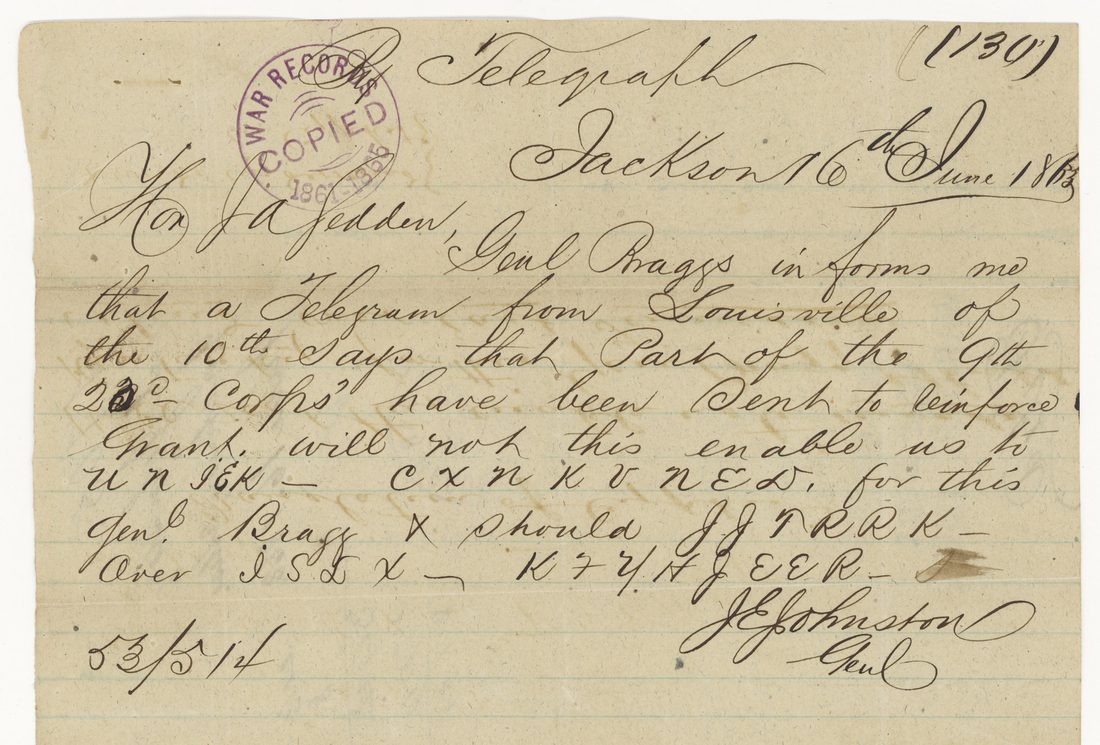
The five cipher words are UNIEK, CXNKVNED, JJTRRK, ISLX and KFYHJEER, 31 letters. The catalogue had the fourth as ISDX; on the full-resolution page image its third letter is a script capital L, so ISLX. The second letter of KFYHJEER is a crossed “7”, the script F of this hand.

02 The 1863 decipherment
The War Department deciphered the words on receipt. Its leaf reads: “Will not this enable us to x invade Kentucky, for this Gen Bragg & should extend over East Tennessee”, with the five cipher words underlined and the note “x words underscored in Cypher”. The text was then printed twice: in Richmond in 1864, in Correspondence between the President and General Joseph E. Johnston … during the months of May, June and July, 1863, and in the Official Records, Series I, vol. 24, part 1 (1889), p. 227, where it reads “the Ninth and Twenty-third Corps” and “General Bragg’s command should extend”. The letter to Bragg of 17 June (p. 196) quotes the sentence.
03 The key
MANCHESTERBLUFF is one of the Confederate Vigenère keys known from other messages, with COMPLETEVICTORY and COMERETRIBUTION. The catalogue entry had tried all three and found nothing. The reason is how the key moves: it runs on from one cipher word to the next, but advances by the length of each plaintext word. INVADE has six letters and UNIEK only five, so a key advanced by cipher length slips one place out of step from the second word on and matches 5 of 33 positions; restarting the key at each word matches 4.
With the key advanced by plaintext length, the expected encipherment matches the written one at 26 of 33 positions:
| plaintext | key | expected | written | slip |
|---|---|---|---|---|
| INVADE | MANCHE | UNICKI | UNIEK | key C used as E; last letter not written |
| KENTUCKY | STERBLUF | CXRKVNED | CXNKVNED | the N left in clear |
| EXTEND | FMANCH | JJTRPK | JJTRRK | key C used as E |
| EAST | ESTE | ISLX | ISLX | none |
| TENNESSEE | RBLUFFMAN | KFYHJXEER | KFYHJEER | one S (cipher X) left out |
The key was not assumed. Subtracting the 1863 words from the cipher letter by letter gives the key stream MANEH | STARBLUF | FMANEH | ESTE | RBLUFMAN, which is MANCHESTERBLUFF read straight through with the slips. Both places where the key letter is C were enciphered with E, so the clerk’s copy of the key, or his reading of it, had E for C: one systematic slip, not two.
Controls (check.py): COMPLETEVICTORY matches 1 position of 33 and COMERETRIBUTION 3; 20,000 random 15-letter keys average 1.2, best 11; the fourteen wrong starting points of the right key give 0–4. Every other decryption is gibberish.
04 What it says
General Bragg informs me that a telegram from Louisville of the 10th says that part of the 9th, 23d Corps have been sent to reinforce Grant. Will not this enable us to INVADE KENTUCKY? For this General Bragg & should EXTEND over EAST TENNESSEE. J. E. Johnston, General.
The cipher words are in capitals. Johnston, who had told Seddon the day before that he thought saving Vicksburg hopeless, passes on Bragg’s report that Burnside’s corps were going west to Grant, and proposes that Bragg use the opening to move into Kentucky with his command extended over East Tennessee. Only the operative words were enciphered; the movement of the Union corps went in clear. Vicksburg surrendered on 4 July.
05 What remains uncertain
- UNIEK: the fourth letter is an E with a hooked top. A hasty C would fit the key (27 of 33 instead of 26); either way the word is INVADE.
- The cross-like sign after “Bragg” is in clear, read as “&” on both the telegram and the 1863 leaf; the prints have “Bragg’s command”.
- Which telegraph office enciphered the words, and which copy of the key it held, is not shown on the leaf.
Full texts
The transcription and the decryption of every document on this page, so that the reading can be used and checked. Short files are shown here; all are in the repository.
Johnston to Seddon, Jackson, 16 Jun 1863
During the siege of Vicksburg, Johnston passes on Bragg's news that part of the Union 9th and 23d Corps has been sent to reinforce Grant (a telegram from Louisville), and asks Seddon whether this does not allow an invasion of Kentucky, for which Bragg's command should extend over East Tennessee. The words 'invade Kentucky', 'extend' and 'East Tennessee' were enciphered.
Transcription
# Johnston to Seddon, Jackson, 16 June 1863: the telegram as written (NARA naId 3854726, image 1)
# https://catalog.archives.gov/id/3854726  (images 1-3; image 3 is the "Translation of Cypher")
# Clear text as written, line by line. The five cipher words are in capitals, as on the leaf.
# [?] = uncertain reading. The cipher letters were read on the native page image of the NARA PDF (2510 x 2400 px).

By Telegraph                                        (130)
                       Jackson 16th June 1863
Hon J A Seddon,
          Genl Bragg[s?] informs me
that a Telegram from Louisville of
the 10th says that Part of the 9th
23d Corps' have been sent to reinforce
Grant. will not this enable us to
UNIEK - CXNKVNED. for this
Genl Bragg & should JJTRRK -
Over ISLX - KFYHJEER -
                       J E Johnston
                            Genl
53/514

# Stamp "WAR RECORDS COPIED" on the leaf. Docket (image 2): "1705. Genl Johnston, Jackson Miss. June 16. 1863."
# The "&" after "Bragg" is written as a cross-like sign; the 1864 print has "General Bragg's command should".

# Cipher words only (31 letters):
UNIEK CXNKVNED JJTRRK ISLX KFYHJEER

# Sign notes
# ISLX     third letter is a script capital L (bottom loop, top stroke to the right), not D: the catalogue's "ISDX" is a misreading.
# KFYHJEER second letter is a crossed "7" form, a script F; a script T is possible but less likely (T fails under the key).
# UNIEK    fourth letter is E-like with a top hook; a hasty C cannot be excluded [?] (C would match the key).
Decipherment of the time
# "Translation of Cypher": the decipherment of the time, NARA naId 3854726, image 3 (Confederate War Department, 1863)
# https://catalog.archives.gov/id/3854726  (object 18859_2008_003_a.jpg)
# Transcribed line by line. Underlined words (the five cipher words) are in capitals here.

Translation of Cypher

Will not this enable us to x INVADE
KENTUCKY, for this Gen Bragg & should
EXTEND over EAST TENNESSEE

x words underscored }
  in Cypher         }
Decryption
# Johnston to Seddon, 16 June 1863: decryption line by line against transcription.txt
# Key MANCHESTERBLUFF, Vigenere (tabula recta), running across the cipher words only, advancing by plaintext length.
# Columns: cipher word as written | key letters | written deciphered | plaintext (image 3) | what differs
# python check.py reproduces every column (check_output.txt).

Line "Grant. will not this enable us to"   (clear)
Line "UNIEK - CXNKVNED. for this"
  UNIEK     key MANCHE     -> INVCD      INVADE      4th letter: key C applied as E (A+E = E); final letter (E+E = I) not written
  CXNKVNED  key STERBLUF   -> KEJTUCKY   KENTUCKY    3rd letter: plaintext N written unenciphered (key E gives R)
  "for this"                                          (clear)
Line "Genl Bragg & should JJTRRK -"
  JJTRRK    key FMANCH     -> EXTEPD     EXTEND      5th letter: key C applied as E (N+E = R)
Line "Over ISLX - KFYHJEER -"
  "Over"                                              (clear)
  ISLX      key ESTE       -> EAST       EAST        exact
  KFYHJEER  key RBLUFFMAN  -> TENNEZSR   TENNESSEE   one S (key F, cipher X) left out; the rest follows one place on

Totals: 31 cipher letters; 26 of the 33 plaintext positions match the expected encipherment.
The two places where the key letter is C are the two places where the clerk used E: one systematic slip, not two errors.

Plaintext of the cipher words: INVADE KENTUCKY | EXTEND | EAST TENNESSEE

The telegram with the cipher words in place (cipher words in capitals):
  Genl Bragg[s?] informs me that a Telegram from Louisville of the 10th says that Part of the 9th 23d Corps' have
  been sent to reinforce Grant. will not this enable us to INVADE KENTUCKY. for this Genl Bragg & should EXTEND
  Over EAST TENNESSEE. J E Johnston Genl
Reading
# Johnston to Seddon, Jackson, 16 June 1863: the telegram as sentences

Words that were in cipher are in capitals. The telegram is in English, so no translation is given. Notes on "9th, 23d"
and on the sign after "Bragg" are in NOTES.md.

## Reading

General Bragg informs me that a telegram from Louisville of the 10th says that part of the 9th, 23d Corps have been
sent to reinforce Grant. Will not this enable us to INVADE KENTUCKY? For this General Bragg & should EXTEND over EAST
TENNESSEE.

J. E. Johnston, General.
Key: key.md
06 Sources
- National Archives, RG 109, War Department Collection of Confederate Records, Telegrams Received by the Confederate Secretary of War (series naId 651917), item naId 3854726, “Enciphered Telegram from General J. E. Johnston to Secretary of War J. A. Seddon”: image 1 the telegram, image 2 the docket, image 3 the “Translation of Cypher”; also as a two-page PDF with the native page images.
- Correspondence between the President and General Joseph E. Johnston, together with that of the Secretary of War and the Adjutant and Inspector General, during the months of May, June and July, 1863 (Richmond: R. M. Smith, 1864), archive.org.
- The War of the Rebellion: Official Records of the Union and Confederate Armies, Series I, vol. 24, part 1 (1889), p. 196 (letter to Bragg, 17 June 1863) and p. 227 (the telegram), archive.org.
Files: targets/johnston1863/ (notes, transcription, the 1863 leaf, key, check.py with its output). Contributed by WAINUT in pull request #100; reviewed for the site on 27 October 2026.