11 70 82 34 29 40 they give “la pre m i er e”, la première, and “que” stands over 46. The cipher is therefore a two-digit table of letters and syllables, not the homophonic letter cipher DECODE records. DECODE has no Saxon key later than 1806. Solvers (simulated annealing) for homophonic and syllabic keys, checked on a synthetic control, produce no French.
No key was recovered. What could lead to a decipherment: the key itself, UV or multispectral imaging of the erased pencil, or a transcription of the three sibling letters.01 The documents
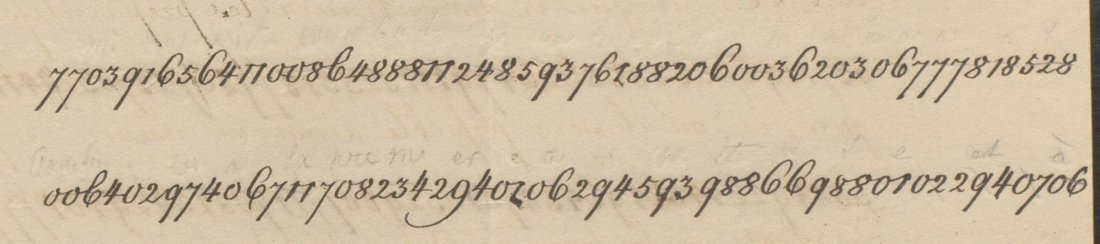
0064029740671170823429402062…, and the rubbed pencil above 11 70 82 34 29 40 reads “la pre m i er e”. Image: Hauptstaatsarchiv Dresden, 10731 Sächsische Gesandtschaft in Russland Nr. 12, image P5, via DECODE R5005.| DECODE | Date | Language | Cipher |
|---|---|---|---|
| R5005 | 18 Jan 1841 | French | the whole despatch, 70 lines, 3,969 digits |
| R5006 | 6 Apr 1842, No. 13 | French | clear opening (“J’accuse la réception de vos rapports … nº 17 du 22 Mars”), then 8 + 3 lines |
| R5007 | 13 Jun 1842, No. 18 | German | about ten lines between clear paragraphs (DECODE’s title has 1846) |
| R5008 | 26 Oct 1843, No. 17 | German | five lines inside a sentence: “Indem ich nach dem Eingang Ihrer Berichte NN. 21 und 22 … bekenne, [cipher] habe ich die Ehre” |
02 The cipher
The figures are written without separation. Divided into pairs, the digits use 96 of the 100 possible groups. About a third of the lines have an odd number of digits, so a group can run over a line break. Where each line’s pairs begin was fixed by choosing the division with the strongest pair statistics. Long repeats such as 7778948206 (five times) and 06777818711001 (three times) should be names or set phrases.
The erased decipherment settles the unit size. Seven values are legible in it:
| group | 11 | 70 | 82 | 34 | 29 | 40 | 46 |
|---|---|---|---|---|---|---|---|
| value | la | pre | m | i | er | e | que |
So the table mixes single letters with syllables (pre, er, que, la). Elsewhere the pencil gives stray words (“pour”, “ce”, “ne”) that cannot be tied to a group with any confidence. Show-through from the reverse side adds false strokes.
03 What was tried
- Keys and print. Every Dresden key record on DECODE was listed. The latest dates from 1799–1806, and none belongs to fonds 10731. No edition of the Zeschau–Seebach correspondence was found.
- Structure. Tested single-digit nulls (every set of one to three digits), a prefix code (the first digit fixes a group length of 1, 2 or 3) and pairs in both phases. Only plain pairs are consistent with the glosses.
- Letter solver. A homophonic solver (simulated annealing) scored with a French 4-gram model deciphers a synthetic 1,800-letter homophonic control (score −2.18 per letter). On R5005 it reaches −3.05 to −3.17 under every division into units, which is not French.
- Syllable solvers. A solver (simulated annealing) choosing each group’s value from letters plus about 150 common French syllables, with the seven gloss values fixed, was run in three variants: free, one cell per syllable, and length-neutral scoring. All three drift to fluent-looking nonsense.
04 What would finish it
- The key, or Seebach’s deciphered copies, in the legation papers (HStAD 10731, other numbers) or Seebach’s own papers.
- UV or multispectral imaging of R5005. The pencil decipherment was once complete, and a rubbed graphite trace often survives under raking or UV light.
- Transcribing R5006–R5008, which add text in the same table, with clear frames on either side of each cipher passage.
05 Sources
- DECODE R5005, R5006, R5007, R5008 (images require login).
- Hauptstaatsarchiv Dresden, 10731 Sächsische Gesandtschaft in Russland, Nr. 12.
Transcription, solvers, notes and profile: targets/zeschau1841/.