01 The documents
Antoine de Pas, marquis de Feuquières, took over the governorship of Pignerol at the end of the 1690 campaign from the marquis d’Herleville. In January 1691 he pressed Catinat, commanding in Piedmont from Suze, to let him surprise Veillane (Avigliana), a Savoyard post half way between Suze and Turin: five hundred Germans of Lorraine and the Croix-Blanche in the castle, four companies of Macel’s dragoons in the town. Catinat consented on condition of directing the attack himself, sent his “Mémoire pour l’entreprise de Veillane” on 19 January (rendezvous at the head of the ponds, the roads by Gumiane and Javan or by Trane, four days’ bread, tools, grenades, twenty horses to be asked of Feuquières for the cannon), and the two agreed by letter to march on the evening of the 26th and strike at daybreak on the 27th. The attack failed and the two blamed each other for the rest of their lives. This despatch is Feuquières’ side of the arrangement.
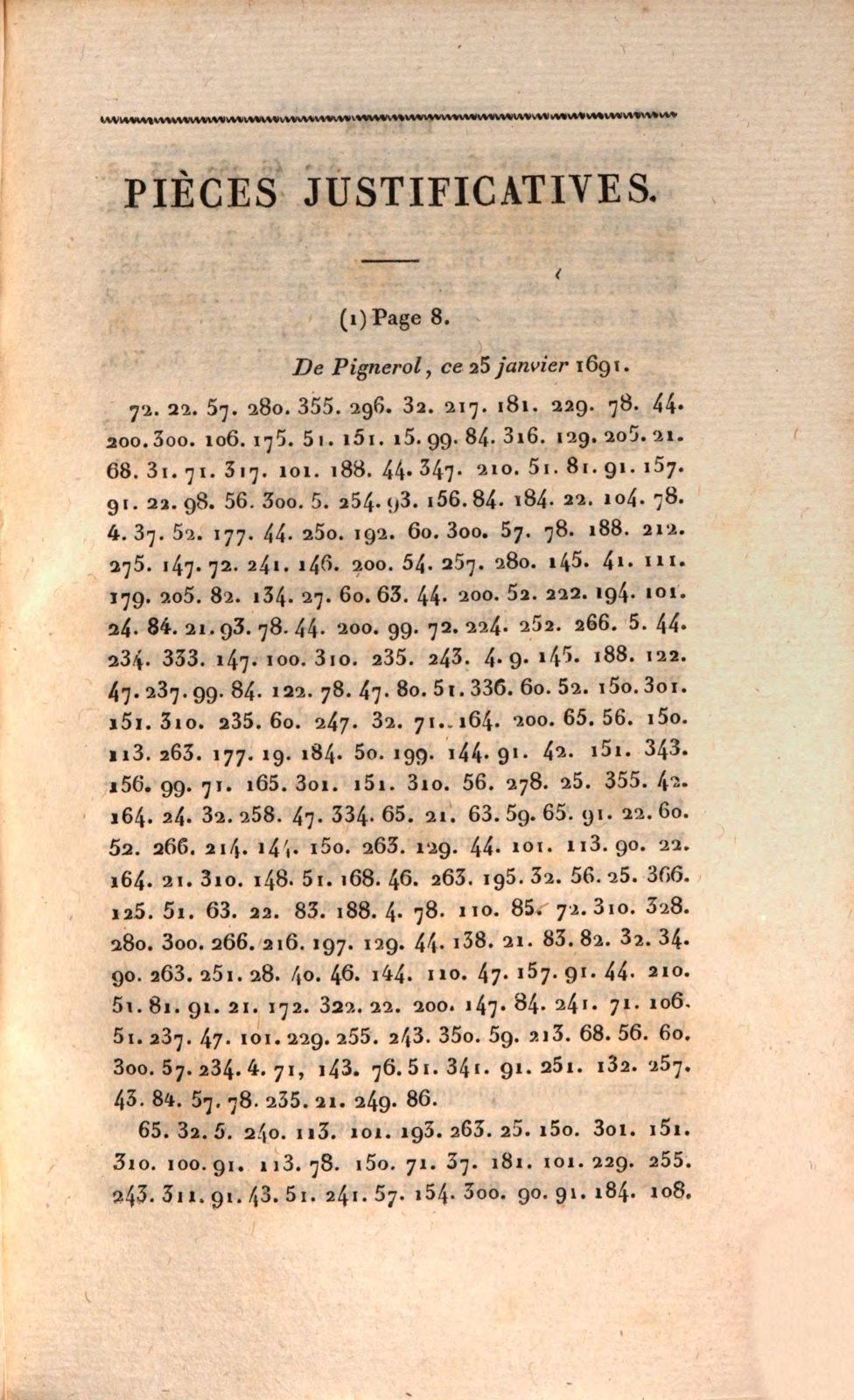
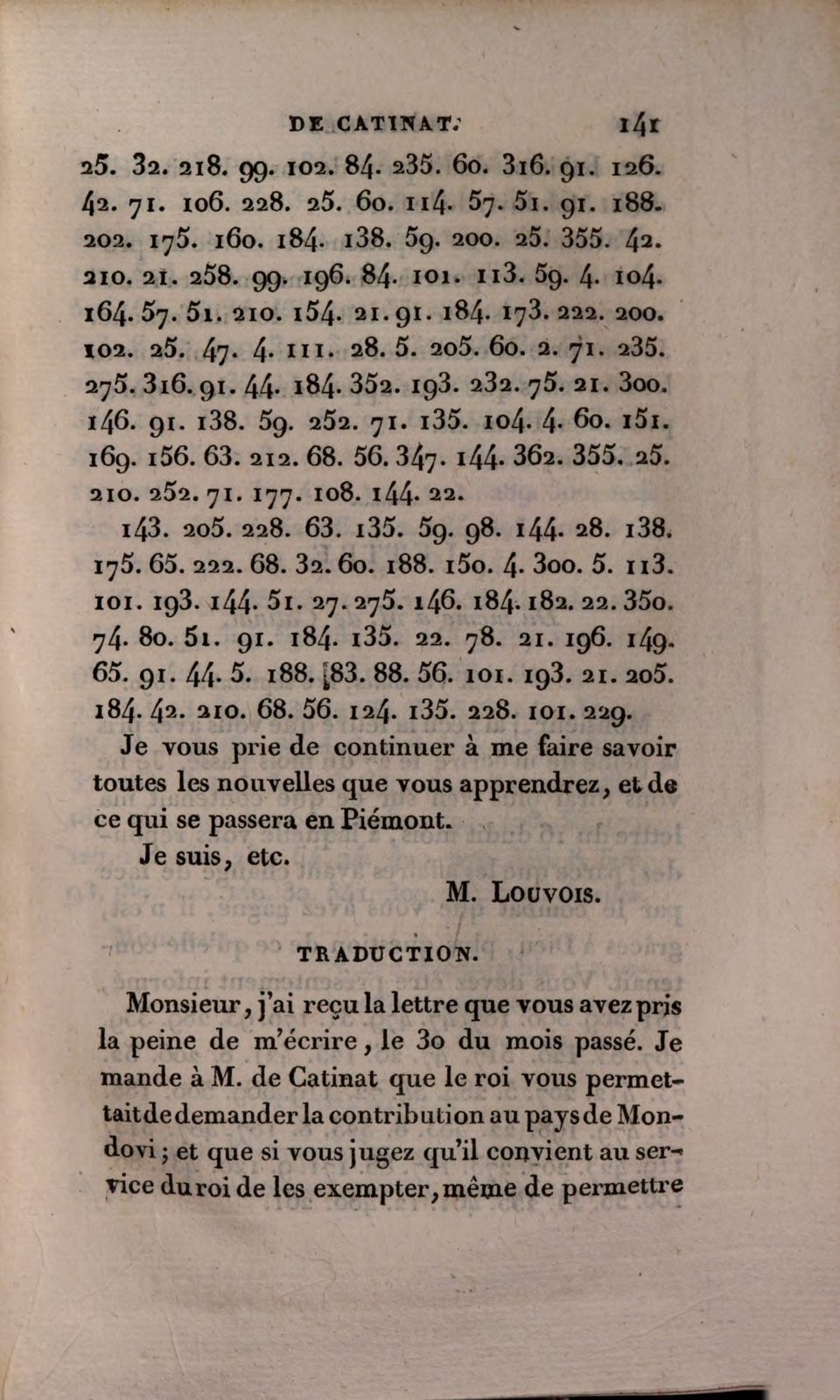
The break came from volume I of the same edition. Among Louvois’ letters on the contributions of Piedmont the editor printed one to d’Herleville, “gouverneur de Pignerol, sur Mondovi”, dated Versailles 6 September 1690, whose body is in figures — 183 groups, none above 366 — followed by a traduction. The two Grand Chiffre letters to Catinat of the same days, also printed with translations, decode with Bazeries’ table and show that these translations are the clerks’ free renderings, not word-for-word decipherments.
02 Structure
- One code, two letters. 72 of the d’Herleville letter’s 91 groups occur in the Feuquières letter; both have 46 % of their tokens on groups below
100; twenty bigrams and the trigram
25 355 42(de Mon-de[vis]) are common to both. The union is 179 groups over 601 tokens, within Bazeries’ figure of 367 for the petit chiffre of 1691. - Design, from the Grand Chiffre. Bazeries says the small cipher “ne différait du grand que par son nombre de groupes”, and so it proves: letters with two to four homophones each (i/j and u/v counted as one letter), consonant-vowel syllables, a stock of word stems (de, que, les, pour, tout, mesme, comme, lettre, honneur, le roy, Monsieur, M. de Catinat, scavoi[r]), and nulls doubling as full stops. Numbers and place names are spelled: dix, vingt-quatre, quatre-vingts, ve-il-la-ne, ia-va-n, Saint-Ambroise.
- No order. Neither block is alphabetical; the numbering is a two-part list, as in the Grand Chiffre.
03 The key, and how it was found
Every automatic route failed, and the failures are documented in the repository: a beam aligner for exact known plaintext (which recovers 60 of 69 units on synthetic encodings) finds no consistent alignment of the d’Herleville cipher with its printed translation, because the translation paraphrases and because u and v are one letter; annealers scored on a French 7-gram model with the Grand Chiffre inventory, on the translation’s own 5-grams, or with a partial key fixed all return fluent nonsense, as they do on a matched synthetic control.
What worked was the oldest method. The last 31 groups of the d’Herleville letter admit one segmentation into Grand-Chiffre-style units for comment aura réussi vostre entreprise sur le
chasteau de Villefranche in which every repeated group carries the same unit (91 = t twice, 184 = au twice, 135 = ra twice, 21 = s twice, 56 = le
twice, 101 = c twice). Carried into the Feuquières letter those units gave heures du matin, du vingt-quatre, m’escrire,
duplicata; each word fixed further groups; the thrice-repeated 301 151 310 became Veillane; 150 = ve gave
enleveront, trouve, doivent; 243 = ns gave dragons, chemins,
maisons; the clause faire passer à … gave Saint-Ambroise, the village between Avigliana and Rivoli. Each new reading was checked in
both letters before it was kept.
| class | groups (unit) |
|---|---|
| letters | e 4 41 125 212 · s 21 134 200 252 304 · t 91 322 343 362 · n 51 154 228 · r 60 82 178 275 · a 32 213 251 · u/v 37 78 191 285 · i/j 90 144 182 · d 63 168 · l 43 68 · y 24 59 · g 81 259 · x 181 352 · b 40 50 · f 124 366 · p 5 240 · c 101 · m 28 · o 27 · z 104 |
| syllables | ma 106 · ti 175 · ro 113 · ri 188 · ra 135 · re 22 44 · se 83 110 183 · pe 235 · ve 150 165 · vi 210 · co 57 153 · di 146 217 · li 254 · ca 93 · ha 193 · he 229 · mi 255 · bo 318 · bu 202 · cu 179 · fa 108 · ga 279 · go 145 · lo 231 · ta 156 · te 205 · to 250 · va 76 · ci 169 · do 214 311 · su 247 · xe 111 · on 160 · en 65 · ns 243 · st 234 · is 280 · oit 126 · ment 85 · mais 172 · moy 334 · puis 136 · vie 148 · sca 328 · scavoi 74 |
| words | de 25 42 71 · que 99 147 · le 56 177 · la 114 151 · les 47 · des 237 · du 300 347 · au 184 · et 258 341 · si 196 · y 24 · on 100 · ou 197 · par 216 · pas 195 · pour 350 · sur 88 · tout 266 · vous 84 241 · mesme 2 · comme 80 · peu 278 · lettre 15 · honneur 31 · le roy 102 · M. de Catinat 218 · Monsieur 296 (mon 355) · vostre 149 · qu’il 164 |
| nulls / points | 52 194, and the opening groups of the d’Herleville letter (39 249 190 86 103 11) and the closing groups of Feuquières’ (342 103 190) |
Full key with occurrence counts and confidence marks: feuquieres/key_petit_chiffre_1690.tsv; group-by-group alignment of both letters: feuquieres/reading.txt.
04 Reading
Seventeenth-century spelling kept; unread groups in brackets; a few readings marked with a query in the notes
Feuquières to Catinat, Pignerol, 25 January 1691. Je reçois, Monsieur, à dix heures du matin la lettre que vous me faites l’honneur de m’escrire du vingt-quatre, avec le duplicata. Vous aurez veu [par] le retour du courrier que je vous dis [54 257]is [go] exécuter vos ordres. [Par] cecy vous sçaurez que je suis tout prest, [333] qu’on ne pense [9 go ri 122] les [des] que vous [122]u les commencer. [À] Veillane, persuadé qu’ils enlèveront le [19] au bruit de l’attaque de Veillane, le peu de monde qu’il y a et les moyens d’y entrer, tout doi[ven]t faire croire qu’ils ne viendront pas à le défendre sérieusement. Je ne sçais du tout par où faire passer à Saint-Ambroise les quatre-vingts maistres que vous [vous] demandez ; les chemins pour y aller du costé de Javan e[t] [a 132 257 l] vous coupe[s] [249 86]. En approchant de Veillane on trouve deux chemins, dont l’un vous conduit au fauxbourg des Trois Couronnes, l’autre aux maisons [292] et le long de l’estang. J’attaqueray [353] deux endrois, et surtout [mes se 271 se s] prendray garde que les dragons ne puissent m’eschaper. [342 103 190]
Louvois to d’Herleville, Versailles, 6 September 1690 (the control). [8 groups] Je mande à M. de Catinat que le roy vous permettoit de demander la contribution au pays de Mondevis, et que si vous croyez qu’il convien[s]t au servi[ce s] le roy de les exempter, mesme de permettre aux habitans dudit pays de razer la citadelle du[d]it Mondevis, de le faire. — J’atendray avec impatience l’arrivée du prochain ordi[n]aire pour sçavoir comment aura réussi vostre entreprise sur le chasteau de Villefranche.
English translation
Feuquières to Catinat, Pignerol, 25 January 1691. I receive, Sir, at ten in the morning the letter you do me the honour of writing on the twenty-fourth, with the duplicate. You will have seen [by] the return of the courier that I tell you […] to carry out your orders. [By] this you will know that I am quite ready, [and] that no one thinks […] the […] that you [wish?] to begin them. [At] Veillane, persuaded that they will carry off the [post] at the noise of the attack on Veillane, the few men there are and the ways of getting in all must make one believe that they will not come to defend it seriously. I do not at all know by what way to pass the eighty troopers you ask [of us] to Saint-Ambroise; the roads for getting there from the Javan side cut across […]. Approaching Veillane one finds two roads, one of which leads you to the faubourg of the Three Crowns, the other to the houses […] and along the pond. I shall attack [at] two points, and above all […] shall take care that the dragoons cannot escape me. […]
Louvois to d’Herleville, Versailles, 6 September 1690. […] I am writing to M. de Catinat that the King permitted you to demand the contribution of the country of Mondovì, and that if you believe it suits the King’s service to exempt them from it, even to allow the inhabitants of the said country to raze the citadel of the said Mondovì, to do so. — I shall await with impatience the arrival of the next post to learn how your enterprise against the castle of Villafranca will have succeeded.
“Troopers” renders maistres, the period word for a mounted soldier; enlever le poste, to carry off a post, is the technical term for surprising and taking a garrison; Villefranche is Villafranca Piemonte, which d’Herleville took from Pignerol on 2 September 1690.
The Feuquières letter is what the editor guessed and more. It answers Catinat’s letter of the 24th, not the memoir of the 19th directly, and it is written the day before the march. The eighty maistres (troopers) are Catinat’s request, to be posted at Sant’Ambrogio on the Turin side to cut off the garrison’s relief and retreat; Feuquières does not see how to get them there unseen, because the roads from Javan cross the approach. His two roads into Avigliana — one to the faubourg, one to the houses along the pond — are Catinat’s “se saisir des Capucins et du faubourg” and “la teste des estangs”. And the last sentence is the whole point of the operation as Feuquières later described it in his Mémoires: “ce régiment de dragons qu’on vouloit enlever dans la ville” must not be allowed to retire into the castle. On the 27th it did, because the two columns did not arrive together.
05 What remains uncertain
- Twelve groups are unread (9, 19, 54, 122, 132, 194, 257, 271, 292, 333, 353 and the opening and closing groups taken as nulls). All occur once or twice; nothing in either letter fixes them.
- Des Trois Couronnes is the reading that fits
237 322 46 280 153 78 113 51 310 200(des t-ro-is co-u-ro-n-ne-s) after fauxbourg; a faubourg or inn of that name at Avigliana has not been verified. - 241 reads vous in three places (que je vous dis, l’un vous conduit) but gives que vous vous demandez in the fourth; nous is possible.
- Two clerk’s slips are read as such: ordi-au-i-re for ordinaire and du-i-t for dudit in the d’Herleville letter.
- The originals are in the Archives du dépôt de la guerre at Vincennes (vol. 1079 holds Catinat’s report of 29 January on the same affair); Bazeries’ own reading, if it survives, is in his papers there. Neither has been seen.
06 Method
- Ciphertext collated against the Munich page images (three corrections to the copy on Tomokiyo’s site). Structure tests: 46 % of tokens below 100, no step-10 chains, no alphabetical order.
- Bazeries’ Le Masque de fer (1893) read in full: p. 272 note 1 says he deciphered this despatch with the “petit chiffre” of 367 groups; his Grand Chiffre table (pp. 280–289) transcribed from the Gallica images into a machine-readable file and verified on the 19 August 1691 despatch he prints as proof and on three Louvois–Catinat letters of September 1690 in the 1819 edition.
- The OCR of all three 1819 volumes pulled from the Bayerische Staatsbibliothek’s API and searched for runs of figures. Volume I pp. 140–142 holds the d’Herleville letter with its translation; volume II pp. 297–343 holds some 12,000 groups of Grand Chiffre letters of 1691 without translations, which the table now reads and which have not yet been examined.
- Exact known-plaintext alignment, three annealers and a design-faithful synthetic control run and recorded as failures.
- Hand anchoring on the consistent 31-group stretch, then propagation of every unit between the two letters, checking each in both before keeping it; 167 of 179 groups.
07 Sources
- Mémoires et correspondance du maréchal de Catinat, ed. Bernard Le Bouyer de Saint-Gervais (Paris, 1819), t. I pp. 140–149 and t. II pp. 6–8, 283–284; Bayerische Staatsbibliothek, bsb10720286, bsb10720287.
- É. Burgaud and V. Bazeries, Le Masque de fer, révélation de la correspondance chiffrée de Louis XIV (Paris, 1893), pp. 37, 272–289; Gallica.
- Lettres inédites des Feuquières, ed. É. Gallois, t. V (Paris, 1845), pp. 323–334: Catinat to Feuquières, 12 and 19 January 1691, and the extract of Feuquières’ Mémoires on Veillane; Internet Archive.
- C. Rousset, Histoire de Louvois, t. IV (Paris, 1863), pp. 453–455, quoting Catinat to Louvois of 29 January 1691 on the “cacade à Veillane”.
- S. Tomokiyo, “French Cipher Despatch received by General Catinat (1691)” and “Louis XIV’s ciphers” §7 (cryptiana).
Transcriptions, the Grand Chiffre table, the key, the aligned readings and every failed solver are in the repository (feuquieres/).