01 The files
The series is 各国内政関係雑纂/支那ノ部/革命党関係(亡命者ヲ含ム)/特定人ノ発受郵便物取調, Gaimushō 1.6.1.4-2-1-2, volumes 2 to 4, on JACAR as B03050088300, B03050088400, B03050089100, B03050090000, B03050090100 and B03050090200. Each batch comes under a covering note headed 特定人發着郵便物等取調ノ件 (“inquiry into mail etc. sent and received by specified persons”), from the Director of the Communications Bureau (逓信省通信局長 田中) to the Director of the Foreign Ministry’s Political Affairs Bureau (政務局長 小池, Koike Chōzō). A typical note, 秘第八?之一號 of 25 May 1916, received the next day, reads 別紙寫電報及左記郵便物有之候: “attached are copied telegrams and the postal item noted below”.
The telegrams are copied onto the Imperial Telegraphs’ own forms. Outgoing messages from Tokyo are on “Forwarded” forms, signed 中山 (Nakayama, Sun’s Japanese alias) or, in May, with the handler’s name 林蔚陸 (“Linwailuk”). Incoming messages are on “Received” forms addressed to “Rosamonde Tokio” (Soong Ching-ling), to “Linwailuk Tokio”, or to Nakayama at 109 Harajuku, Aoyama. The correspondents are Yamada Junzaburō in Shanghai (“Junzaburo Shanghai”), “Konglipo” in Manila, Kayano Nagatomo and Ju Zheng’s men at Qingdao (Seitō), “Youngchina” at San Francisco, Honolulu, Hankow, and the Shanghai leadership: Chen Qimei, Xu Chongzhi and the rest. Some of the traffic is in clear English (“2000 through Shokinginko”), and some is in plain telegraph code. Most of it is in ten-letter condenser words.
The files hold no decodes. The Foreign Ministry did try. In B03050089100, frames 0076–0078 are a notebook copy of a long romanised kana stream (126 ten-letter groups, ending owari), and frames 0079–0081 are the analysts’ worksheets on it. They copy the stream into katakana, divide it with slashes into groups of two or three, and pencil kanji guesses beside the groups, often with a question mark: 事, 先生, 國, 電, 軍, 謀. No continuous sense comes out of them, and the stream is not read here either.
02 One family, seven keys
The system is the one described on the Swatow page. Twenty consonants (no w) and five vowels give a hundred syllables numbered 01…99, 00, and two syllables make one four-figure group of the standard Chinese telegraph code. The syllables run on across ten-letter words without regard to the word breaks, and there is no additive. Every table in the family is a rule: the alphabet rotated or reversed, the vowels in some order, the numbers filled vowel by vowel. What changes between correspondents is the rotation and the vowel order:
| key | row for 01 | vowel order | used on |
|---|---|---|---|
| swatow1916 | l | e a i o u | “Tanaka”, Swatow → Rosamonde, 3 April 1916 (the Swatow telegram) |
| shanghai1916 | z (alphabet reversed) | i o a e u | Sun ↔ Yamada Junzaburō, Shanghai; Shanghai (Chen Qimei, Xu Chongzhi …) → Rosamonde, March–April 1916 |
| manila1916 | g | o e u a i | Sun ↔ Konglipo, Manila; one Shanghai telegram signed by Xu Chongzhi |
| seito1916 | m | u i e o a | Qingdao (Ju Zheng; Kayano Nagatomo) ↔ Tokyo, March–April 1916 |
| sanfran1916 | x | o e u a i | Tokyo → “Youngchina”, San Francisco |
| yamada1916 | q | e u i o a | Tokyo (Xie Chi, “Linwailuk”) ↔ Junzaburo, Shanghai, May 1916 |
| shanghai1917 | k | a e u o i | Sun ↔ Dai Jitao, March 1917 (below) |
“Row for 01” is the consonant that takes 01 with the first vowel; the next consonant in the alphabet takes 02, and so on. The key names are those in famtest.py.
Two more keys are tentative, each resting on one short telegram: Honolulu (alphabet reversed, filled consonant by consonant, vowels e a o u i; z 4.9) and
Manila in May (row for 01 d, vowels e u a o i; z 4.4).
Finding and accepting a key. The whole family, 57,600 tables counting the fill orders, origins and the ±111 additive, was run on each telegram, and each table was scored with a Chinese character model. The z figures on this page are that score measured against the whole family. A short telegram can put a wrong key on top by chance, so a key was accepted only when it reached z ≥ 6 on at least one long telegram and then read other telegrams it had not been fitted to. For example, shanghai1916 was found on a long Shanghai → Rosamonde telegram and then read Sun’s own outgoing telegrams to Yamada at z 7–10. The May key yamada1916 reads every telegram that carries the clear prefix word “Thirtyseventh”. Some short telegrams read under their pair’s key although another table scores slightly higher on them alone. They are counted as read because the text makes sense and the key is fixed elsewhere, not because of their own score.
The dates check themselves. Chinese telegrams give the day of the month by a rhyme-category character (韻目代日). Where a signature carries one, it agrees with the date on the Japanese form: 支 4, 元 13, 篠 17, 皓 19, 號 20, 箇 21, 漾 23, 有 25, 宥 26, 豔 29. The one exception is a Shanghai telegram handed in on 22 May that ends 馬, the 21st. The date characters come out of the decryption and the key search never looked at them, so the agreement is an independent check.
The clerks. These are copies made by Japanese telegraph clerks, copying letter strings that meant nothing to them, and they make the same mistakes throughout: g↔q by far the most often, then x written like d or s, h↔k↔n, e↔c, a↔o, and a dropped pair of letters now and then. Every emendation is a single letter of one of these kinds, justified by the sense and usually by a clean occurrence of the same group elsewhere. Examples are gequ → qequ 款 (“funds”), which recurs across the Manila traffic, and dunu → xunu 東. The transcriptions give the letters as written and list each change. A telegram with a pair dropped reads as noise until the pair is restored. The 25 May telegram from Tokyo scores z 4.1 as written and 6.8 once the missing ge of its first word is put back.
03 March–April 1916: the monarchy cancelled, the money, the Shanghai rising
Conventions: [?] = group read as written but doubtful; a character in brackets = the reading after a one-letter emendation, where the notes mark it; □ = unread. Frame numbers are JACAR frames of B03050088300 unless stated.
Yuan Shikai announced the end of his monarchy on 22 March 1916. At that point Sun Yat-sen was in Tokyo and his party was planning a rising in Shanghai.
25 March, Shanghai → Rosamonde (fr. 0468; z 6.7)
帝制取消,馮、朱等當漸觀望。滬異派力弱,於我略可從容佈置。海軍[?]發策較萬全,然猶急備未懈…
“The monarchy is cancelled. Feng [Guozhang], Zhu [Rui] and the others will now wait and see. The opposing faction in Shanghai is weak, so we can make our dispositions at some leisure. A plan launched by the Navy … is safer, but we are still preparing urgently without slackening …” There is no signature.
26 March, Sun → Yamada (fr. 0465; z 7.4)
京信□□□策:袁暫退,使黎代;俟歐戰終,乃借英力[復]出。故滬事當發於袁退之前乃可。文
“The Peking letter … plan: Yuan to step down for now, with Li [Yuanhong] acting; when the European war ends, he comes back with British support. So the Shanghai action must be launched before Yuan withdraws. — Wen.” The same evening a 38-word telegram from Shanghai signed 美 (Chen Qimei; z 9.2) asked for arms to be shipped and a handover procedure, and closed: 穆日當局允暗濟械,已有接洽否? (“The authorities have agreed to supply arms secretly: has contact been made?”). 穆 occurs twice with the same letters and is probably a cover word.
27 March, Sun → Konglipo, Manila (fr. 0462; manila1916)
滬電乃崇智所發,勿疑。文
“The Shanghai telegram was sent by [Xu] Chongzhi. Do not doubt it.” Earlier that day Manila had asked who was using the code to send telegrams from Shanghai, calling it 萬可疑, “most suspicious”. Xu Chongzhi’s own telegram of the 26th, signed in clear Shuichunchee, is in the Manila key, not the Shanghai one.
30 March – 4 April: money
Much of the traffic is fund-raising. Tokyo asks the Fujian merchants in Manila to 盡力向閩幫籌[款?] (“do their utmost to raise funds from the Fujian guild”); Qingdao asks for fifty thousand, 惟需五萬元,懇速電匯 (“only we need 50,000 yuan; wire it urgently”); Manila reports what seems to be four thousand sent through the Hongkong Bank (a four-word telegram, weakly scored), and Tokyo acknowledges [四?]千圓. From Shanghai on 31 March (z 8.2): 田在滬交五千,到漢匯八千。近[又?]索三萬,無力應之 (“田 [a person] handed over 5,000 in Shanghai, 8,000 to be remitted on reaching Hankow. Lately another 30,000 is demanded; we have no means to meet it”). On the same day Sun warns Yamada (fr. 0485; z 7.9):
北方來電,帝制取消,軍心益振。而[滬?]反[?]觀望。恐前聯絡之人皆多不實,故托此爲辭,[?]得款耳。望兄詳察,勿受其欺。孫文
“Telegrams from the north: the monarchy is cancelled and the army’s spirit rises. But [Shanghai?] is … waiting to see. I fear the people we contacted earlier are mostly not genuine and use this as an excuse to get money. Look into it carefully and do not be taken in. — Sun Wen.”
4 April, Sun → Yamada (fr. 0494; z 9.8, no emendation)
由臺灣電六百金,請交寶昌路寶康里一八三號張宗海,往甘費。聞西林赴南寧組政府,定設法破之。文
“600 gold wired by way of Taiwan: please give it to Zhang Zonghai, 183 Baokang-li, Baochang Road, for the journey to Gansu. I hear Xilin [Cen Chunxuan] is going to Nanning to form a government: I will find a way to break it. — Wen.” This is the cleanest telegram in the files: forty characters and not one letter to change. Two more went out that afternoon. One ends 山東消息甚佳,月內當動。孫文。支 (“news from Shandong is very good; it will move within the month. — Sun Wen, the 4th”). The other, to Kayano at Qingdao (fr. 0492; seito1916, z 7.4), reports fifty thousand sent through the Yokohama Specie Bank, and arms to be shipped under the name of the Qingdao military administration (以寄青島軍政官名義).
13 April, Hankow → Sun (B03050088400 fr. 0517)
This telegram is in digits, not condenser letters. It uses the +111 code that Consul Segawa described to the Foreign Ministry that May: each four-figure code group has 111 added, here without the digit reversal. A search over every additive and both digit orders puts −111 175 log-points clear of the next candidate, and the telegram then reads with no emendation:
武漢發動事,日人謂非念五萬不辦。迭電陸參兩部,桐以軍械運輸困難且爲時久。刻人心已熟,海陸均有七分以上把握,三萬可行。機不可[失],望速決電示。元
“On the Wuhan rising: the Japanese say it cannot be done for under 250,000. [We] have wired the Army Ministry and the General Staff again and again; 桐 says the arms and their transport are difficult and would take a long time. Opinion here is ripe; army and navy are both more than seventy per cent sure; 30,000 would do it. The moment must not be missed. Decide quickly and wire. — the 13th.”
04 May 1916: Chen Qimei
By May, Sun was in Shanghai, where he arrived at the start of the month, and the Tokyo end was run by Xie Chi (謝持), who signs 持 and dates with rhyme characters. Every Tokyo–Shanghai condenser telegram of that month that reads at all reads under one key, yamada1916 (frames of B03050089100).
19 May, Shanghai → Linwailuk, Tokyo (fr. 0066; z 6.0)
英士昨下午在山田家被兇[轟?]斃,捕兇[一?]人,關係者數人。
“Yingshi was shot dead by assassins yesterday afternoon in the Yamada house; one assassin and several accomplices arrested.” Chen Qimei (陳其美, courtesy name Yingshi) was murdered in Shanghai on 18 May 1916 in the house of Yamada Junzaburō, the addressee of most of the Tokyo traffic. Tokyo replied the same day in two telegrams (both signed 持皓, the 19th): 英士被刺,傷[勢?]如何?盼覆 (“Yingshi stabbed: how are the wounds? Please reply”), and then
電悉。英士捐軀,極堪慟悼。主使爲誰?盼覆。先生[?]在滬[?],務處處戒備。持皓
“Telegram received. Yingshi has given his life; we mourn him deeply. Who was behind it? Please reply. The Master … in Shanghai … must take every precaution. — Chi, the 19th.” Others asked the same question in other ways. From Kobe, 英士君遭難確否乞覆 came in plain code. From Manila, received on 23 May, 聞陳英士死確否?請覆 came to Tōyama Mitsuru in a key of its own. The Shanghai answer of 22 May (z 8.2) gives the instigator as 遣之暗殺主謀爲[政?]府, “the government”, and says that the pistols have been entrusted to Miyazaki to bring back.
23–25 May: arms and the students
Tokyo on 23 May (z 8.2): Wu Feiji, back in Shanghai at 26 Rue Joffre, has ordered 300 Type-30 rifles and 100 Browning pistols through the Ōkura company at Dalian, with 2,000 taels already paid as deposit. Tokyo and Shanghai also wire back and forth about 席、趙兩處學生事, the business of Xi Zhengming’s and Zhao’s students at Tianjin, which had been demanding money for a rising. On 22 May Shanghai orders it stopped; on 24 May it says 學生事暫擱 (“shelve the students affair”); on 25 May Tokyo asks which of the two it means.
26 May, Tokyo → Yamada (fr. 0092–93; z 9.6)
克強言外務省意先生宜緩赴青島。又軍械事能得青木一電參謀本部較更有力云云… 宥
“Keqiang [Huang Xing] says the Foreign Ministry’s view is that the Master should put off going to Qingdao. Also, on the arms, a telegram from Aoki [probably Lt-Gen. Aoki Nobuzumi] to the General Staff would carry more weight … — the 26th.” Here Sun’s Tokyo office passes the Japanese Foreign Ministry’s own advice to Sun, and the Foreign Ministry was being sent a copy of the telegram. It had no means of reading it. Earlier that morning Tokyo had asked 報載先生昨[潛?]離滬,確否? (“the papers report that the Master secretly left Shanghai yesterday; is it true?”).
29 May, Tokyo → Yamada (fr. 0113–14; z 6.6)
據譚根云,岑有軍[火]船四艘由神戸回粤,今遣彼來東運機[?]二臺,交該船載[?]…謝持 豔
“According to Tan Gen, Cen [Chunxuan] has four military steamers going from Kobe back to Guangdong, and has sent him to Japan to ship two machine[-guns?] on them … — Xie Chi, the 29th.” Cen Chunxuan is the “Xilin” whose government at Nanning Sun had promised on 4 April to break.
05 After the condensers: Cai E and Huang Xing
From July the ciphered traffic changes to a code that is not in the family (below), but some telegrams in the later volumes are in plain telegraph code. Two of them belong to the same story.
10 July, Luzhou → “Ilchang Tokio” (B03050090000 fr. 0417)
宥電敬悉。承念甚感。久罹喉病,軍中失調,醫治漸痊,幸釋綺注。鍔叩。蒸
“Your telegram of the 26th received with respect. I am most grateful for your concern. I have long suffered from a throat illness, made worse by life with the army; treatment is gradually curing it; please set your mind at rest. — E, the 10th.” This is Cai E (蔡鍔), who led the Yunnan rising against the monarchy. The throat illness killed him in Fukuoka on 8 November 1916.
13 September, Tokyo (中田) → Huang Xing, Shanghai (B03050090100 fr. 0471)
閱報憂悚。接[?]電,母[恙?]稍安。請靜養。現如何?
“Alarmed to read the papers. […] telegram received; your mother is a little better. Please rest. How are you now?” Huang Xing was already ill, and he died on 31 October 1916, eight days before Cai E. The Japanese clerk’s own kanji glosses on this form differ from the codebook at two groups (4443 and 3225).
06 Sun and Dai Jitao, March 1917
B03050090200 (vol. 4, item 5, frames 0503–0513) holds three condenser telegrams of late March 1917. Two are from Sun in Shanghai, signed Sunwen in clear, to “Toi c/o Kikuchi Rioichi” in Tokyo. The third is the reply to “Sun yatsen Shanghai”, signed Tenkiutai (天仇, Dai Jitao). “Toi” is therefore Dai Jitao (戴季陶), staying with Kikuchi Ryōichi (菊池良一).
The key is a seventh member of the family: row for 01 k, vowels a e u o i, no additive. It was found by running the family on the 23 March telegram alone, where it scores −321.6 against a population mean of −556.4 and s.d. 25.8, about nine standard deviations up; the next unrelated key is 124 points behind. The Swatow key gives nonsense. The 25 and 26 March telegrams played no part in finding the key, and both read in it at once.
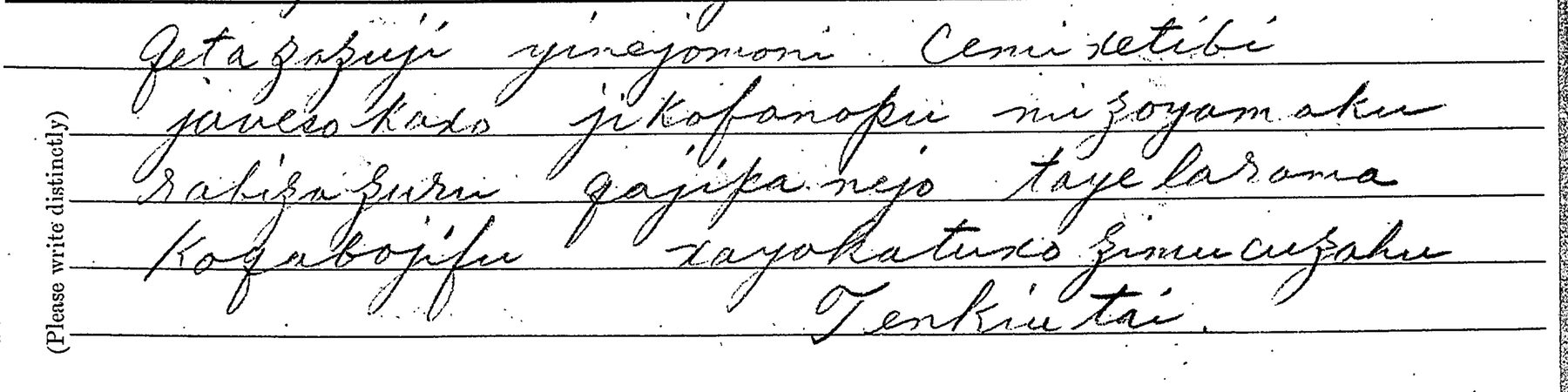
23 March, Sun → Dai (fr. 0504)
前電云三日後商妥□□□□□後音。此間必俟前約取消,始可致電北京照辦。各約已取消否?速覆。公司抄件瑞士尚未辦妥。文
“My previous telegram said that after three days [the matter] would be settled by agreement … [further] word. Here we must wait until the former contract is cancelled before we can wire Peking to act accordingly. Have the contracts all been cancelled? Reply at once. The company copy … [瑞士?] not yet settled. — Wen.” Words 4 and 5 as copied, pixaqaqe eianakerele, have 19 letters where 20 are needed, and ei is not a syllable. The clerk misplaced the word break and lost or misread at least two letters. pi completes 妥, and the last code of the damaged run, lebe 接, reads as written, so “…接後音” (“received further word”) is likely. The five codes between cannot be recovered with confidence. A search allowing one insertion and up to two substitutions finds nothing clean. 瑞士 needs an x/m change and is the least certain emendation. The telegram’s last word, qixapfete, has nine letters; read qixa pi ne te it gives 辦妥 and 文, Sun’s signature character, which also closes the 25 March telegram.
25 March, Sun → Dai (fr. 0507)
函悉。約取消後,當□□□能否。取消卽覆。文
“Letter received. After the contract is cancelled, [whether] … is possible. Reply as soon as it is cancelled. — Wen.” 能 needs zubo → xubo; three codes do not read, and no one-letter variant makes sense of them.
26 March, Dai → Sun (fr. 0506)
本定今日赴熱海。□□來云:彼等須先□定,約三日回。□公司事如何?電示。宥
“I was to have gone to Atami today. … came and said that they must first settle …; [I shall be] back in about three days. How stands the company matter? Wire me. — the 26th.” 公司 has the same qabo for 司 that reads cleanly on 23 March. The two characters before 來云 do not read. 小池 (Koike Chōzō, who had left the Foreign Ministry’s Political Bureau in 1916) is two letters away and is no more than a guess.
Together the three telegrams show Sun, in the last week of March 1917, waiting for “the former contract” to be cancelled before he can wire Peking, pressing Dai for news, and Dai asking after “the company matter”. They do not say what the contract or the company was. That needs the Chinese record for March 1917, which has not been consulted.
07 What remains open
- Sun’s 文密 code. From July 1916 (B03050090000 fr. 0416: Tokyo → 中華新報 Shanghai, and Tokyo → 軍務院 Zhaoqing with the prefix 文密) to June 1917, some of Sun’s traffic uses ten-letter words with y as a sixth vowel and w as a consonant. It is not in the five-vowel family. A six-vowel version of the family, about 200,000 tables, finds nothing above z 4.1. The prefix names it as a separate code, probably one built on a table that is not a rule.
- The June 1917 telegrams between Sun and Dai (B03050090200 fr. 0509, 0511) are in that system, and they also contain clusters that are not consonant–vowel pairs (myzoasdoke, liriopen). Transcribed, not read.
- Late May 1916. Five Tokyo → Junzaburo telegrams have no “Thirtyseventh” prefix. Three are eight words long, and one survives as a typed copy, so misreading is ruled out. The pair statistics say the text is structured, but no key in the family reads them, and yamada1916 fails with every additive from 0 to 9999. Two Shanghai → “Ylchang Tokio” telegrams of 29–30 May use w as a consonant. These are probably early 文密.
- The kana stream of B03050089100 fr. 0076–0078, which the Foreign Ministry’s analysts worked on, is not read here either.
- The Swatow original. Every Latin-letter form in B03050088300 and B03050088400 was read, and none is from Swatow. The copy in B03050738800 is still the only one found, and its three garbled tail groups stay lost.
- Unread groups. Most long telegrams keep a few groups marked [?]: names that are not in the model, codes one letter from several readings, and supplementary-code characters. The two tentative keys (Honolulu; Manila in May) rest on one short telegram each. The March 1917 lacuna and the identity of the contract and the company are open.
08 Sources
- JACAR (Japan Center for Asian Historical Records), 外務省記録 1.6.1.4-2-1-2, 各国内政関係雑纂/支那ノ部/革命党関係(亡命者ヲ含ム)/特定人ノ発受郵便物取調, vols 2–4: B03050088300, B03050088400, B03050089100, B03050090000, B03050090100, B03050090200.
- JACAR B03050738800, for the Swatow telegram and Consul Segawa’s report of 11 May 1916 on the +111 code; see the Swatow page.
- S. Tomokiyo, “Chinese Cryptography: 1871–1945” (cryptiana), for Yamada Junzaburō’s two condenser tables, which first suggested the family.
- Unicode Unihan database, kTaiwanTelegraph / kMainlandTelegraph, for the standard telegraph code.
Per-telegram transcriptions, headers, keys, z-scores, emendations and every unread group are in the repository: sunyatsen/y1916/transcripts_A.md–transcripts_D.md
and NOTES.md, sunyatsen/y1917/NOTES.md, the family search sunyatsen/famtest.py, and the Hankow decoder sunyatsen/y1916/hankow.py. The JACAR PDFs are not committed.