

At a glanceExisting decipherment · complete
- The letter
- Federico III of Naples to Ferdinand and Isabella, San Germano, 11 January 1497. It is in Italian, partly in cipher.
- Where
- Bibliothèque nationale de France, Espagnol 318 no. 5, ff. 5–6v (Gallica, canvases 32–35). It is one of five ciphered letters in the volume, catalogue item 9.
- The cipher
- The cipher issued to Joan Ram Escrivà, the Spanish ambassador at Naples: signs for letters and a nomenclator of letter groups beginning with p, q, r, s, t, v or x.
- How it was deciphered
- Ivan Parisi identified the cipher and printed the whole letter in 2020. His article was found here by searching the shelfmark. The nomenclator groups he lists were checked on the leaf and match.
- What it says
- Federico confirms the pre-agreement for the marriage of his nine-year-old son Ferrando, duke of Calabria, to one of the Spanish infantas.
- Other letters
- The other ciphered letters of the volume use other ciphers and have their own pages: no. 92 (the Cifra general), no. 95 (Lasry’s alphabet) and nos. 93–94 (key not identified).
01 The letter
No. 5 of BnF Espagnol 318, the Ruffo di Scilla collection of letters to Ferdinand and Isabella, is a letter of Federico III of Naples, the last Aragonese king of Naples, written at San Germano on 11 January 1497. A later endorsement at the head names d. Fadrique Rey of Naples, en cifra. Its first clear line names the man whose cipher it uses: Da poi de havere resposto ad micer Joan Scrivà, oratore de le Maiestate Vostre. Until 14 October 2026 it shared a page with the volume’s four other ciphered letters, which are in other ciphers and now have their own pages.
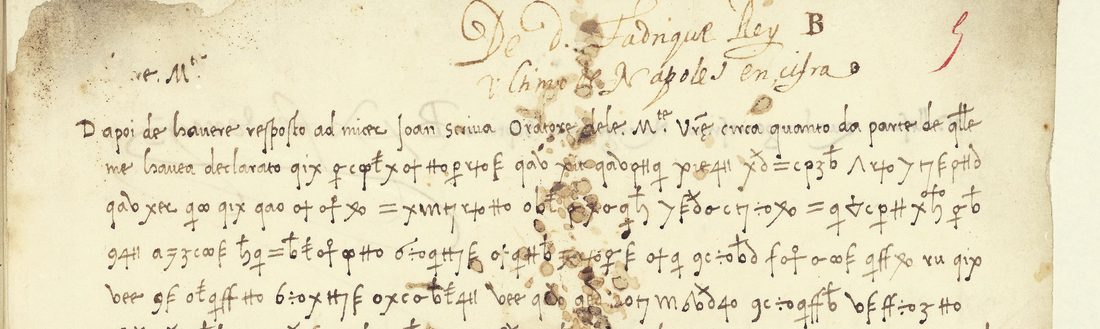
qix, is del in Parisi’s list. Image: Bibliothèque nationale de France, Espagnol 318 f. 5r, via Gallica (btv1b52503046q).02 Parisi’s decipherment
The first check was for an existing decipherment. Searching for the shelfmark rather than the cipher turns up Ivan Parisi, Un cifrario in prestito per una lettera segretissima di Federico d’Aragona re di Napoli ai Re Cattolici nel BnF, Espagnol 318, in Studi di storia medioevale e di diplomatica, n.s. IV (2020), pp. 157–177, open access, DOI 10.54103/2611-318X/14378. It prints the letter entire.
The article’s point is an anomaly. Federico wrote to Ferdinand and Isabella to confirm a pre-agreement for the marriage of his nine-year-old son Ferrando, duke of Calabria, to one of the Spanish infantas. He had the secret part enciphered in the Spanish ambassador’s cipher, the key issued to Joan Ram Escrivà, who was standing in Naples at the time. Parisi pins the encipherer by a Spanish speaker’s mistake: whoever wrote the cryptogram failed to use the double-s sign in possano, obedientissimo and promesso, an error an Italian would not make and a Spaniard would. So the king of Naples handed his minute to the ambassador, and the ambassador made the fair copy and enciphered it.
The nomenclator elements Parisi lists are legible on the Gallica image at 3000 px and match the image:
qix del, qao duque, qav de, qae con, qed cosa,
qie como, rae el, rof en, ru mensajero, saf Italia,
sul la, tad no, tay parte, vee que, vet si,
vog sobre, xer and xoq Vuestras Altezas, xit una, pam bien.
The band of initials, p, q, r, s, t, v, x, is what rules this key out for the volume’s nos. 93 and 94.
03 What was done here
Only the search, and the check of Parisi’s nomenclator list on the leaf. No transcription was made and the key (printed by Parisi in 2004) was not applied; the text is Parisi’s. Nothing about it is new here.
Full texts
The transcription and the decryption of every document on this page, so that the reading can be used and checked. Short files are shown here; all are in the repository.
Esp. 318 no. 5, Federico III to the Catholic Monarchs, 11 Jan 1497
Federico III of Naples to Ferdinand and Isabella, San Germano, 11 Jan 1497, enciphered by the Spanish ambassador Joan Ram Escrivà in his own cipher: Federico confirms the pre-agreement for the marriage of his nine-year-old son Ferrando, duke of Calabria, to one of the Spanish infantas.
Decryption: 14378
04 Sources
- BnF, Département des Manuscrits, Espagnol 318, ff. 5–6v, ark
btv1b52503046qon Gallica. - Ivan Parisi, “Un cifrario in prestito per una lettera segretissima di Federico d’Aragona re di Napoli ai Re Cattolici nel BnF, Espagnol 318”, Studi di storia medioevale e di diplomatica, n.s. IV (2020), 157–177 — open access.
- Ivan Parisi, “La correspondencia cifrada entre el rey Fernando el Católico y el embajador Joan Escrivà de Romaní i Ram”, Pedralbes 24 (2004), 55–116; appendix II has the alphabet and nomenclator used here.
Notes and profile in targets/federico1497/; the scans and Parisi’s article are in targets/esp318/.