
At a glanceKey from adjacent plaintext · complete
- The letters
- Count Georg Ernst zu Erbach (1629–1669) to Landgrave Ludwig VI of Hesse-Darmstadt, then in Stockholm: letter No. 1 (Fürstenau, 22 March 1666), No. 2 (27 April 1666) and an undated two-page letter almost wholly in cipher.
- Where
- Hessisches Staatsarchiv Darmstadt, D 4 Nr. 248/3, a file of 39 letters from Erbach to Ludwig (1654–1670) described as “partly ciphered”. Only these three of the 39 contain cipher.
- The cipher
- Number pairs written inline, such as “3,14. 1,19.”: line and letter of an eight-line rhymed Lord's Prayer that begins “O Vatter aller frommen”. Any occurrence of a letter in the verse may be used.
- How it was deciphered
- A Latin outline of the long letter, in a hand of the time, was filmed beside it. Its phrases gave the first letters. The rows of the key then began to spell German words, and the verse filled in the rest.
- What it says
- Eight reasons why Erbach cannot leave his county, among them his wife's illness, his young brothers' government and disloyal councillors. Can a lord, he asks, “put his sheep under hirelings”?
- Still open
- 19 pairs are the writer's slips, read from context. Some words of the clear German around the cipher are illegible on the microfilm, and the long letter is undated (before 27 April 1666).
01 The letters
The file D 4 Nr. 248/3 of the Hessian house archive at Darmstadt holds 39 letters from Count Georg Ernst zu Erbach to his friend Landgrave Ludwig VI of Hesse-Darmstadt (1630–1678), dated 1654 to 1670. The finding aid notes alchemy (it mentions a Dr Johann Tack) and “z. T. chiffrierte Briefe”, letters partly in cipher. The archive's 78 microfilm images are online. Most of the letters are about alchemical work and court news, and are signed with an anagram (“J. Strenuus Segrego” = Georgius Ernestus). Ludwig answers as “Tuus Totus 666”: LUDOVICUS read as Roman numerals sums to 666.
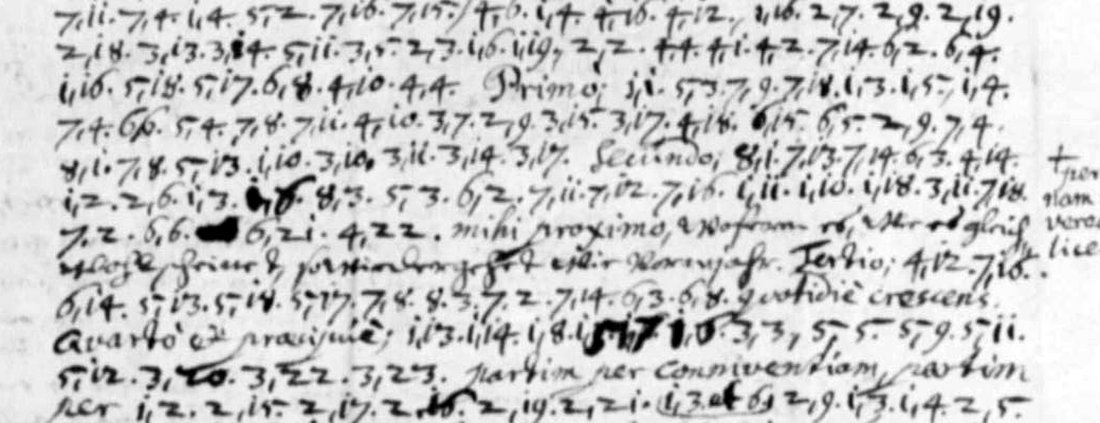
The cipher is in three letters only, all from a numbered series of 1666 addressed to Ludwig “à Stokholm”: No. 1 of 22 March, with two short runs; No. 2 of 27 April, with one; and an undated letter of two pages that is almost all cipher. Its points are headed in Latin, Primo to Octavo, and it ends with a question in Latin (Hic quaeritur…). The scans are microfilm frames, with the leaves small and turned on their side.
02 The cipher and the key
Each pair a,b is the b-th letter of line a of a short verse, counting letters only. The verse is a rhymed German version of the Lord's Prayer, in eight lines:
| line | text (as rebuilt) | letters |
|---|---|---|
| 1 | O vatter aller frommen | 19 |
| 2 | geheiligt werd dein nahm | 21 |
| 3 | las dein reich zu uns kommen | 23 |
| 4 | dein will der mach uns zahm | 22 |
| 5 | gib brod vergib die sund | 20 |
| 6 | kein args das hertz entzunde | 24 |
| 7 | los uns aus aller nott | 18 |
| 8 | p ? x … | (only 8,1 and 8,3 used) |
So 1,1 is o, 7,18 is t, and the e of a word can be 1,6, 2,2, 3,5, 4,2, 6,2 and many more. Erbach usually ran forward along one line, so stretches of plaintext come out as rising numbers (1,10 1,11 1,12; 3,20 3,22 3,23). The 610 pairs use 123 different cells. Letters of the verse that no pair uses are filled in from the wording of the rhyme. Line 8 is known only from two cells (p and x). No printed source for this version of the verse was found.
About one pair in thirty is a slip, where Erbach miscounted by a letter or two: 5,14 (d) three times for t or u, consrliis for consiliis, beschafmenheit. Every slip lands on a neighbouring letter of the right line, and the context corrects all of them. They are listed in the reading file.
03 The decipherment
The undated letter answers a question Ludwig must have put: whether Erbach would leave his county, presumably to join him. The two had agreed that “inter nos conventum sit” each should speak “secundum conscientiam”. Erbach then sets out his reasons for refusing. Deciphered text is plain; the Latin headings and German connecting words in clear are in italics.
Primo; obstat turbulentus statu[s] publicus. Secundo; pericula ex bello electorum mihi proximo… Tertio; morbus uxoris quotidie crescens. Quarto et praecipue; fratris regimen partim per conniventiam, partim per veniam aetatis jam jam suscipientes. Quinto; ex ipsorum consiliis iuvenilibus pericula jamdum apparentia, jam quoad salutem subditorum quam meam domesticam. Sexto: subditorum proinde praecipua et bona in me fiducia. Septimo; divisio bonorum cum fratribus… Octavo; et quod maximum est, defectus fidelitatis consiliariorum.
First, the troubled state of the Empire. Second, the war of the electors close by. Third, his wife's illness, worse every day. Fourth and chiefly, his brothers taking up the government, partly by connivance and partly by a dispensation of age. Fifth, the dangers already visible from their young counsels, to his subjects and his own household. Sixth, his subjects' trust in him. Seventh, the division of property with his brothers. Eighth and greatest, the disloyalty of the councillors. The letter then asks:
Hic quaeritur; an rebus sic stantibus quidem dominus, cui deus salutem ecclesie, subditorum, domus et uxoris sue concredidit, sine lesione conscientie et offensione dei hec omnia possit deserere, mercenariorum directioni oves suas submittere, ac sic periculis jamdum praevisis exponere? Ego quidem non credo…
“Whether a lord to whom God has entrusted the welfare of the church, of his subjects, his house and his wife can, without hurt to his conscience and offence to God, abandon all this, put his sheep under the direction of hirelings, and so expose them to dangers already foreseen? I for my part do not believe it.” The hireling who leaves the sheep is John 10:12. For Ludwig, he adds, it would be quite another matter, since he need fear none of points three, four, five, seven and eight.
The short runs in the other two letters belong to the same business. No. 1 (22 March) speaks of “unsers vorhabens” (our plan) and promises news of the “mutationes” since. No. 2 (27 April) says that “im Majo oder Junio will Gott unsere bonorum divisio vorgehen”: God willing, the division of the property will go ahead in May or June. That is point seven of the long letter. No. 2 also says Erbach has already sent “meine rationes” by letter, hoping Ludwig will find them “relevant genug” and not accuse him of inconstancy: so the eight reasons were written before 27 April 1666. The cipher hides exactly the family and political matters, not the alchemy.
04 Method
The 571 pairs of the long letter were transcribed from rotated, enlarged crops of the microfilm, and checked against a second filming of the same leaves. The numbers looked like coordinates: no row goes past 24, and stretches climb inside one row. A homophonic solver with a Latin language model could not settle 124 symbols on so short a text.
The crib was on the same microfilm frame. A slip next to the letter carries a Latin outline in a hand of the time, probably the recipient's: Status turbulentus…, onerosa… quotidie crescens, subditorum fiducia, divisio bonorum, defectus fidelitatis. On its lower flap is an almost word-for-word gloss of the closing question, up to mercenariorum directioni oves suas submittere.
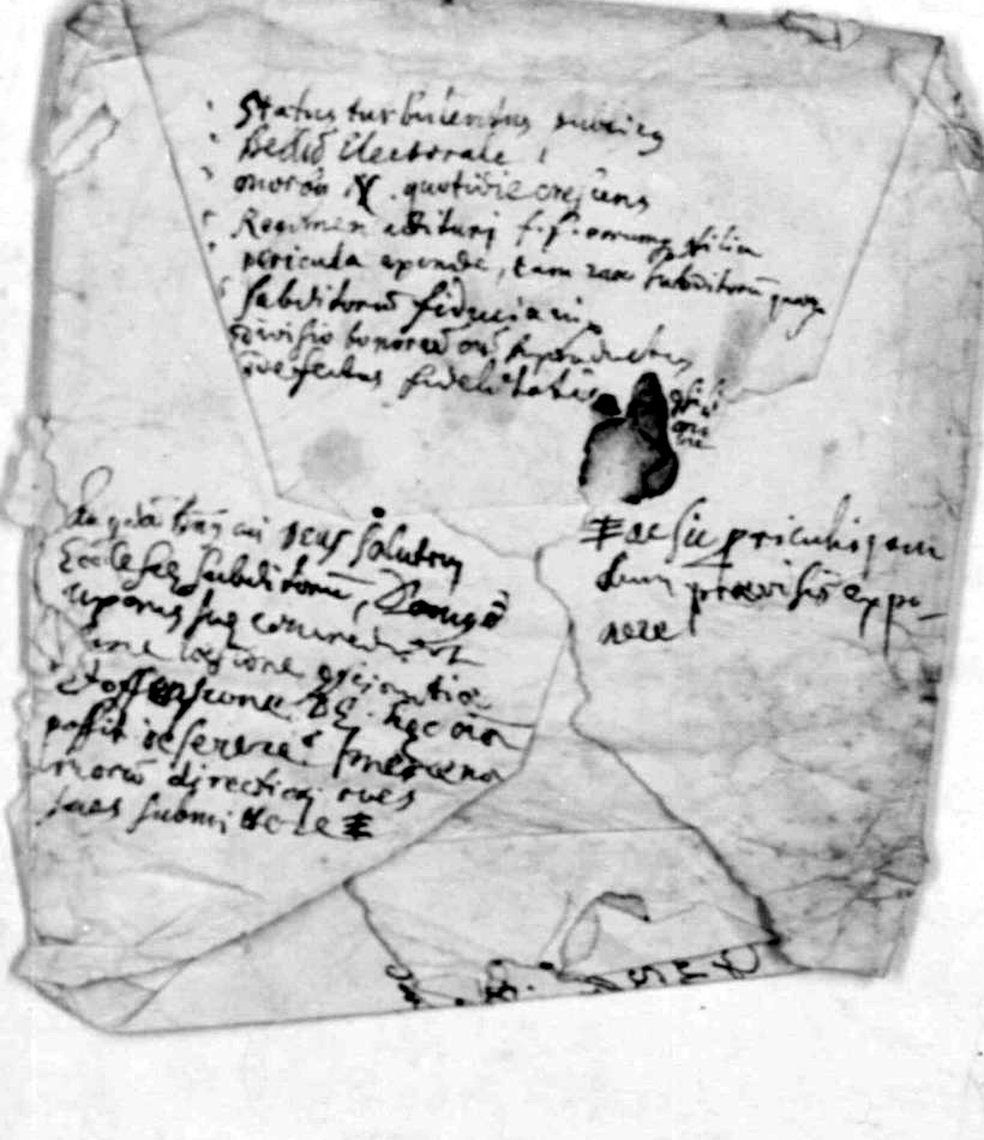
Laid against the cipher, turbulentus, defectus, dominus cui deus salutem, conscientie et offensione dei and oves suas fixed about eighty cells. Read row by row, those cells began to spell German: line 4 dein will … uns, line 3 las dein reich zu uns, line 7 los uns aus aller not, line 1 o vatter aller frommen. That is a rhymed Lord's Prayer, and its wording supplied the rest of each line. With the verse unchanged as the key, all three letters read.
Checks: 591 of the 610 pairs give the intended letter exactly. The letter-model test (docs/_validate.py) scores the reading at −2.39 per letter, against −4.60 for random keys of the same shape and at most −2.59 for keys fitted to shuffled ciphertext; verdict: pass. Before this work, no edition, study or modern decipherment of the letters was found.
05 What remains open
- Nineteen pairs are slips (fifteen in the long letter, four in the short ones). Each reads from context and is listed with its correction. The least certain is zu b⟨r⟩ingen in the opening of the long letter.
- One pair in No. 2 and a short blotted clause in the long letter are under ink on both filmings.
- Some words of the clear German around the cipher are marked doubtful or unread. The text survives only on this microfilm, and the Kurrent is small.
- The long letter is undated. It must be the letter of “rationes” that No. 2 refers to, so it was written before 27 April 1666.
- Line 8 of the verse is known only as p ? x, and the source of this version of the rhymed prayer is not identified.
Full texts
The transcription and the decryption of every document on this page, so that the reading can be used and checked. Short files are shown here; all are in the repository.
Letter 004, undated [before 27 Apr 1666], two pages
Erbach gives Ludwig VI eight reasons why he cannot leave his county: the troubled Empire, the electors' war nearby, his wife's illness, his brothers taking up government by connivance and a dispensation of age, their youthful counsels, his subjects' trust, the division of property, and disloyal councillors. He asks whether a lord may abandon church, subjects, house and wife and 'put his sheep under hirelings' (John 10:12). No. 2 (27 Apr 1666) refers to this letter of 'rationes', so it predates it.
Transcription
# D 4 Nr. 248/3, image 004: Erbach to Ludwig VI, undated two-page letter, almost wholly in number pairs.
# Transcribed 26 Oct 2026 from rotated, enlarged crops of the microfilm frame (work/p004/*_b*.png).
# Format: one manuscript line per line. Cipher pairs written a,b ; clear words in {braces};
# '|' = the writer's word divider (a vertical stroke); [X] = ink blot or deliberate deletion covering
# one or more pairs; '?' after a pair = doubtful reading. Lines 1-3 (clear German opening) omitted.
# Page 1 (the leaf at the bottom of the frame, turned 90 degrees).
p1.04 {erinnern sich gnädigst Wir daß} 2,5 1,19 1,5 2,2 1,7 | 2,17 1,1 3,3 |
p1.05 3,11 1,15 7,1? [X] 1,2 3,5 3,7 7,18 7,8 4,12 | 7,3 6,3 6,15 | {in dieser Sache ein}
p1.06 {jeder} 7,6 7,13 3,11 3,14 3,16 3,4 7,5 1,16 | 4,14 5,6 6,4 6,18 3,11 4,3
p1.07 6,2 6,14 7,18 5,2 1,3 2,21 | 6,6 6,2 6,9 6,13 6,18 7,4 7,5 6,9 6,15
p1.08 6,12 7,4 7,5 7,3 1,1 1,10 1,11 1,12 {Diesem zufolge so kann}
p1.09 {ich nicht lassen ... heraus ... werden so} 1,3 7,4 7,6
p1.10 1,13 1,15 2,6 2,1 2,4 3,7 3,4 3,5 7,8 7,14 7,9 [X] 6,5 3,11 3,12 4,2
p1.11 6,4 6,3 4,14 4,15 | 4,5 4,6 4,10 6,8 3,11 3,12 2,11 [X] 1,7? 1,5? 7,9? [X] 5,17
p1.12 1,3 7,4 4,14 4,15 6,21 5,4 4,2 2,12 7,6 2,3 2,4 5,5 1,4 6,16 6,20
p1.13 3,14 5,3 5,7 5,2 4,4 2,1 2,2 3,7 | 4,1 4,3 4,2 3,8 6,2 3,3 1,1
p1.14 7,11 7,4 1,4 5,2 7,16 7,15 | 4,6 1,4 4,16 4,12 1,16 2,7 2,9 2,19
p1.15 2,18 3,13 3,14 5,11 3,5 2,3 1,6 1,19 2,2 4,4 4,1 4,2 7,14 6,2 6,4
p1.16 1,16 5,18 5,17 6,8 4,10 4,4 {Primo;} 1,1 5,3 7,9 7,18 1,3 1,5 1,4
p1.17 7,4 6,6 5,4 7,8 7,11 4,10 3,7 2,9 3,15 3,17 4,18 6,15 6,5 2,9 7,4
p1.18 8,1 7,8 5,13 1,10 3,10 3,11 3,14 3,17 {Secundo;} 8,1 7,13 7,14 6,3 4,14
p1.19 1,2 2,6 1,3 [X] 8,3 5,3 6,2 7,11 7,12 7,16 1,11 1,10 1,18 3,11 7,18
p1.20 7,2 6,6 [X] 6,21 4,22 {mihi proximo, und wofern es ... gleich}
p1.21 {... Tertio;} 4,12 7,16
p1.22 6,14 5,13 5,14 5,17 7,8 8,3 7,2 7,14 6,3 6,8 {quotidie crescens.}
p1.23 {Quarto et praecipue;} 1,13 1,14 1,8 [X] 1,10 3,3 5,5 5,9 5,11
p1.24 5,12 3,20 3,22 3,23 {partim per conniventiam, partim}
p1.25 {per} 1,2 2,15 2,17 2,16 2,19 2,21 1,3 6,2 2,9 1,3 1,4 2,5
p1.26 3,3 {jam jam suscipientes. Quinto; ex ipsorum} 3,11
p1.27 7,2 7,5 7,6 5,10 7,1 4,3 4,6 4,18 5,2 7,4 1,2 7,13 7,15
p1.28 6,3 4,8 4,6 5,4 7,8 7,3 8,1 1,11 1,12 2,7 3,11 3,14 3,1 3,2
p1.29 {jamdum apparentia, jam quoad} 6,8 6,10 4,8 4,16 7,18 6,24
p1.30 4,12 7,3 7,4 5,4 5,7 5,12 5,14 5,6 5,? [X] 1,17 {quam}
p1.31 {meam domesticam. Sexto:} 3,3 7,4 5,4 6,9 5,12 5,14 1,1 2,12 4,16
p1.32 4,12 {proinde praecipua et bona} 2,5 3,7 1,17 6,2 1,13 5,2 4,1 7,8 3,11 3,10 1,3
p1.33 {Septimo;} 4,1 4,3 1,2 6,3 7,6 4,6 1,1 {bonorum} 3,11 3,14 4,12 1,13 1,14 1,3 1,5 2,12
p1.34 3,6 5,3 6,21 5,17 [X] {welches noch dire[ct?] Rapporen? ... gegeben werden,}
# Page 2 (the leaf at the top of the frame).
p2.01 {Octavo; et quod maximum est,} 4,1 4,2 1,13 6,2 4,14 2,9 3,14 3,1?
p2.02 1,13 3,10 3,14 3,5 3,1 4,3 1,4 1,3 [X] 7,18 6,3 6,8 4,14 1,15 2,18 3,3 3,6?
p2.03 3,1 4,3 6,5 6,6 5,2 5,6 5,5 5,8 4,12 {Wann nun E. Hochf. Durchl.}
p2.04-08 {German clear text: dieser 8. Puncten ... consideration ... capabel sein ... Hic quaeritur; an rebus sic stantibus}
p2.09 {quidem} 4,1 1,1 1,16 2,5 1,19 7,4 7,6 3,11 3,14 4,3 4,1 4,2 7,8 7,9 7,6 7,7 7,11
p2.10 7,4 7,18 6,2 1,17 1,6 3,11 4,14 4,7 6,2 6,8 4,3 2,2 3,3 7,4 5,3 5,7 5,2
p2.11 1,4 1,1 1,7 7,4 7,14 7,8 1,16 4,1 1,1 1,16 7,4 7,6 2,2 2,9 7,4 8,3 5,6
p2.12 5,5 6,3 6,8 7,3 7,4 6,2 3,11 7,16 7,15 3,11 3,8 3,9 3,4 3,6 4,1 4,3 2,9
p2.13 3,3 3,6 3,7 3,9 | 1,9 1,11 7,3 5,2 5,6 4,4 4,10 4,14 5,6 4,17 4,18 4,14 4,3
p2.14 4,2 4,4 1,4 2,5 2,4? 2,12? 2,9 1,1 1,13 1,13 1,18 1,19 3,3 3,6 5,6 4,4 4,10
p2.15 5,7 5,9 5,12 | 2,3 2,4 3,11 1,1 1,15? 1,19 2,16 2,19 {possit} 4,1 4,2
p2.16 3,3 3,5 3,8 3,9 3,8 3,9 | 4,12 6,2 6,6 4,14 3,5 3,7 7,7 6,6 6,3 5,6 5,5 7,4
p2.17 1,16 {directioni} 1,1 1,2 1,6 3,3 7,3 7,4 7,7 7,9 {submittere, ac sic}
p2.18 8,1 6,2 7,14 5,2 4,14 7,4 7,12 4,3 4,18 {jamdum praevisis} 7,13 8,3
p2.19 8,1 7,2 7,5 7,13 7,14 6,2 {? ego quidem non credo, sed tamen S.C. [margin: + per literas, nam scribere vereor ut liceat,] Vestrae sententiam cordialem anxie expecto. Mitt E.}
p2.20 {Hochf. Durchl. hatte es} 2,1 1,3 1,19 6,15 6,16 6,2 6,3 6,4 4,2 6,5 4,4
p2.21 4,1 4,2 4,11 4,10 5,3 3,5 3,3 3,11 3,12 3,2? 1,13 1,17 1,18 1,19 2,3 2,4 2,5
p2.22 2,9 | 4,1 1,3 1,19 3,3 3,6 3,5 7,3 6,3 4,14 4,15 {der obangeführten}
p2.23 {dritten, 4ten, 5. 7. und 8ten Puncten} 6,4 6,3 6,15 6,16 6,22 5,3 6,2
p2.24 1,13 1,3 1,7 1,6 1,19 {Nun E. Hochf. Durchl. will ich diesmahl nicht länger beschwerlich sein ... Gottes ... Gnaden ... E. Hochf. Durchl. unterthänigst gehorsamster [blotted] Knecht Georg Ernst Graf zu Erbach}
Transcription
# Clear text of the three 1666 Erbach letters (transcription in progress)

Conventions: original spelling; cipher passages from reading_004.md / reading_003_006.md in {curly braces};
[?] = doubtful word; [..] = unreadable; "-" at line end = word divided by the writer.

## Letter 004 (undated, spring 1666), page 1 (lower leaf, image 004)

p1.01 Desselbigen [?] Vorgedancken [?] fassen müssen, E. Hochf. Durchl. ge-
p1.02 horsambst zu entdecken [?], und umb dero Hochf. Verstän- [?]
p1.03 diges [?] Sentiment unterthänigst zu bitten. E. Hochf. Durchl.
p1.04 erinnern sich gnädigst wie [? Wir] daß {inter nos conventum sit}
p1.05 {..} in dieser Sache ein
p1.06 jeder {secundum conscientiam reden und}
p1.07 {thun soll er.}
p1.08 {} Diesem zufolge so kann
p1.09 ich nicht lassen, schuldigst [?] herauß zu fahren [?] [..] [werden?], so {aus folgende[n]}
p1.10-15 {urs[X]ache[n] nich[t] wie sche[X]rts[X]s auch übers hertz zu b⟨r⟩ingen die resolution ...itum mit anzugehen, enderen müssen.}
  (p1.09: a bracket "[" stands before "schuldigst"; the words between "schuldigst." and "so" are faint on both films, 004 and 033.)
p1.16-19 {...} Primo; {obstat turbulentus statu[s] publicus.} Secundo; {pericula [X: e]x bello elector[X]um}
p1.20 {} mihi proximo, & wofern es, über [?] od[er] [?] gleich
p1.21 Kriegs[?]heere & partien [?] durchgehet [?] einer Verwüstung [?]. Tertio; {morb⟨u⟩s}
p1.22 {uxoris} quotidie crescens.
  (p1.20-21: "&" for "und"; the run between "es," and "gleich" is two short words; "einer Verwüstung" is a guess from the shape,
  it may be an abbreviated "Verwüsth." Right margin beside p1.18-21 carries the end of a marginal note, "ver..", "lic..",
  probably the "per literas, nam scribere vereor ut liceat" note.)
p1.23-33 (as in reading_004.md: Quarto et praecipue; {fra[X: tri]s regimen} partim per conniventiam, partim per {veniam aetatis}
  jam jam suscipientes. Quinto; ex ipsorum {consi⟨l⟩iis iuvenilibus pericula} jamdum apparentia, jam quoad {salutem
  subdi⟨t⟩o[X: rum]} quam meam domesticam. Sexto: {subdi⟨t⟩orum} proinde praecipua et bona {in me fiducia.}
  Septimo; {divisio} bonorum {cum fratribus})
p1.34 {3,6...: [cum fratribus] [X]} & welches noch Dire [?] Rappar[..]ione [?] gegeben
p1.35 wird,
  (p1.34: two words between "noch" and "gegeben" unread; the second begins with a looped capital (K/R), "-app-", ends "-ione";
  line 35 holds only "wird," at the right, so the sentence runs "... gegeben wird," into page 2.)

## Letter 004, page 2 (upper leaf, image 004)

p2.01 Octavo; & quod maximum est, {defectu⟨s⟩ fi-}
p2.02 {⟨d⟩elita[X]tis consili-}
p2.03 {ariorum.} Wann nun E. Hochf. Durchl.
p2.04 dieser 8. Ihro [?] mit Erinnerung [?] eröffneten [?] Puncten mit Fleiß [?] nach-
p2.05 dencken, werden Sie sie [?] [blot]nädig[..] [..] [..] nicht, keine so gahr ge-
p2.06 ringe consideration finden, dan sie meines ermessens [?] wohl
p2.07 capabel sein, wie klar es [?] auch hochgelehrten [?] würde [?], manchem Com-
p2.08 pass [?] zu verwirren [?]. Hic quaeritur; an rebus sic stantibus
  (p2.04: "8." is the numeral; the word after it is short with a large initial, read "Ihro"/"Ihrer". p2.05: an ink blot
  covers the capital before "-nädig-"; the run between it and "nicht" is two or three letters' worth of cursive, not
  read. p2.07-08: "würde" and the last two words are shape-guesses; "Com-|pass" may be "Com-|plexion" or similar.)
p2.09-19 (cipher as in reading_004.md: quidem {dominus, cui deus salutem ecclesie ... mercenariorum} directioni {oves suas}
  submittere, ac sic {periculis} jamdum praevisis {exponere})
p2.19 {8,1 ... exponere}? Ego quidem non credo, sed tamen S.C.
  [left margin, keyed by a "+" in the text: + per [lite]ras, nam [..] ver[eor] [..] li[ceat] — only "+ pe-", "nam", "ver-",
  "lic-" and "-ras," are legible on 004; the rest of the note is cut by the leaf edge]
p2.19b [lite]ras, vestrae sententiam cordialem + anxie expecto. Mitt E.
p2.20 Hochf. Durchl. hatte es {gantz eine andere beschaf-}
p2.21 {⟨f⟩enheit, dan sie sich}
p2.22 {[sich]} der obangeführten
p2.23 dritten, 4ten, 5. 7. und 8ten Puncten {nit z⟨u⟩ befah-}
p2.24 {ren.} Nun E. Hochf. Durchl. will ich diesmahl nicht
p2.25 länger beschwerlich sein, sondern solches schließlich dem
p2.26 Stande [?] d[es] H[öch]s[ten] [?] Gottes treulichst empfehlen, aber mich Dero
p2.27 beharrlichen Gnaden unterthänigst befohlen, der beständig [?]
p2.28 außerste [?] biß in mein grab verharren werde zu sein
p2.29 E. Hochf. Durchl.
p2.30 unterthänigst gehorsamster
p2.31 [blot: Knecht?] von [?] hertzen [?]
p2.32 Georg Ernst Graff
p2.33 zu Erbach
  (p2.23: a small superscript over "7." is unread. p2.26: the first word may be "Schutz"/"Beistand"; "d. H. 5" written
  with abbreviation strokes, read as "des Höchsten". p2.27-28: "der beständig[st] ... biß aufs äußerste" is the likely
  sense; the end of p2.27 and start of p2.28 are cramped. p2.31: an ink blot covers the first word of the line.)

## No. 1, Fürstenau 22 March 1666 (image 032, = 003), the passage around the two cipher runs

(From the 7th line before the end of p. 1; the earlier lines of the letter not transcribed.)

n1.a E. Hochf. Durchl. sich befinden möchten, dan auch [..] und [..]
n1.b [..]wort [?] ich vernommen, daß auch zu Darmstadt einige
n1.c Zeit mit schreiben sey [?] ingehalten [?] worden, habe [?] also ohne [?]
n1.d gegebenen befehl oder Veranlassung mich solcher künfftig
n1.e nicht unterfangen dörffen, welches E. Hochf. Durchl. mir
n1.f gnädigst nachsehen wollen. Daß im übrigen E. Hochf. Durchl.
n1.g [blot] {uns⟨e⟩rs vorhabens}
n1.h {[3,3]} und etlicher Veränderungen, [blot] welche
n1.i doch nicht benachrichtet [?] werden, gedencken wollen, dardurch
n1.j werde ich veranlaßt [?] Dir [?] {mutatio⟨n⟩es}
n1.k {} so sich unterdessen [deleted: bey mir [?]] begeben, und was ich
  (continued on the left leaf)
  (n1.f-g: "E. Hochf. Durchl." stands at the end of n1.f, before the blot that opens n1.g; the blot covers about one word.
  n1.h: a second blot after "Veränderungen," over a short word. n1.j: "veranlaßt" may be "vermahnt"/"vermeldt"; "Dir"
  is written so, perhaps for "Dero". n1.k: two short words before "begeben" are struck through.)
(left leaf, the continuation, written in the same direction as the page; first lines)
n1.l E. Hochf. Durchl. gehorsambst aufzuwarten,
n1.m [..]n [?], daß dieselben in Philosophicis [?] 2 [..]
  (n1.l opens with a large E-flourish: "Ew."; the leaf then runs on about 13 more lines to the subscription
  "Durchleuchtigster Fürst / Gnädigster Herr / E. Hochf. Durchl." and the signature at the head of the leaf; not transcribed.)

## No. 2, [Fürstenau] 27 April [1666] (image 035, = 006), the sentence around the cipher run (left leaf)

n2.a durch ein [..] Schreiben [?] [..] [..] berichtet, der hoffnung daß
n2.b E. Hochf. Durchl. selbige meine rationes vor relevant genug halten, und mich so
n2.c keiner [? keine] [..]lichkeit [?] und Unbeständigkeit beschuldigen werden, sintemahl [?]
n2.d dan [?] eben [?] im Majo oder Junio will Gott unsere {⟨b⟩onorum divi⟨s⟩io}
n2.e {[3,7? 3,6 5,6]} vorgehen [?], [..] ich auch [..]
  (n2.a-c on film 035, the leaf upside down on the frame. n2.c: the noun before "und Unbeständigkeit" is unread (a long
  word, "-lichkeit"/"-fertigkeit"); "sintemahl" is a guess for the last word. n2.d: the first two words are faint.
  n2.e: the line after the run not read beyond "vorgehen"; check on 006.)
Decryption
p1.04 erinnern sich gnädigst Wir daß inter | nos |
p1.05 col[X]ventum | sit | in dieser Sache ein
p1.06 jeder secundnm | connci
p1.07 ertiam | redenundt
p1.08 hunsoler Diesem zufolge so kann
p1.09 ich nicht lassen ... heraus ... werden so aus
p1.10 folgendeurs[X]ache
p1.11 nich | wiesche[X]rts[X]s
p1.12 auchubershertzz
p1.13 ubdingen | diereso
p1.14 lution | itummita
p1.15 nzugehenenderen
p1.16 mussen Primo; obstatt
p1.17 urbulentusstatu
p1.18 publicus Secundo; peric
p1.19 vla[X]xbelloelect
p1.20 or[X]um mihi proximo, und wofern es ... gleich
p1.21 ... Tertio; mo
p1.22 rbdsuxoris quotidie crescens.
p1.23 Quarto et praecipue; fra[X]lsreg
p1.24 imen partim per conniventiam, partim
p1.25 per veniamaetati
p1.26 s jam jam suscipientes. Quinto; ex ipsorum c
p1.27 onsrliisiuven
p1.28 ilibuspericula
p1.29 jamdum apparentia, jam quoad salute
p1.30 msubdido[X]m quam
p1.31 meam domesticam. Sexto: subdidoru
p1.32 m proinde praecipua et bona inmefiducia
p1.33 Septimo; divisio bonorum cumfratr
p1.34 ibus[X] welches noch dire[ct?] Rapporen? ... gegeben werden,
p2.01 Octavo; et quod maximum est, defectul
p2.02 fiuelita[X]tisconsi
p2.03 liariorvm Wann nun E. Hochf. Durchl.
p2.04-08 German clear text: dieser 8. Puncten ... consideration ... capabel sein ... Hic quaeritur; an rebus sic stantibus
p2.09 quidem dominuscuideussal
p2.10 utemecclesiesubdi
p2.11 torurumdomusetuxo
p2.12 rissueconcredidit
p2.13 sine | lesioneconsci
p2.14 entiertoffensione
p2.15 dei | hecoonia possit de
p2.16 serere | mercenarioru
p2.17 m directioni ovessuas submittere, ac sic
p2.18 periculis jamdum praevisis ex
p2.19 ponere ? ego quidem non credo, sed tamen S.C. [margin: + per literas, nam scribere vereor ut liceat,] Vestrae sententiam cordialem anxie expecto. Mitt E.
p2.20 Hochf. Durchl. hatte es gantzeinean
p2.21 derebeschafmenhei
p2.22 t | dansiesich der obangeführten
p2.23 dritten, 4ten, 5. 7. und 8ten Puncten nitznbe
p2.24 faren Nun E. Hochf. Durchl. will ich diesmahl nicht länger beschwerlich sein ... Gottes ... Gnaden ... E. Hochf. Durchl. unterthänigst gehorsamster [blotted] Knecht Georg Ernst Graf zu Erbach
Reading
# Letter 004: Erbach to Ludwig VI, undated [before 27 April 1666], reading

D 4 Nr. 248/3, image 004 (refilmed as 033). Two pages, almost wholly in cipher, with Latin frame words
(Primo ... Octavo; Hic quaeritur ...) and German clear passages. Deciphered with `key.txt` (the rhymed Lord's
Prayer) from `ct_004.txt`; the raw output is `decrypt_004.txt`, pair by pair in `reading.tsv`.

Conventions: deciphered text in plain type, clear text of the letter in *italics*. Letters the writer dropped are
added in [square brackets]; ⟨x⟩ marks a letter where he took a neighbouring cell of the key (the key gives
another letter; listed at the end). [X] = an ink blot or deletion in the manuscript. "..." = clear German not yet
transcribed from the microfilm (outside the cipher). Spelling as written (u/v and i/j as the key gives them).

## Reading

### Page 1

*Desselbigen[?] Vorgedancken[?] fassen müssen, E. Hochf. Durchl. gehorsambst zu entdecken[?], und umb dero Hochf.
verständiges[?] Sentiment unterthänigst zu bitten. E. Hochf. Durchl. erinnern sich gnädigst, wie daß* inter nos
co⟨n⟩[X]ventum sit, *in dieser Sache ein jeder* secund⟨u⟩m consci⟨e⟩n⟨t⟩iam reden und thun soll er. *Diesem zufolge
so kann ich nicht lassen, schuldigst[?] herauß zu fahren[?] [..], so* aus folgende[n] urs[X]ache[n], nich[t] wie
sche[X]rts[X]s auch übers hertz zu b⟨r⟩ingen, die resolution [..]itum mit anzugehen enderen müssen.

*Primo;* obstat turbulentus statu[s] publicus.

*Secundo;* pericula [X: e]x bello elector[X]um *mihi proximo, & wofern es über[?] od[er][?] gleich Kriegs[?]heere &
partien[?] durchgehet[?], einer Verwüstung[?].*

*Tertio;* morb⟨u⟩s uxoris *quotidie crescens.*

*Quarto et praecipue;* fra[X: tri]s regimen *partim per conniventiam, partim per* veniam aetatis *jam jam
suscipientes.*

*Quinto; ex ipsorum* consi⟨l⟩iis iuvenilibus pericula *jamdum apparentia, jam quoad* salutem subdi⟨t⟩o[X: rum]
*quam meam domesticam.*

*Sexto:* subdi⟨t⟩orum *proinde praecipua et bona* in me fiducia.

*Septimo;* divisio *bonorum* cum fratribus [X] *& welches noch [..] [..] gegeben wird,*

### Page 2

*Octavo; & quod maximum est,* defectu⟨s⟩ fi⟨d⟩elita[X]tis consiliariorum. *Wann nun E. Hochf. Durchl. dieser 8.
Ihro[?] mit Erinnerung[?] eröffneten[?] Puncten mit Fleiß[?] nachdencken, werden Sie sie [..] [..] nicht, keine so
gahr geringe consideration finden, dan sie meines ermessens[?] wohl capabel sein, [..] manchem Compass[?] zu
verwirren[?]. Hic quaeritur; an rebus sic stantibus quidem* dominus, cui deus salutem ecclesie, subditorum [ru]m,
domus et uxoris sue concredidit, sine lesione conscientie et offensione dei hec o⟨m⟩nia *possit* deserere,
mercenariorum *directioni* oves suas *submittere, ac sic* periculis *jamdum praevisis* exponere? *Ego quidem non
credo, sed tamen S.C. [margin: + per [lite]ras, nam [..] ver[eor] [..] li[ceat],] vestrae sententiam cordialem anxie
expecto. Mitt E. Hochf. Durchl. hatte es* gantz eine andere beschaf⟨f⟩enheit, dan sie sich *der obangeführten
dritten, 4ten, 5. 7. und 8ten Puncten* nit z⟨u⟩ befahren. *Nun E. Hochf. Durchl. will ich diesmahl nicht länger
beschwerlich sein, sondern solches schließlich dem Stande[?] des Höchsten[?] Gottes treulichst empfehlen, aber mich
Dero beharrlichen Gnaden unterthänigst befohlen, der beständig[?] außerste[?] biß in mein grab verharren werde zu
sein E. Hochf. Durchl. unterthänigst gehorsamster [blot] von[?] hertzen[?] Georg Ernst Graff zu Erbach.*

Clear text from `clear_text.md` (transcribed 27 Oct 2026 from the microfilm; [?] doubtful, [..] unread).

## Writer's slips (key value -> intended)

| where | pair | key gives | intended |
|---|---|---|---|
| p1.05 | 7,1 | l | n (co[n]ventum) |
| p1.06 | 7,5 | n | u (secundum) |
| p1.06 | 6,18 | n | s (conscientiam) |
| p1.07 | 6,14 | r | n (conscientiam) |
| p1.13 | 5,7 | d | r (bringen) |
| p1.22 | 5,14 | d | u (morbus) |
| p1.23 | 1,10 | l | i (fratris) |
| p1.27 | 5,10 | r | i (consiliis) |
| p1.30, p1.31 | 5,14 | d | t (subditorum, twice) |
| p2.01 | 3,1 | l | s (defectus) |
| p2.02 | 3,14 | u | d (fidelitatis) |
| p2.14 | 2,12 | r | e (conscientie et) |
| p2.15 | 1,15 | o | m (omnia) |
| p2.21 | 1,17 | m | f (beschaffenheit) |
| p2.23 | 6,22 | n | u (zu) |

Fifteen of the 571 pairs (2.6%): every one is a neighbouring letter of the key line or a near neighbour
(5,14 for 5,13/5,18; 6,18 for 6,17). The p1.13 reading "bringen" is the least certain of the emendations.
Translation
# Letter 004: English translation of the cipher passages and their frame

[I have had to form] my thoughts about it, to disclose them obediently to Your Highness and to ask humbly for Your
Highness's understanding opinion. Your Highness will graciously remember that it was agreed between us that in this
matter each should speak and act according to his conscience. Accordingly I cannot refrain from saying it out, as I
ought: for the following reasons, however hard it is for me to bring myself to it, I have had to change the
resolution ...

First: the troubled state of public affairs stands in the way.
Second: the dangers from the electors' war, which is closest to me, and if armies and war parties pass over or
through it, of devastation.
Third: my wife's illness, growing daily.
Fourth and chiefly: my brother's government, which they are about to take up, partly by connivance, partly by a
dispensation of age.
Fifth: from their youthful counsels dangers are already apparent, both for the welfare of the subjects and for
my own household.
Sixth: hence the subjects' particular and good trust in me.
Seventh: the division of the property with my brothers, which is still to be made.
Eighth, and the greatest: the want of loyalty in the councillors.

If Your Highness will consider these eight points carefully, you will find them of no small weight, for in my
judgement they could well confuse many a compass. The question is whether, things standing so, a lord to whom
God has entrusted the welfare of the church, of his subjects, of his house and of his wife can, without hurt to
his conscience and offence to God, leave all this, put his sheep under the direction of hirelings, and so expose
them to dangers already foreseen. I for my part do not believe it; but I anxiously await Your Serene Highness's
heartfelt opinion [by letter, for I fear writing may not be safe]. With Your Highness it would be quite another
matter, since you need fear nothing of the third, fourth, fifth, seventh and eighth points above. I will not trouble Your
Highness longer now, but commend it all faithfully to God's protection[?], and myself to your lasting grace ...

The "hirelings" and "sheep" are John 10:12. Who the brothers are and what move Ludwig had proposed are not said
in the cipher; the 1666 letters in the file (Nos. 1 and 2, below) speak of a planned undertaking ("unsers
Vorhabens") and of the division of property due in May or June.
No. 1, Fürstenau 22 Mar 1666
Two short runs, 'unsers vorhabens' and 'mutationes', in a letter about a planned undertaking and the changes since.
Transcription
# D 4 Nr. 248/3, image 003 (= 032, sharper): letter No. 1, Fürstenau 22 Mar 1666, to Ludwig VI "à Stokholm".
# Two runs in the last lines of p. 1, transcribed 27 Oct 2026 from work/survey/cipher_032_a.jpg (enlarged).
# Second pair of run 1 read 1,1 (the survey's '1,12' is a 1,1 with a long stroke). Same conventions as ct_004.txt.
a.1 {Daß im übrigen} [X] 3,14 1,19 7,3 2,7 4,11 3,17 | 1,2 1,1 2,12 2,3 1,3 5,3 4,2 4,4 3,3 | {und etlicher Veränderungen ... nicht ... werden, gedencken wollen, darbei werde ich Vermeldt Dir}
a.2 1,16 3,14 1,4 1,3 2,9 2,7 1,1 1,19 7,5 3,3 | {so sich unterdessen ... begeben, und was ich}
Decryption
a.1 Daß im übrigen [X]unsirs | vorhabens | und etlicher Veränderungen ... nicht ... werden, gedencken wollen, darbei werde ich Vermeldt Dir
a.2 mutationns | so sich unterdessen ... begeben, und was ich
Reading
# Letters No. 1 and No. 2 (1666): the short cipher runs, reading

Deciphered with `key.txt` from `ct_003.txt` and `ct_006.txt` (raw output `decrypt_003.txt`, `decrypt_006.txt`).
Deciphered text plain, clear text in *italics*, slips as in `reading_004.md`.

## No. 1, Fürstenau 22 March 1666, to Ludwig VI "à Stokholm" (image 003, refilmed 032)

*... habe also ohne gegebenen befehl oder Veranlassung mich solcher künfftig nicht unterfangen dörffen, welches E.
Hochf. Durchl. mir gnädigst nachsehen wollen. Daß im übrigen E. Hochf. Durchl.* [blot] uns⟨e⟩rs vorhabens *und
etlicher Veränderungen, [blot] welche doch nicht benachrichtet[?] werden, gedencken wollen, dardurch werde ich
veranlaßt[?] Dir* mutatio⟨n⟩es, *so sich unterdessen [struck: bey mir] begeben, und was ich ...*

"That otherwise [...] our plan and certain changes ... I will report to you the changes that have happened in
the meantime ..."

Slips: 2,7 i for e (unsers); 1,19 or 7,5 n for e (mutationes: the run reads o n n s).

## No. 2, [Fürstenau] 27 April [1666] (image 006, refilmed 035)

*... durch ein [..] Schreiben [..] berichtet, der hoffnung daß E. Hochf. Durchl. selbige meine rationes vor relevant
genug halten, und mich keiner [..]lichkeit und Unbeständigkeit beschuldigen werden, sintemahl[?] dan[?] eben[?] im
Majo oder Junio will Gott unsere* ⟨b⟩onorum divi⟨s⟩io *vorgehen ...*

The "Schreiben" with "meine rationes" is very likely the eight-reason letter (004), which therefore predates 27
April 1666.

"... in May or June, God willing, our division of property will go ahead ..." (the same division as point 7 of
letter 004).

Slips or misreadings: the first pair reads 5,2 (i) where the sense needs 5,3 (b); the eleventh is unclear on
both films (7,7 = a as read; the sense needs s, e.g. 7,6).
Translation
# Letters No. 1 and No. 2 (1666): English translation

## No. 1, Fürstenau, 22 March 1666

"... so without an order or occasion given I may not venture on it in future, which Your Highness will graciously
forgive me. That otherwise Your Highness [...] has been pleased to remember our plan and certain changes, of which
nothing has been reported, gives me occasion to [tell] you of the changes that have happened here in the meantime,
and what I ..."

## No. 2, 27 April [1666]

"... [I have] reported by a letter, in the hope that Your Highness will think my reasons weighty enough and not
accuse me of [fickle]ness and inconstancy, since in May or June, God willing, our division of property is to go
ahead ..." (the division of point 7 of the eight-reason letter, which this "letter" with "my reasons" very likely is).
No. 2, 27 Apr [1666]
'Im Majo oder Junio will Gott unsere bonorum divisio vorgehen': the division of property with his brothers, point 7 of letter 004.
Transcription
# D 4 Nr. 248/3, image 006 (= 035): letter No. 2, 27 Apr 166[6], one run on the continuation leaf.
# Transcribed 27 Oct 2026 from work/survey/cipher_006_a.jpg. First pair read 5,2 (a miscount for 5,3 = b, or a
# misreading); the pair before 3,6 is unclear (7,7 or 3,7; the decipherment needs an s).
b.1 {... im Majo oder Junio will Gott unsere} 5,2 5,6 4,4 7,2 6,6 7,4 1,16 4,1 4,3 1,2 2,5 7,7? 3,6 5,6 {vorgehen}Reading
# Letters No. 1 and No. 2 (1666): the short cipher runs, reading

Deciphered with `key.txt` from `ct_003.txt` and `ct_006.txt` (raw output `decrypt_003.txt`, `decrypt_006.txt`).
Deciphered text plain, clear text in *italics*, slips as in `reading_004.md`.

## No. 1, Fürstenau 22 March 1666, to Ludwig VI "à Stokholm" (image 003, refilmed 032)

*... habe also ohne gegebenen befehl oder Veranlassung mich solcher künfftig nicht unterfangen dörffen, welches E.
Hochf. Durchl. mir gnädigst nachsehen wollen. Daß im übrigen E. Hochf. Durchl.* [blot] uns⟨e⟩rs vorhabens *und
etlicher Veränderungen, [blot] welche doch nicht benachrichtet[?] werden, gedencken wollen, dardurch werde ich
veranlaßt[?] Dir* mutatio⟨n⟩es, *so sich unterdessen [struck: bey mir] begeben, und was ich ...*

"That otherwise [...] our plan and certain changes ... I will report to you the changes that have happened in
the meantime ..."

Slips: 2,7 i for e (unsers); 1,19 or 7,5 n for e (mutationes: the run reads o n n s).

## No. 2, [Fürstenau] 27 April [1666] (image 006, refilmed 035)

*... durch ein [..] Schreiben [..] berichtet, der hoffnung daß E. Hochf. Durchl. selbige meine rationes vor relevant
genug halten, und mich keiner [..]lichkeit und Unbeständigkeit beschuldigen werden, sintemahl[?] dan[?] eben[?] im
Majo oder Junio will Gott unsere* ⟨b⟩onorum divi⟨s⟩io *vorgehen ...*

The "Schreiben" with "meine rationes" is very likely the eight-reason letter (004), which therefore predates 27
April 1666.

"... in May or June, God willing, our division of property will go ahead ..." (the same division as point 7 of
letter 004).

Slips or misreadings: the first pair reads 5,2 (i) where the sense needs 5,3 (b); the eleventh is unclear on
both films (7,7 = a as read; the sense needs s, e.g. 7,6).
Translation
# Letters No. 1 and No. 2 (1666): English translation

## No. 1, Fürstenau, 22 March 1666

"... so without an order or occasion given I may not venture on it in future, which Your Highness will graciously
forgive me. That otherwise Your Highness [...] has been pleased to remember our plan and certain changes, of which
nothing has been reported, gives me occasion to [tell] you of the changes that have happened here in the meantime,
and what I ..."

## No. 2, 27 April [1666]

"... [I have] reported by a letter, in the hope that Your Highness will think my reasons weighty enough and not
accuse me of [fickle]ness and inconstancy, since in May or June, God willing, our division of property is to go
ahead ..." (the division of point 7 of the eight-reason letter, which this "letter" with "my reasons" very likely is).
Key: key.txt
06 Sources
- Hessisches Staatsarchiv Darmstadt, D 4 Nr. 248/3, “Briefe des Grafen Georg Ernst v. Erbach-Fürstenau an Landgraf Ludwig VI. (39 Briefe)”, 1654–1670: Arcinsys Hessen; images 003 (No. 1, refilmed 032), 004 (the long letter and the slip, refilmed 033) and 006 (No. 2, refilmed 035).
- Checked and not the key: D 4 Nr. 141/2 (cipher alphabets of Georg II and Cardinal Friedrich of Hesse, 1652 and 1658), and D 4 Nr. 239/1 (Ludwig VI's notes, with a 1640s number table and decipherments).
Transcriptions, the key, the decoder and the working notes: targets/erbach1653/.