01 What was catalogued, and what was there
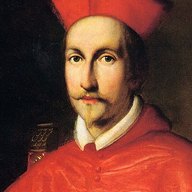
Busta 346 of the Francia series of the Segreteria di Stato holds the originals and ciphers sent from Rome to Ceva during his extraordinary nunciature, 1632 to 1634. DECODE catalogued eleven ciphertexts from it, R74 to R84. The catalogue entry here named five (R75, R77, R78, R82, R84) and scored them by rule from the metadata, unviewed.
Opening the records changed the problem. Every one of the eleven carries, as an attachment, a key marked #KEY: reconstructed, #TRANSCRIBER NAME: George Lasry, #DATE OF TRANSCRIPTION: October 24, 2020. Every one also carries the same 29,050-byte file of aligned decipherments, covering four letters. So the state of the dossier before this session was:
| DECODE | Item | Date | Pages | Before |
|---|---|---|---|---|
| R74 | 346-1 | 7 Sept 1632 | 1 | read by Lasry |
| R75 | 346-2 | 25 Sept 1632 | 2 | not read |
| R76 | 346-3 | 1632 | 3 | marked decrypted |
| R77 | 346-4 | 1632 | 2 | read by Lasry |
| R78 | 346-5 | 1632 | 2 | read by Lasry |
| R79–R81, R83 | 346-6 to -8, -10 | 1632–34 | 7 | marked decrypted |
| R82 | 346-9 | 27 [Oct] 1632 | 1 | read by Lasry |
| R84 | 346-11 | 18 Dec 1632 | 2 | not read |
Three of the five ciphertexts the catalogue named were therefore already deciphered by Lasry, and two were not. R75 and R84 carry a raw ciphertext transcription and nothing else. Lasry, for his part, left every one of the ninety-five nomenclator elements he met printed as <xxx>; none was given a value.
02 The system
The key is Lasry’s. It was re-derived here from his four aligned decipherments, parsed into 104 line pairs and 179 distinct tokens, which confirms it and settles three points the key note leaves open.
| Token | Value |
|---|---|
6 | word separator |
2x | null — no pair beginning 2 ever carries plaintext |
XY | letter or syllable, 61 codes: three homophones for each vowel, two for most consonants, and groups for al, che, chi, con, da, de, di, et, il, in, io, la, ma, mi, no, per, qu, quel, se, si, st |
pXY | nomenclator element: one prefix digit followed by an ordinary two-digit code |
First, the figure 6 occurs inside no code, neither in a key pair nor in any of the ninety-five nomenclator elements. Word boundaries in this cipher are therefore certain, which is unusual and is what makes the rest tractable.
Second, the DECODE key note says the nomenclator elements “have 4 digits starting with prefix 4”. They have three. Concatenating Lasry’s own token stream for 346:1 and diffing it against the original transcription of the same leaf gives a 99.7% match with no dropped prefix; the elements are three digits as they stand. The prefix is 4 in twenty-seven of the ninety-five, but it is also 0, 1, 3, 5, 7, 8 or 9.
Third, in ninety-one of the ninety-five the two digits after the prefix are themselves a valid key code. The element is a prefix plus an ordinary code, which is exactly why the parse is ambiguous: at most positions a two-digit and a three-digit reading are both legal. Twenty-nine of the hundred pairs are dead (02 05 06 12 16 32 33 36 42 46 52 56 60–69 72 76 82 86 92 96 99), and meeting one forces the three-digit reading, but that is not enough on its own.
03 Dividing and decrypting the digit stream
The decoder works along the digit stream and keeps the several hundred most probable partial decryptions at each position. Every 6 is taken as a separator; elsewhere the decoder chooses between a two-digit code, a two-digit null and a three-digit element, scored by a character model. Scoring is incremental: the shared lang package’s dense model is a flat table of log P(c | previous four characters), so each emitted character costs one array lookup and several hundred candidates are cheap to keep.
The model matters more than the search. it-cinquecento is Renaissance diplomatic Italian but stops around 1620 and knows nothing of this clerk’s hand: one sign for u and v, doubled letters dropped, word division his own. It was interpolated with a model built on 7,693 characters from the dossier itself: the passages the clerk wrote in clear, plus Lasry’s plaintext of whichever letters were not under test.
Calibration is leave-one-document-out against Lasry’s four letters: the nomenclator inventory offered for a document is built from the other three only, which is the situation of R75 and R84. Agreement with his own segmentation:
| Model | Tokens | Nomenclator recall | Precision |
|---|---|---|---|
it-cinquecento alone | 0.945 | 0.52 | 0.70 |
| interpolated, w = 0.6 | 0.958 | 0.70 | 0.79 |
Per letter, interpolated: 346:1 0.871, 346/4 0.928, 346/5 0.905, 346/9 0.951. The figure to keep in view is the nomenclator recall. Three elements in ten are still missed, and a missed element comes out as two or three plausible Italian letters, with no gap to mark it. Errors in the decipherments below are concentrated there.
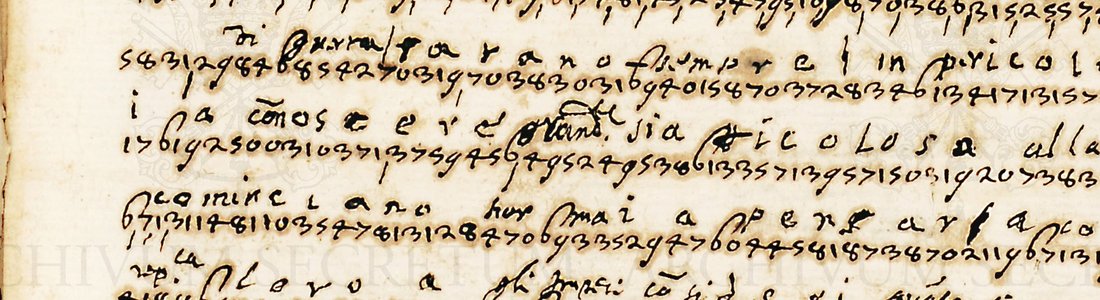
The one independent check is R75’s own leaf. A decipherer in 1632 wrote his decipherment between the cipher lines, and the DECODE transcriber copied what was legible of it. It was used for nothing else: neither for the key, the model nor the decoder. On the twenty-four lines where enough survives, 1,105 letters, 77.5% agreement, ignoring word division; the last line agrees at 100%. The residue is shared between errors in this decryption and the witness’s own illegibility, since the transcriber flagged much of the faded interlinear with ? and *.
04 R75: “Di Roma li 25 di Settembre 1632”
Two pages, 1,446 code groups. Barberini on what the Swedish victories do to the French alliance. The letter makes one argument: the victories make l’accomodamento easier and l’unione far harder, and the nuncio is to make the French court see that the power now winning is a danger to France herself. Gaps are unresolved nomenclator elements or transcription noise; italics mark elements given values here.
…le vittorie di […] e quella forza renderanno per avventura più facile […] quell’accomodamente di […], ma più difficile assai […] quell’unione… per […] interessi di Francia…
è tempo che se cominci a conoscere quanto sia pericolosa alla Francia la potenza d[i …], che cominciano [hor]mai a pensar a cose [grandi] et ad indrizar la [mira] loro a […]; consideri quanto sia oportuno alli vastissimi pens[ieri] di […] natione estendere il loro dominio sino al Mediterraneo con acquisto d’una piazza, e con quanto buon fondamente lo possono sperare in una [rivoluzione] … di Francia … hanno tanto forze marittime e terrestri; consideri… che la vittoria […] è altretanto formidabile alla Francia quanto alla […]…
[non si] sarà sempre al medesimo, darà sempre orecchie a[l] torbidi, et haverà chi li suggerisca; et un successor[e]… restringer in maniera che sempre non habbi libertà di [salvarsi] in campagna… [bisogna] cercar di compor[re gli] esterni, che cagioneranno e fo[men]teranno li domestici…
[è] già… arrivata a tal […] di gloria… che può con ragion temere che la […] fortuna non si rivolti; cerchi dunque d’augumentarla con l’arti… pur vuol seguitar… indrizi le cose per intraprender guerra contro… quel[li] che sola parte manca alla gloria di […]. In somma… le congiunture presenti sono più contrarie alla s[ua] […] quell’unione, tanto più deve […] pensar a ritrovar ragioni che la persuadano.
The unnamed power is Sweden. The 1632 decipherer’s own interlinear supplies, where this decryption has a gap, the words pensieri di goto natione (the Gothic nation), and it is the reach of that nation sino al Mediterraneo that Rome wants Paris to contemplate.
05 R84: “Roma li 18 di Xbre 1632”
Two pages, 954 code groups, written a month after Lützen (16 November 1632). The first folio is largely in clear: Barberini acknowledges Ceva’s despatch of the 8th, says he has nothing further to answer, and refers him to Mons. Bichi at court. The cipher carries the analysis, and it turns throughout on quella vittoria.
ricordando a […] che si […] quella vittoria contro […] con la sua consueta prudenza, ad indur[re] […] a facilitar il […]…
[…] che bollivano in Francia dopo la mia partenza; pure de[…] li torbidi di […] furono cagione che li […] concludessero la […]…
le gelosie [che] quella potenza di Francia cerca di […]; e li spiriti inquieti […] fanno pastura su li impegni che il […] tiene con […] potenti, e si muovono più facilmente con speranza di fo[men]to e diversione. Per stabilire et assicurar le cose […] bisogna levarsi le inimicitie esterne… nascerà l’alt[r]o in mano di Francia. Posso dire che stia […] se vo[gliono] ridur a termini ragionevoli le pretensioni…
non […] entrar in […] cose, non lascierà di andar [f]acilitando le […] maniera che a lei s[i] accenna… la fuga di […] non so quanto sia a proposito con ins[o]liti rigori… [in] Francia metter in disperatione… potendo da[…] conseguenze che tengano disunita per un lungo pezzo la Francia, e sotto giogo alle esterne violenze, o almeno impotente a soccorrer li suoi alleati.
That last clause is the point of the despatch. A month after Lützen and the death of Gustavus Adolphus, Rome’s concern is France: the danger is now a France held disunited, under external pressure, and unable to help her allies.
06 Six elements of the nomenclator
Lasry gave no value to any of the ninety-five elements he met. Deciphering R75 puts a placeholder at each element; aligning that decryption against the 1632 interlinear shows which word of the contemporary decipherment stands at the placeholder. Twenty-two elements caught a witness fragment, and six survive checking against Lasry’s four letters, where they were not fitted:
| Code | Reading | Evidence |
|---|---|---|
474 | mente | piena~, principal~, non sola~ per il solo proprio, malacomoda~; witness fragment met |
495 | quanto | “e ~ al proporre arbitrare”; pairs with 498 |
498 | tanto | “che ~ in <347> quanto in <857> si sappia la cagione” |
830 | Francia | four times out of four in Lasry’s letters, always after a feminine article: “render la ~ più poderosa”, “valere a danno quella ~”, “hoggi la ~ in a di dar legge” |
854 | guerra | R75 interlinear, twice |
149 | piazza | R75 interlinear, “acquisto d’una ~” |
Adding the six raised the control agreement on R75 from 0.737 to 0.775. That test is partly circular for 854 and 149, which came from the witness itself; the independent evidence for 474, 495, 498 and 830 is that they fit the four letters Lasry read, which the witness never touched. The pairing of 498 and 495 as tanto…quanto around two undecoded place codes is the best supported of them.
One element was rejected. 491 drew the fragment goto (the Gothic nation, Sweden), but it does not fit its four contexts in Lasry’s letters, where it stands before unione and after conferito con. It is left open.
07 What remains open
- The nomenclator, almost entirely. Eighty-nine of the ninety-five elements Lasry met still have no value, and twenty-eight more appear only in these two letters (twenty-one in R75, seven in R84), 117 in all. The people and places of both despatches are inside them: who is to be induced, whose pretensions are to be reduced, whose flight is in question. A key for this dossier, if one survives in the Vatican archive, would close it.
- The transcriptions are DECODE’s and were not re-checked against the images. R75’s transcriber flagged doubtful digits throughout. Several stretches that give no sense here (quzper cavsevc, l v osts sevom) are more likely transcription than decipherment. The images are R75 I589/I590 and R84 I639/I640, behind a DECODE login.
- Grades. The connected passages quoted above are C (confirmed by the contemporary decipherment, for R75) and M (machine decryption consistent with context, for R84 and the unchecked parts of R75). The six nomenclator values are M. Nothing here is graded H.
- The other six letters. R74 was deciphered by Lasry; R76, R79, R80, R81 and R83 are marked decrypted on DECODE. None of them is touched here.
08 Sources
- Archivio Apostolico Vaticano, i. 1025, Segretario di Stato, Francia, doss. 346: records and images on DECODE, R74, R75, R76, R77, R78, R79, R80, R81, R82, R83, R84.
- George Lasry, reconstructed key for ASV Francia 346, 24 October 2020, and aligned decipherments of 346:1, 346/4, 346/5 and 346/9, attached to every record of the dossier on DECODE. The key, the four decipherments and the identification of the nomenclator as a separate layer without values are his; this page builds on them.
- DECODE transcriptions: R75 by IB, 25 July 2020 (with the 1632 interlinear copied as far as legible); R84 by MEG, 3 April 2020.
- The contemporary decipherment written between the lines of R75 in 1632, by a clerk of the Paris nunciature.
- No modern printed decipherment of R75 or R84 was found; the Nunziature series does not cover Ceva’s extraordinary mission.
The transcriptions, the key, the decoder, the calibration and control scripts and the full decipherments are in ceva1632/.