01 The documents
Maltravers (1608–1652), heir of the Earl of Arundel, sat in the Irish Parliament of 1634 and was a friend and correspondent of the young Earl of Ormonde. His letters from England report court news; the sensitive parts — the quarrel between the Earl of Kildare and the Lord Deputy, Wentworth, and what was being written about Ormonde himself — are in figures. The originals are in the Ormonde papers (now National Library of Ireland); the only witness online is the HMC calendar, whose figures were checked against the page scans.
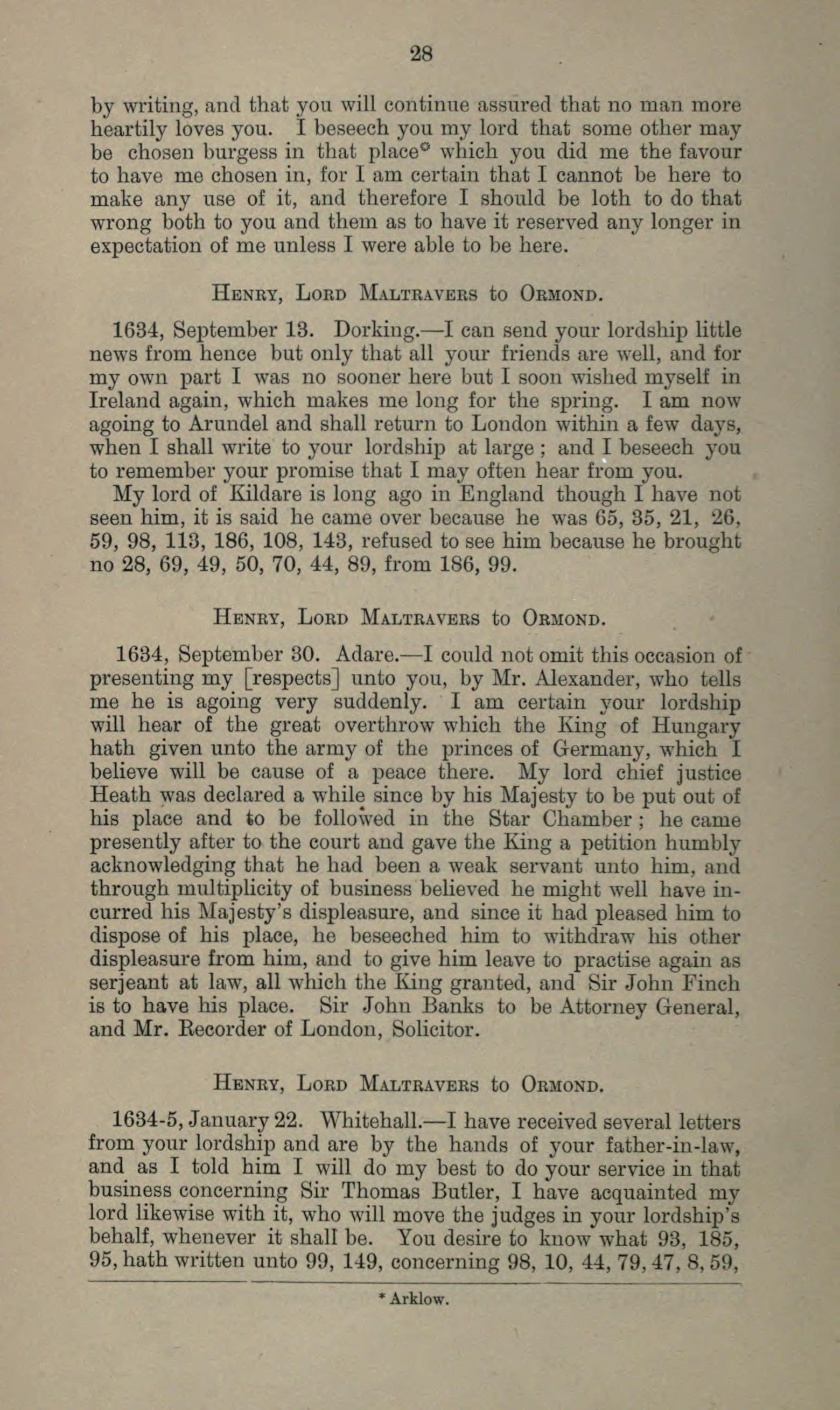
calmarqormonde01greauoft).13 Sept 1634: ...he came over because he was 65, 35, 21, 26, 59, 98, 113, 186, 108, 143, refused to see him
because he brought no 28, 69, 49, 50, 70, 44, 89, from 186, 99.
22 Jan 1634/5: You desire to know what 93, 185, 95, hath written unto 99, 149, concerning 98, 10, 44, 79, 47, 8, 59,
for whom 270 thus hereafter ... 95, 186, 98 hath written unto 98, 218, 97 much in praise of 100, 174,
103 in general, and particularly for his good carriage in 111, 95, 221, and upon his motion 93, 31,
174 99 is to be 64, 99, 11, 79, 85, 35, 12, 69, 28, 29, 79, 44, in which courses 174 shall do well
to continue.
02 Structure
- Nulls, 91–111. Nine values (93 95 97 98 99 100 103 108 111); seventeen of their eighteen occurrences stand at the edge of a
cipher run or beside a code number —
93 185 95,99 149,95 186 98,98 218 97,100 174 103,111 95 221. Tomokiyo's guess is confirmed: they pad the names. - Nomenclator, 112 and above. 113 143 149 174 185 186 218 221 270, each standing alone; 270 is a code being assigned ("for whom 270 thus hereafter").
- Letters, below 91. The spelled runs contain
49 50,69 70,28 29,11 12— doubled letters written with adjacent figures. Each letter therefore owns a block of consecutive figures, the commonest design of the period (Tomokiyo's survey of Wentworth-circle ciphers notes the same "three or six figures to each letter in regular arrangement").
03 The key
Three cribs fix the grid. "brought no 28 69 49 50 70 44 89" must be letters; "is to be 64 [null] 11 79 85 35 12 69 28 29 79 44"
gives a councellor; "concerning 10 44 79 47 8 59, for whom 270 thus hereafter" — the man whose fortunes were about to "go worser" in
January 1635 — is Crosby (Sir Piers Crosby, purged from the Irish Council by Wentworth that winter). All three fit one arrangement, and an
exhaustive scan of 42 regular grids (start 1–11, block size 2–4, vowel blocks 2–6) ranks it first by English quadgram score:
| b | c | d | f | g | h | k | l | m | n | p | q | r | s | t | w | x | y | z |
|---|---|---|---|---|---|---|---|---|---|---|---|---|---|---|---|---|---|---|
| 7–9 | 10–12 | 13–15 | 16–18 | 19–21 | 22–24 | 25–27 | 28–30 | 31–33 | 34–36 | 37–39 | 40–42 | 43–45 | 46–48 | 49–51 | 52–54 | 55–57 | 58–60 | 61–63 |
| a | e | i | o | u | nulls | codes |
|---|---|---|---|---|---|---|
| 64–… | …69, 70… | … | 79–… | 85–… | 91–111 | 112 + (names, words) |
Consonants: the nineteen of the 24-letter alphabet (i = j, u = v). Attested figures: b 8 · c 10 11 12 · g 21 · l 28 29 · m 31 · n 35 · r 44 · s 47 · t 49 50 · y 59 · a 64 65 · e 69 70 · o 79 · u 85. The vowel block sizes (five each from 64, or a = 3 and the rest 6) cannot be fixed from this text; 1–6 are unattested.
04 Reading
Red = spelled in cipher · blue = nomenclator code, value inferred from context · nulls dropped
13 September 1634. My lord of Kildare is long ago in England though I have not seen him; it is said he came over because he was angry [113 = with?] [186 = the Lord Deputy]; [143 = the King?] refused to see him because he brought no letters from [186 = the Lord Deputy].
22 January 1634/5. You desire to know what [185] hath written unto [149] concerning Crosby, for whom 270 thus hereafter; of which I can give you no account at all, only by what I hear it is like to go worser with him rather than better. [186 = the Lord Deputy] hath written unto [218] much in praise of [174 = Ormonde] in general, and particularly for his good carriage in [221 = Parliament], and upon his motion [174 = Ormonde] is to be a councellor, in which courses [174 = Ormonde] shall do well to continue.
The history confirms the reading. George FitzGerald, 16th Earl of Kildare, fell out with Wentworth over the Kildare estates during the 1634 Parliament and crossed to England that summer; Sir Piers Crosby, having opposed the Lord Deputy in the same Parliament, was removed from the Irish Council early in 1635; and Ormonde, who had backed Wentworth in the Commons debates, was sworn of the Irish Privy Council in January 1635 — the very month of the second letter. 186 as the Lord Deputy is used three times consistently; 174 as Ormonde ("your lordship") three times; 221 as Parliament follows "his good carriage in". The remaining codes (113, 143, 149, 185, 218) are persons or connectives that the text does not determine.
05 What remains uncertain
- The fourth figure of angry is printed
26, which the grid makes k; r is 43–45. The scan confirms the print, so either Maltravers slipped or the 1895 transcriber misread 44/45. "Angry" is the only word that fitsa n g ? y. 89at the end of letter is either u (a slip for s, if the vowel blocks are six wide) or a null/plural sign (if they are five wide).31(= m) before 174 in "upon his motion 31 174 is to be" is unexplained — perhaps "m[y lord]" begun and abandoned.- The nomenclator values are contextual. A key sheet, if one survives, would be among the Ormonde papers (NLI) or the Arundel papers; neither is online.
06 Method
- OCR of the HMC volume from the Internet Archive; both letters extracted and every figure checked against the page images.
- Regex scan of the whole volume (and the New Series volumes) for other figure runs: the only other ciphers (1644, 1650s) use different keys; no key or decipherment is printed.
- Positional test of 91–111 (edge-of-run statistic) → nulls. Consecutive-figure doublets → block alphabet.
- Cribs from the clear frame and the events of 1634–35; exhaustive scan of regular grids scored by English quadgrams; the crib-derived grid wins.
- For comparison, a simulated-annealing homophonic solver on the 28 letter-figures alone returns quadgram-pleasing nonsense — at this length the structure, not the statistics, carries the solution.
07 Try the key
Figures separated by spaces or commas. Letters decode from the grid; nulls are shown as ·; codes as [n] with the inferred value where there is one.
08 Sources
- HMC, Calendar of the Manuscripts of the Marquess of Ormonde, K.P., preserved at Kilkenny Castle, [old series] vol. i (London, 1895), pp. 28–29; Internet Archive.
- S. Tomokiyo, "Unsolved Historical Ciphers" (cryptiana), and "Ciphers in Early Stuart England before the Civil War" (strafford.htm) for the Wentworth-circle ciphers of the same design.
- C. V. Wedgwood, Thomas Wentworth, First Earl of Strafford (London, 1961), p. 159 (Ormonde sworn of the Council, January 1635); Hugh Kearney, Strafford in Ireland (1959) on Kildare and Crosby.
Analysis scripts and the full ciphertext are in the repository (ormonde/).