01 The records
| DECODE | ASMo b. 4 | Vestigia | Date | What was found |
|---|---|---|---|---|
| R1128 | 1519–20 no. 1 | 1853 | 9 Mar 1519 | Seven lines in the 1519 two-tier cipher, no decipherment. Not read. |
| R1129–R1133 | nos. 3a–7a | 1855–1867 | Apr–May 1519 | Decipherments of 1882 filed as 3b/3c … 7b/7c. Read at the time. |
| R1134 | no. 8a | 1870 | 12 Jun 1519 | 8b, 8c; interlinear on pp. 4–5. Read. |
| R1135 | no. 10a | 1874 | 1519 | Interlinear gloss on the leaf and 10b. Read. |
| R1136 | no. 11 | 1876 | 8 Mar 1520 | Twelve lines in the 1520–21 sign cipher, no decipherment. Read in part here. |
| R1137 | Cistarelli no. 3 | 1904 | 25 Jul 1520 | Figure cipher, 584 two-digit groups. Fragments only. |
| R1138 | 1520–21 no. 10 | 1919 | 16 Feb 1521 | Deciphered by W. Somogyi (2025). |
| R1139 | no. 13 | 1922 | 6 Apr 1521 | Nine lines of the sign cipher on a slip. Read in part here. |
The same cipher is also in the 1521 file outside DECODE: the second version of the 16 February postscript (no. 11, Vestigia 1920), which Somogyi also printed, and phrases set inside the clear text of no. 12 (25 February 1521).
02 The key
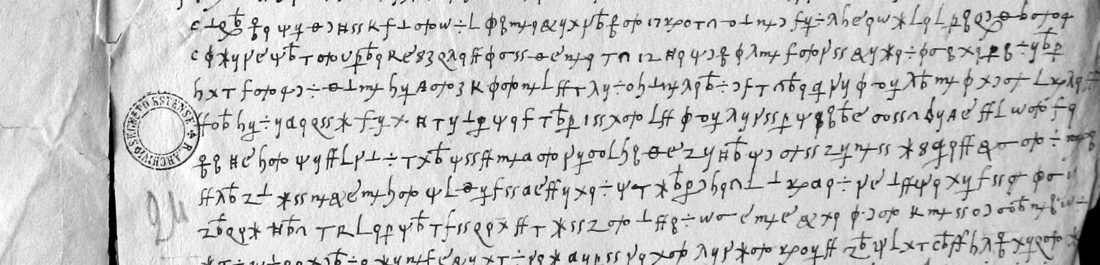
The 1520–21 cipher is a run of invented signs with no word division: φ, ψ, λ, ÷, ss, ff, a crossed b, m and n with a cross, an inverted T, and some forty more. There are 49 labels in all, over 2,278 signs in five texts, transcribed from the DECODE and Vestigia images. Somogyi calls it homophonic, and it is. The key was built in two steps:
- A ciphertext-only solver run (simulated annealing) over all five texts, scored with a sixteenth-century Italian n-gram model. It gave a rough key in which scritti, regno, signore and Ungaria could already be recognised.
- That key seeded a monotone alignment (Viterbi with gaps, re-estimated until stable) of the transcription against Somogyi’s two texts. 714 letters align, and 90% of alignments agree with the majority value of their sign.
The values:
a = q, T, ⊥ · c = φ, θ · d = ψ, r · e = y, ss · g = w, u · i = ƀ, ɔ, L · l = ff, n · m = z, Ħ · n = ÷, p · o = ɛ, the stacked q/b, oσo · p = & and its looped variant · r = *, x · s = m+, n+ · t = h, f · u = λ, a
A lone o between letters is usually a null. So, in one place, is the figure 8.
03 R1139, 6 April 1521 (partial)
A slip pasted into the letter of 6 April. Nine lines of cipher, then the clear text “Expettamo sino a S. Georgio…”. The phrases the key gives with confidence (grade C):
Post: il custode … io scrissi … è tornato governator de[l] … ogni cosa … è tenuto Agria … in castello … la venuta … in Italia … li scritti … vedendo io … deli danari del suo … come mi disse … lui m’ha resposto dice de voler andar in Italia quando al dare … Milan … parlaremo a longo sopra ciò … per andar … el mi dirà …
It is the estate business of Somogyi’s article: the keeper (custode) and the governor of Eger, “the money of his” (the late bishop’s), and someone who says he wants to go to Italy.
04 R1136, 8 March 1520 (partial)
Twelve lines after a clear opening, written the day after Ippolito crossed out of Hungary for the last time (7 March 1520). Grades C and M:
e la susseguente matina … il custode … questo episcopato … il custode … governator … Lactantio … tesoro … in gran … conclusi … congrega[tione] … ogni episcopa[to] … in questo modo … poco spensi … Excellentia … al custode … de Ungaria sopra il suo … secondo … tornato … intendere … [s]pensier suo … tal debito
05 What stays open
- The rest of R1139 and R1136. The transcription is a single pass over small, crowded signs, and mis-transcribed signs leave most letters between the quoted phrases wrong. A second transcription of the images, checked against the key, would go most of the way to a full text. The mechanical decrypt is in
decrypt21_raw.txt. - R1128 (9 March 1519). Attempted, not decrypted. The 1519 system was worked out on R1133 against its 1882 decipherment. Each column, a small sign over a base sign, is one plaintext letter with homophones: “oratore” = L/7 -/n u/7 x/7 c/7 m/n -/a, and c/7 = o, m/n = r, x/7 = t hold across the page. Each bracket-L sign stands for a whole word: the run [d][s][&] recurs where the decipherment has “de vostra maesta”. The 1519 letters are copies of reports to the King of France on the imperial election. A fifth of R1128 is code words, and only nine letter values are secure, so a language-model search gives nothing readable. Its clear part and Caprile’s next letter (“In un’altra mia ve mandai in zifra…”) say it concerned his own lawsuit at Rome. A second, careful transcription of R1133 and another 1882-paired letter would fill the table.
- R1137 (Cistarelli, 25 July 1520). Two-digit groups, nearly all ending in 5 or 0, and 83 other signs, mixed with clear Italian. A ciphertext-only anneal settles part of the key (e = 0, 25; a = 86; o = 70; i = 45; t = 95; r = 85; s = 90; n = 65) and phrases such as “lettere per”, “presto”, “saria meglio”, “non se poteria” and “dua milla” (grade M). These fragments are not a decipherment.
06 Sources
- Archivio di Stato di Modena, Archivio Segreto Estense, Cancelleria, Carteggio ambasciatori, Ungheria b. 4. Images via DECODE R1128–R1139 (login) and Vestigia (vestigia.hu), items 1853–1876 and 1904–1922.
- ASMo inventory, Carteggio ambasciatori, Ungheria (PDF), on the 1882 decipherments.
- Judit W. Somogyi, “Estei Hippolit püspöki hagyatéka Giuliano Caprili magyarországi leveleinek tükrében”, Scriptorium VI (2025) 247–264 (REAL), n. 50: the decipherments of the 16 February 1521 postscript used as the crib.
Transcriptions, key, alignment scripts and notes: caprile1519/ in the repository.