01 The documents
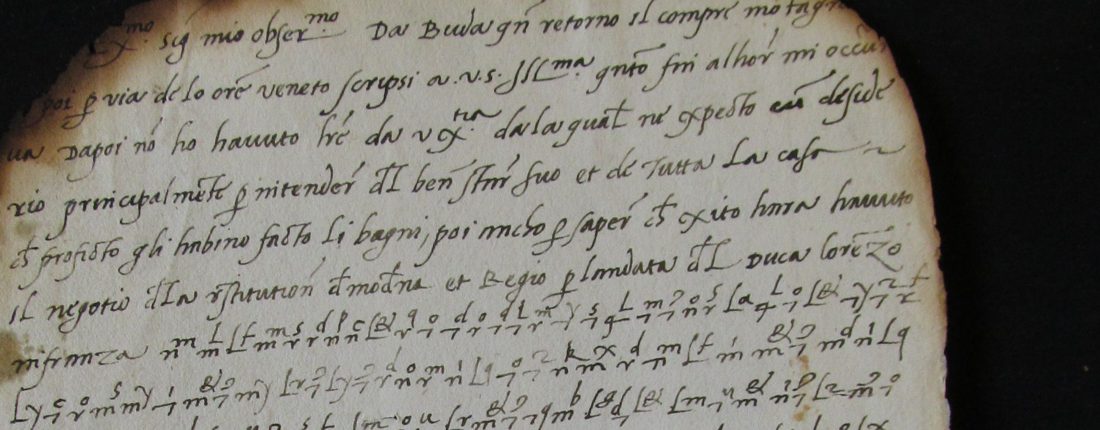
| DECODE | ASMo no. | Date, place | Cipher |
|---|---|---|---|
| R1126 | Fantini no. 5 (Vestigia 1849) | [spring 1518?], Buda. Vestigia and DECODE give “1517”, the file year | p. 1 after six clear lines (18 lines) and all of p. 2 (25 lines): 1,370 columns; pp. 3–6 clear |
| R1127 | Fantini no. 6 (Vestigia 1851) | 6 March 1518, Eger (“Agria”) | five short lines, about 46 columns, in a torn and faded leaf |
The letters are addressed to a lord styled “Vostra Signoria Illustrissima” and “Vostra Eccellenza”, most likely Duke Alfonso I. The clear opening of no. 5 asks for news of the restitution of Modena and Reggio and of Lorenzo de’ Medici’s journey to France. The clear pages 3–6 report the Hungarian diet and the governors appointed around the young Louis II. They continue the letter; they are not a decipherment. Fantini’s other letters (nos. 1–4 and 7, 1515–1518) are in clear.
02 The cipher
Each unit is a base stroke written on the line (shapes like 7, m, n, g, y, 4, t, a) with a small sign written above it (o, 2, 1, b, &, c, L, s, d, 9 …), or an L-shaped bracket enclosing a small sign. The transcription (t1126.txt) counts 1,370 columns: 167 distinct forms, 299 of them brackets (22%) with 22 different inner signs. The commonest columns are 2/7 (77), -/7 (63), o/7 (60), -/y (47), -/g (46) and &/m (44).
Caprile’s letters of 1519 use the same kind of script. His letter of 1 May 1519 (DECODE R1130) mixes clear sentences with short cipher runs, and the 1882 archivist’s decipherment (Vestigia 1860, “4c”) covers them. Aligned by hand, the runs decrypt as syllables. intertenere is seven columns, y/7 9/7 [y] c/7 [y] z/m [m]: i, n, te, r, te, ne, re. The same opening recurs in intertenerlo and in che termine. oratore is o [ra] [to] [re], twice. In that key base 7 carries no vowel, m gives e and n gives o. Tested on stretches not used to build it, the values placed 16 of 18 letters in the true text, against 8.1 on average for shuffled text.
03 What was tried
- Siblings, clear pages, print. All seven Fantini letters on Vestigia. Bonzagni’s letters of 1512–14, the other Este–Hungary cipher, use a different, simple alphabet. DECODE has no key record from Modena for 1490–1540, and nothing turned up in print.
- Caprile’s key. Three pairings with the 1882 decipherments. R1131 is water-stained, and its alignment was no better than shuffled controls. R1134’s supposed interlinear decipherment is a second letter in clear with cipher insertions. R1130 gave the syllabic structure and about twenty values.
- A syllabary annealer (
syl_anneal.py: consonant for each upper sign, vowel for each base, a syllable for each bracket, scored with a sixteenth-century Italian 5-gram model). On a control of 2,200 letters from sixteenth-century Italian, enciphered in the same structure with two homophones per consonant, it recovers the text almost word for word once three base values are fixed. It still does so with 10% of the signs corrupted. - On Fantini, eight restarts of 150,000 moves each, on the raw transcription and with the frequent pairs -/7 -/y and -/7 -/g merged as ligatures. The result is Italian-looking syllable salad that differs from restart to restart, scoring −2.37 per letter against −1.77 for the control’s true key. Seeding Caprile’s values drops the score from about −140 to −1,250.
The solver recovers the syllabic control at this length and noise, so the search itself is sound. A later check read Fantini’s roughly 290 brackets as word codes, as they are in Caprile’s letter R1133. A control of that shape recovers only 7% of its text, so a ciphertext-only attack cannot decipher this letter at any transcription quality. Fantini’s key is not Caprile’s.
04 What would finish it
- A key or decipherment in the Este chancery (ASMo, Cancelleria, Cifrari), or a letter to or from Fantini with its decipherment.
- A better image of R1126 from ASMo for the faint upper signs. Page 1 was transcribed twice (90% agreement) and page 2 three times, with an estimated error of 2–3%; the pairing of small signs to bases is sometimes doubtful.
- R1127 is too short and too damaged to attack on its own.
05 Sources
- DECODE R1126 (images P1–P6) and R1127 (P1–P4); images not public domain, used for study only.
- Vestigia, 1849 and 1851; Fantini’s whole file 1846–1852.
- Caprile’s 1519 letters and their 1882 decipherments: see the Caprile write-up.
Transcriptions, the annealer, the control and every run are in the repository folder jantini1517/.