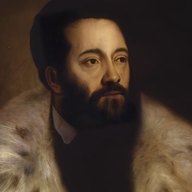
At a glanceKnown key applied · partial (81% of the cipher)
- The letter
- Giovanni Antonio Bilia, the Duke of Milan’s agent with Charles V, to Francesco II Sforza, Burgos, 22 November 1527. One page wholly in cipher, seven more cipher lines, then a clear close, a postscript and the signature.
- Where
- Bibliothèque nationale de France, Français 3013 no. 43, ff. 102r–v (Gallica views 164–167). Catalogue item 291, part. No DECODE record.
- The cipher
- The Sforza chancery’s syllabic cipher: barred letters with two-digit numbers for syllables, numbers and signs for letters, a few words and names, and nulls.
- How it was deciphered
- With the Milan key sheet DECODE R5258, docketed “Cum equite Bilie”, Bilia’s own key. The transcription is by AI and has not been checked by a person; here the project’s own copy of the key was applied to it, the key sheet and the page were compared by eye, and a language model scored it against shuffled keys.
- What it says
- Bilia dined with an old lord who complained that the Duke was troubling a “conte [?Theophimo]”; Bilia calmed him and asks the Duke to write a letter of guarantee “per non desperarlo in questa sua [?vechieza]”.
- Still open
- The seven cipher lines of f. 102v; the name code B.58; about 28 doubtful signs on f. 102r. The letter no. 42 to the ambassador Taverna, same day, is in another cipher.
- Credit
- Transcription and reading by Harumi-Matsuba (issue #55, 20 October 2026), made with Claude and OpenAI Codex. Key values from this project’s transcription of R5258 and George Lasry’s independent recovery of the same key.
01 The letter
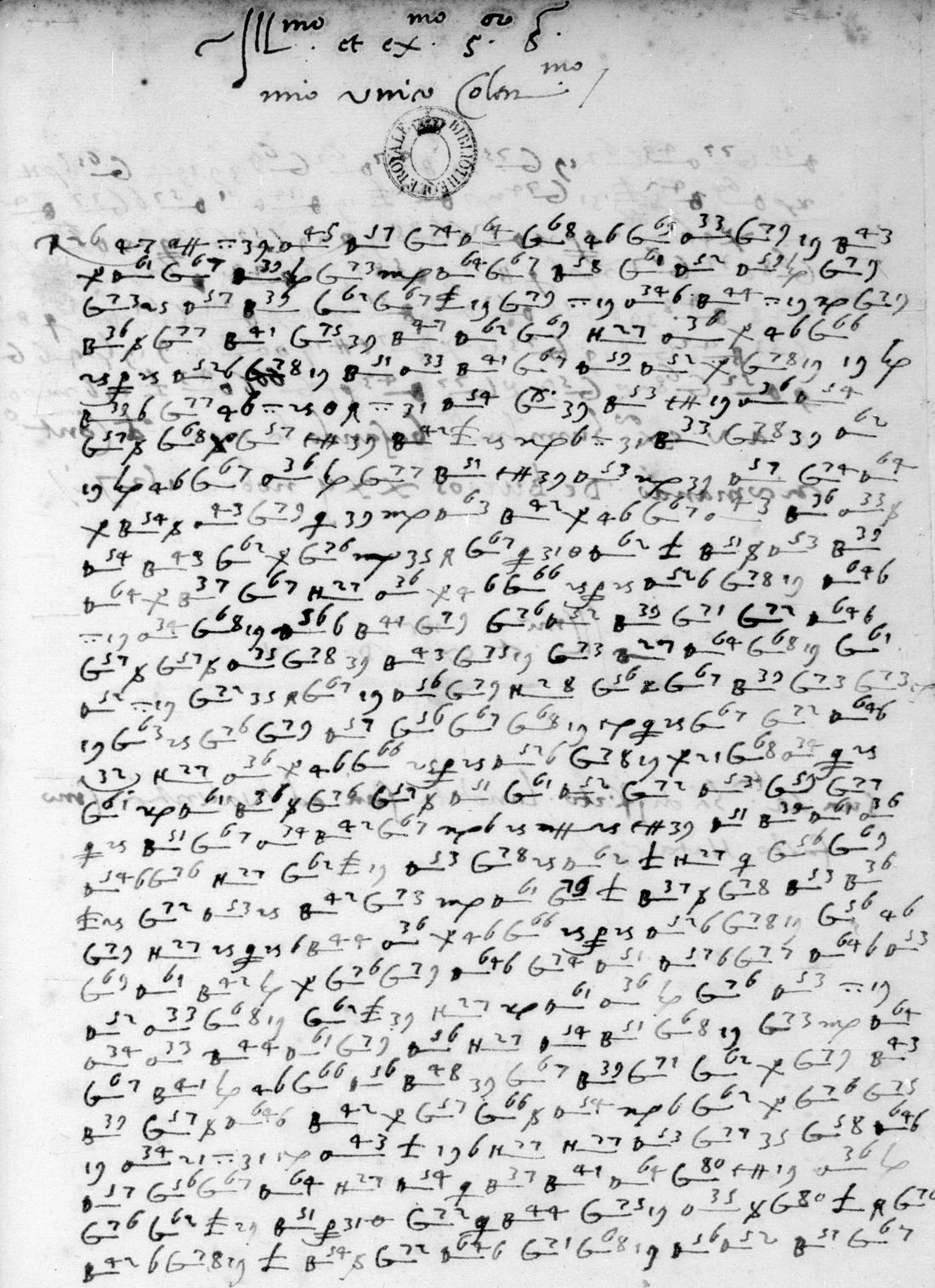
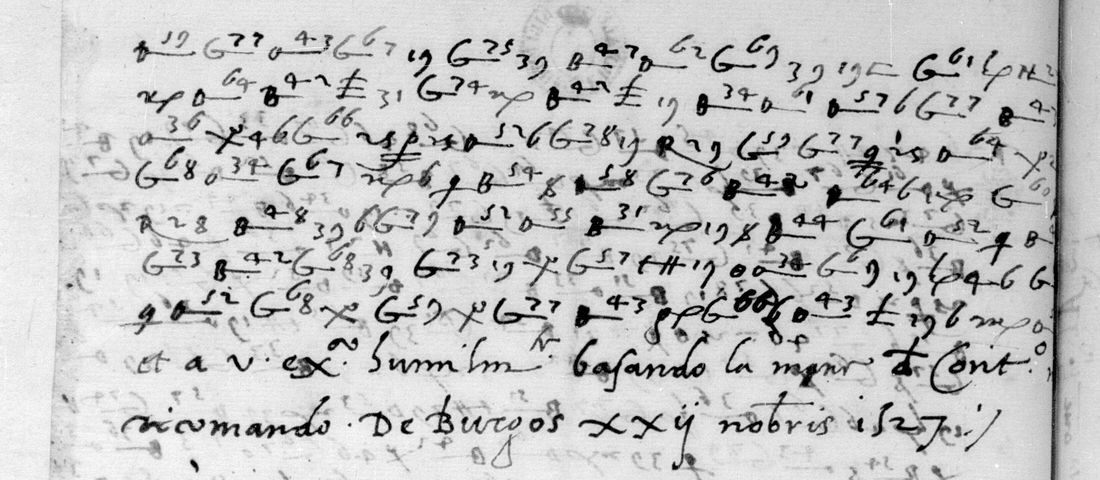
The volume Français 3013 gathers original letters of the sixteenth century. Its no. 43 is a letter of Giovanni Antonio Bilia, the “Cavaliere Bilia”, one of the Sforza agents at Charles V’s court, to Francesco II Sforza, Duke of Milan. The first leaf is entirely in cipher. The verso has seven more lines of cipher, then in clear: “et a v. ex.a humilm.te basando la mano di cont.o ricomando. De Burgos XXII nobris 1527”, the postscript “Sua M.ta ha disposito l’andata sua ad Valentia como facto Natale” and the signature “Humill.mus servus Jo. Ant.s Bilia”.
No. 42 of the same volume, Bilia to Jo. Francesco Taverna (“Zaberna” in the catalogue), the Duke’s ambassador, written the same day, is in a different cipher: base letters M, A, H, R, B and others with numbers 1–29, mixed with clear Italian. Neither R5258 nor Bilia’s other key R5237 fits it, so it is not part of this page and stays in the catalogue.
02 The key
The key is a sheet in the Archivio di Stato di Milano, Carteggio Sforzesco cart. 1591 no. 24, on DECODE as R5258. Its docket reads “Cum equite Bilie / extracta ex cifris”: the cipher used with the Cavaliere Bilia, copied out of the ciphers. The same sheet reads “el Gilino”’s letter of 15 September 1527, a different correspondent with its own page, where the sheet is transcribed; George Lasry recovered the same key independently from that letter.
Syllables are written as a barred base letter with a number above: B.31–50 ba…gu, B.51–55 fa…fu, D.51–65 la…nu, G.56–80 pa…tu, o.33–47 va…zu. Single letters have several signs each (a = 19 or θ-like forms, e = 25, n = 6 or 36, s = 45 or a crossed x, t = 46). A few words have their own signs (H.27 che, H.28 come, R.23 con), names have codes in a separate block, and some signs are nulls. The contributor added values for five signs that are not on the sheet as transcribed here: ß = r, £ = l, F = c, tt = t, qx = ss (41 signs, 8.1% of the page), from the sense of the letter.
03 The reading of f. 102r
Harumi-Matsuba’s reading, put into running sentences here (texts/f102r_reading.md): [?word] a doubtful word or a correction the contributor suggests, [x] supplied letters, [B.58] the unread name code. Their transcription was made by Claude Opus 5.5 and cross-checked by AI only.
Hozi ce sono ritrovato a disnare col signore [B.58] [?pu] [?le] molto; si è meco querelato, havendo hauto carte da suo
genero, che vostra ecelentia fa [?va] dare molestia al conte [?Theophimo] suo [?figlio] [?tavolo] per rispeto dele
inhibitione altre volte fatoli. Gi[à] me sono sforzato con ogni destreza cavarlo di questa imprecione el farli
conoscere che vostra ecelentia non haveria mandato tale cosa se non per [?servitio] di sua signoria, quale ha sempre
amato come [?padre]; cosi si aquietato. Me pareria essere [?bene], se non che vostra ecelentia scrivesse qua [?una] carta
por la quale se li potesse fare vedere in [?effetto] la con a [?volonta] che quela li tiene, el che con parole se li è
designato, l certifi[ca]to che, essendo vostra ecelentia patrona del stato, non solamente non li levaria quelo che una
volta li haveva donato, [?vo] che lo faria signore d'altra magiore cosa. Questo dico per non desperarlo in questa sua
[?vechieza], lanche che li [?tempi] non me pareno che lo concedano; tutavolta quel [?] facio secondo sua virtu l
prudentia; al forse non saria male fare …
In English, roughly: today Bilia dined with a lord (name code B.58) who complained bitterly that, according to letters from his son-in-law, the Duke was troubling “conte Theophimo” over prohibitions made earlier. Bilia talked him out of it, explaining that the Duke would not have sent such an order except for his good, having always loved him like a father. He suggests the Duke write a letter guaranteeing that, as master of the state, he would not take back what he had once given but would make him lord of something greater, “so as not to drive him to despair in his old age”, though the times hardly allow it. The text runs on to f. 102v.
04 The checks made here
The project’s own key. The contributor’s sign transcription was decoded again with the project’s files for R5258 (targets/gilino1527), mapping their sign names onto ours. Our key gives a value to 459 of the 505 signs; where both keys give one, 440 of 459 agree (95.9%). The 19 that differ are the crossed x (null in our Gilino key, s for the contributor), the θ-like sign (a for us, o for them) and one plain o sign. On the image of the R5258 sheet the crossed x stands in the s column and the θ-like sign in the o column, so the contributor follows the sheet and our Gilino values for these signs were guesses from context. The other 45 signs are their five added signs, two nulls, a sign they read as a cursive 25, the name code and one unreadable digit.
Against chance. Scored with the project’s Italian model (it-cinquecento, order 5, letters only), our decode gives −2.18 per character; 1000 shuffles of the same values over the same signs give at best −3.11, and none reaches the real key. The decode reads as Italian from the first line to the last.
The page itself. Lines 1–5 of f. 102r (81 signs) were compared sign by sign with the full-size image: every sign name agrees. At three places the second digit of a number (39 or 33, 69 or 65) cannot be told apart at this resolution, and the transcription follows the sense. No person, on either side, has checked the rest of the transcription.
How much reads. 504 of the 505 signs of f. 102r have a value. Counting the signs inside the readings the contributor marks as doubtful, roughly 94% of the page gives sense (an estimate, not a measurement). Measured on the reading in October 2026, f. 102r builds coherent sentences but reads at 92.2%, under the 95% bar. With f. 102v not deciphered, the letter as a whole is partial.
05 What remains
- f. 102v, seven cipher lines (118 signs). With our key 102 of them have a value and some words appear (“a suo genero”, “vostra ecelentia”, “con desiderio si aspetta”, “con le risposte di”), but there is no continuous sense, and the margin over shuffled keys is thin (−2.60 against −2.75): decoded, not read (reading audit, 22 October 2026). On 23 October the transcription was checked line by line on the full-size Gallica view 165 and decoded again: four signs (R.29, 8?, an open rectangle, o.19) have no value on the key sheet and three more (£, φ, mp) only the contributor’s context values, and the last one or two signs of every line curve into the binding of the microfilm. No decipherment or copy of the letter is known. The partial text is
f102v_partial_reading.md. - B.58, the code of the old lord, is not on the R5258 sheet (its name block has B.55 Imperatore, B.56 Sua Maestà, B.57 Nassau, B.60, B.62, B.63, B.66, B.71, but no B.58).
- About 28 doubtful signs on f. 102r: eight places where the two AI image checks disagreed, the name “Theophimo”, the slips or misreadings pervitio, papre, ina, tompi, vechilza, the sign £ read as l where et may be meant, and one digit lost (B.3?).
- Print. Neither the contributor nor this project has seen Cerioni’s 1970 edition of the Sforza keys or Giudici 2018.
- No. 42, to Taverna, in another cipher with no key yet.
Full texts
The transcription and the decryption of every document on this page, so that the reading can be used and checked. Short files are shown here; all are in the repository.
f. 102r (30 cipher lines) read in part
Bilia dined with an old lord (name code B.58) who complained that, by letters from his son-in-law, the Duke was troubling conte Theophimo(?) over earlier prohibitions; Bilia calmed him and advises the Duke to write a letter showing in deed the good will promised in words. Harumi-Matsuba's reading (contributed/) and this project's independent decode with its own R5258 key (decoded_ours_f102r.txt) are given separately.
Builds coherent sentences, but under the read bar of 95% of words read as sense (92% here); the holes are marked in the reading.
Transcription
# BnF Français 3013 no. 43, f. 102r (Gallica ark:/12148/btv1b9060138r, view 164). Jo. Antonio Bilia to Francesco II Sforza, Duke of Milan, Burgos, 22 Nov 1527.
# Transcription by Claude Opus 5.5 from the full-size image, revised at 20 places where two independent image checks (OpenAI Codex and Claude Sonnet) agreed (check/).
# Symbol names: G.nn / B.nn / o.nn / H.nn / R.nn = base letter with a bar and a two-digit number above; bare numbers (19, 25 …); see docs/METHOD.md.
# 記号名の説明は docs/METHOD.md。人は書き起こしを確かめていない。
102r.01 R~ 6 47 a++ ÷ 39 o.45 B.37 G.74 o.64 G.68 46 G.69 o.33 G.79 19 B.43
102r.02 x o.61 G.67 B.39 φ G.73 mp o.64 G.67 B.58? G.60? o.52 o.59 φ G.79
102r.03 G.73 as o.57 B.39 G.62 G.67 £ 19 G.79 ÷ 19 o.34 6 B.44 ÷ 19 3p G.79
102r.04 B.36 ß G.77 B.41 G.75 39 B.47 o.62 G.69 H.27 o.36 x 46 G.66
102r.05 25 F 25 o.52 6 G.78 19 B.51? o.33 B.41 G.67 o.59 o.52 x G.78 19 19 φ
102r.06 B.39 6 G.77 46 ÷ 25 o R ÷ 31 o.59 G.75 39 B.53 tt 19 o.36? o.54
102r.07 G.57 ß G.68 xo G.57 tt 39 B.42 £ 25 np 6 ÷ 31 B.33 G.78 39 o.62
102r.08 19 φ 46 G.67 o.36 φ G.77 B.51 tt 39 o.53 mp 31 o.57 G.74 o.64
102r.09 x B.54 ß o.43 G.79 q 39 mp o.63 B.42 x 46 G.67 o.43 B.36 o.33 ß
102r.10 o.54 B.43 G.62 x G.76 np 35 R G.67 F 31 θ o.62 £ B.51 ß o.53 B.39
102r.11 o.64 x B.37 G.67 H.27 o.36 x 46 G.66 25 F 25 o.52 6 G.78 19 o.64 6
102r.12 ÷ 19 o.34 G.68 19 o.56 6 B.44? G.79 G.76 o.52 B.39 G.71 G.72 o.64 6
102r.13 G.57 ß G.57 ß o.35 G.78 39 B.43 G.75 19 G.73 B.27 o.64 G.68 19 G.61
102r.14 o.52 ÷ 19 G.72 35 R G.67 19 o.56 G.79 H.28 G.56 R G.67 B.39 G.73 G.73
102r.15 19 G.63 25 G.76 G.79 o.57 G.56 G.67 G.68 19 r7 qx 25 G.67 G.72 o.64 6
102r.16 (32) H.27 o.36 x 46 G.66 25 F 25 o.52 6 G.78 19 x 21 G.68 o.34 qx 25
102r.17 G.61 np o.61 B.36 ß G.76 G.59 ß o.51 G.61 o.52 G.72 o.53 G.59 G.77
102r.18 qx 25 B.51 G.67 o.34 B.42 G.67 np 6 25 a++ 25 tt 39 o.51 B.39 o.61? o.36
102r.19 o.54 6 G.76 H.27 G.62 £ 19 o.53 G.78 25 o.62 £ H.27 q G.56 G.69
102r.20 £ 25? G.72 o.53 25 B.42 G.73 mp o.61 G.79 £ B.37 ß G.78 B.53 B.3?
102r.21 G.79 H.27 25 qx 25 6 B.44 o.36 x 46 G.66 25 F 25 o.52 6 G.78 19 G.56 46
102r.22 G.69 o.61 B.42 φ x G.76 G.79 o.64 6 G.74 o.51 o.57 6 G.77 o.64 6 o.53
102r.23 o.52 o.33 G.68 19 G.62 £ 39 H.27 np o.61 o.36 φ G.76 o.53 ÷ 19
102r.24 o.34 o.33 B.44 o.61 G.79 o.36 H.27 o.54 B.51 G.68 19 G.73 mp o.64
102r.25 G.67 B.41 φ 46 G.66 o.56 B.48 39 G.67 B.39 G.71 G.62 x G.79 B.43
102r.26 B.39 G.57 ß o.64 6 B.42 x G.57 G.66 ß o.54 np 6 G.62 x G.76 G.75
102r.27 19 o.34 21 ÷ 31 φ o.43 £ 19 6 H.27 H.27 o.53 G.79 35 G.58 o.64 6
102r.28 o.57 G.56 G.67 o.64 H.27 o.54 q B.37 B.41 o.64 G.80 tt 19 o.36 φ
102r.29 G.76 G.62 £ 29 B.51 F 31 θ G.72 q B.44 G.75 19 o.35 ß G.80 £ R G.70
102r.30 B.42 6 G.78 19 £ B.54 ß G.72 o.64 6 G.71 G.68 19 o.56 o.52 B.51 G.67
Decryption
# Reading: BnF Français 3013 no. 43, f. 102r

[日本語](READING.md)

Jo. Antonio Bilia to Francesco II Sforza, Duke of Milan, Burgos, 22 November 1527 (date and signature in clear on f. 102v).

**No human has checked the transcription.** It was read from the images by AI. Agreement between AI readers is not a substitute for a human check.

## Conventions
- The sign values given by the key (data/key.tsv) are joined (data/decoded_f102r.txt), and word division and punctuation are added. Spelling follows the values (ecelentia, vechilza …). The manuscript has no word division.
- ( ) = supplied letters or a suggested reading; (?) = uncertain; [ ] = a sign with no known value, or a name code.
- | marks a line break (the number is the line).

## Text (f. 102r, 30 lines, all in cipher)
> [3 nulls] Hozi ce sono ritrovato a di-|2 snare col signore [B.58] pu le(?) molto|3 si è meco querelato, havendo hauto|4 carte da suo genero, che vostra|5 ecelentia fa va(?) dare molestia al|6 conte Theophimo(?) suo fi(glio?) tavolo(?)|7 per rispeto dele inhibitione|8 altre volte fatoli. Gi(à) me sono|9 sforzato con ogni destreza cavar-|10 lo di questa imprecione el farli co-|11 noscere che vostra ecelentia non|12 haveria mandato tale cosa se non|13 per pervitio(=servitio?) di sua signoria, qua-|14 le ha sempre amato come papre(=padre?); cosi si|15 aquietato. Me pareria essere (bene?), se non|16 che vostra ecelentia scrivesse|17 qua ina(=una?) carta por la quale se li pote-|18 sse fare vedere in e[a++]etto(=effetto?) la con a vo-|19 lonta(?) che quela li tiene, el che con paro-|20 le se li è designato, l certifi[ca]-|21 to che, essendo vostra ecelentia pat-|22 rona del stato, non solamente non li|23 levaria quelo che una volta li ha-|24 veva donato, vo(?) che lo faria signo-|25 re d'altra magiore cosa. Questo di-|26 co per non desperarlo in questa su-|27 a vechilza(=vechieza?), lanche che li tompi(=tempi?) non|28 me pareno che lo concedano; tutavol-|29 ta quel g(?) facio secondo sua virtu l pru-|30 dentia; al forse non saria male fare …

(The text runs on to f. 102v, whose reading is unconfirmed and not given here; see [docs/OPEN.en.md](OPEN.en.md).)

- [B.58]: a code in the name section of the key (B.55 onwards); the name has not been read from the key sheet. data/key.tsv gives it the provisional value of D.58 (mi), so data/decoded_f102r.txt shows "mi" here.
- [ca]: B.3? at the end of line 20 (second digit unreadable), taken as B.36 = ca from "certifi[ca]to" (inferred).
- e[a++]etto: a++ is in the null row of the key sheet; here it seems to stand for ff (inferred).

## Summary (partly inferred)
Bilia dined with a person (name code B.58) who complained to him: letters from his son-in-law said that the Duke was troubling "conte Theophimo(?)" on account of earlier prohibitions. Bilia calmed him by explaining that the Duke had acted for his sake and had always loved him as a father. Bilia advises the Duke to write a letter showing in deed the good will promised in words — a guarantee that, as master of the state, the Duke would not only not take back what he once gave, but would make him lord of something greater — so as not to drive the old man to despair, even if the times seem not to allow it.

## Clear text (f. 102v)
> et a v. ex.a humilm.te basando la mano di cont.o ricomando. De Burgos XXII nobris 1527.
> — Ill.mo et ex.mo D. V.ro
> — Sua M.ta ha disposito l'andata sua ad Valentia como facto Natale.
> — Humill.mus servus Jo. Ant.s Bilia
Decryption
102r.01 nhozicesonoritrovatoadi
102r.02 snarecolsignoremipulemolto
102r.03 siemecoquerelatohavendohauto
102r.04 cartedasuogenerochevostra
102r.05 ecelentiafavadaremolestiaal
102r.06 contetheophimosuofitavolo
102r.07 perrispetodeleinhibitione
102r.08 altrevoltefatoligimesono
102r.09 sforzatoconognidestrezacavar
102r.10 lodiquestaimprecionelfarlico
102r.11 noscerechevostraecelentianon
102r.12 haveriamandototalecosasenon
102r.13 perpervitiodisuasignoriaqua
102r.14 lehasempreamatocomepaprecosisi
102r.15 aquietatomepareriaesseresenon
102r.16 chevostraecelentiascrivesse
102r.17 quainacartaporlaqualeselipote
102r.18 ssefarevedereineetolaconavo
102r.19 lontachequelalitienelcheconparo
102r.20 leseliedesignatolcertifi[B.3]
102r.21 tocheessendovostraecelentiapat
102r.22 ronadelstatononsolamentenonli
102r.23 levariaquelocheinavoltaliha
102r.24 vevadonatovochelofariasigno
102r.25 redaltramagiorecosaquestodi
102r.26 copernondesperarloinquestasu
102r.27 avechilzalanchechelitompinon
102r.28 meparenocheloconcedanotutavol
102r.29 taquelgfaciosecondosuavirtulpru
102r.30 dentialforsenonsariamalefare
Decryption
102r.01 [R~]nhozicesonoritrovatoadi
102r.02 narecolsignore[B.58?]pulemolto
102r.03 si[as]mecoquere[£]atohavendohavto
102r.04 ca[ß]tedasuogenerochevotra
102r.05 e[F]elentiafavadaremoletiaal
102r.06 contethezphimosuofi[tt]avolo
102r.07 pe[ß]rispe[tt]ode[£]einhibitione
102r.08 altrevoltefa[tt]oligimesono
102r.09 fo[ß]zatoconognidetrezacava[ß]
102r.10 lodiquetaimpre[F]iane[£]fa[ß]lico
102r.11 nocerechevotrae[F]elentianon
102r.12 haveriamandototalecosasenon
102r.13 pe[ß]pe[ß]vitiodisuasignoriaqua
102r.14 lehasempreamatocomepaprecosisi
102r.15 aquietatomepareriae[qx]eresenon
102r.16 [(32)]chevotrae[F]elentiacrive[qx]e
102r.17 quainaca[ß]tapo[ß]laqualeselipote
102r.18 [qx]efarevedereinee[tt]olaconavo
102r.19 lontacheque[£]alitiene[£]checonparo
102r.20 [£]eseliedesignato[£]ce[ß]tifi[B.3?]
102r.21 tochee[qx]endovotrae[F]elentiapat
102r.22 ronadeltatononsolamentenonli
102r.23 levariaque[£]ocheinavoltaliha
102r.24 vevadonatovochelofariasigno
102r.25 redaltramagiorecosaquetodi
102r.26 cope[ß]nondepera[ß]loinquetasu
102r.27 avechilza[£]anchechelitompinon
102r.28 meparenocheloconcedanotu[tt]avol
102r.29 taque[£]gfa[F]iasecondosuavi[ß]tu[£]pru
102r.30 dentia[£]fo[ß]senonsariamalefare
Reading
<!-- Reading of BnF Français 3013 no. 43, f. 102r (Claude Opus 5.5, 23 Oct 2026): the contributed reading (contributed/docs/READING.en.md, "Text (f. 102r)", built from the key output data/decoded_f102r.txt) put into running sentences: line marks dropped, line-end word splits joined, capitals and punctuation editorial. Spelling is the key's (ecelentia, vechilza ...). Where the contributor suggests a corrected word ("pervitio(=servitio?)") the reading gives [?servitio]; letters the contributor supplies in ( ) are given as [x]; a doubtful word marked (?) is [?word]; [B.58] is an unread name code; the three opening nulls are left out. The whole page is cipher; it runs on to f. 102v (unconfirmed, not given here), whose clear close is given at the end. No human has checked the transcription (contributed/docs/READING.en.md). -->

# Jo. Antonio Bilia to Francesco II Sforza, Burgos, 22 November 1527 (BnF fr. 3013 no. 43, f. 102r)

## Reading

Hozi ce sono ritrovato a disnare col signore [B.58] [?pu] [?le] molto; si è meco querelato, havendo hauto carte da suo
genero, che vostra ecelentia fa [?va] dare molestia al conte [?Theophimo] suo [?figlio] [?tavolo] per rispeto dele
inhibitione altre volte fatoli. Gi[à] me sono sforzato con ogni destreza cavarlo di questa imprecione el farli
conoscere che vostra ecelentia non haveria mandato tale cosa se non per [?servitio] di sua signoria, quale ha sempre
amato come [?padre]; cosi si aquietato. Me pareria essere [?bene], se non che vostra ecelentia scrivesse qua [?una] carta
por la quale se li potesse fare vedere in [?effetto] la con a [?volonta] che quela li tiene, el che con parole se li è
designato, l certifi[ca]to che, essendo vostra ecelentia patrona del stato, non solamente non li levaria quelo che una
volta li haveva donato, [?vo] che lo faria signore d'altra magiore cosa. Questo dico per non desperarlo in questa sua
[?vechieza], lanche che li [?tempi] non me pareno che lo concedano; tutavolta quel [?] facio secondo sua virtu l
prudentia; al forse non saria male fare …

⟨f. 102v, clear:⟩ et a v. ex.a humilm.te basando la mano di cont.o ricomando. De Burgos XXII nobris 1527. Ill.mo et
ex.mo D. V.ro — Sua M.ta ha disposito l'andata sua ad Valentia como facto Natale. — Humill.mus servus Jo. Ant.s Bilia
Translation
<!-- English translation of texts/f102r_reading.md (Claude Opus 5.5, 23 Oct 2026), with the same holes: [?word] = a doubtful or emended word, translated as [?word-in-English]; [B.58] an unread name code; the untranslatable "la con a" and "[?pu] [?le]" kept. The clear close on f. 102v is in ⟨ ⟩. -->

# Jo. Antonio Bilia to Francesco II Sforza, Burgos, 22 November 1527 (BnF fr. 3013 no. 43, f. 102r): English translation

Today I found myself at dinner with Signor [B.58] [?pu] [?le] much; he complained to me, having had letters from his
son-in-law, that Your Excellency [?is having] Count [?Theophimo], his [?son] [?tavolo], troubled on account of the
prohibitions made to him at other times. I have already striven with all skill to draw him out of this impression and
to make him understand that Your Excellency would not have sent such a thing except for the [?service] of His Lordship,
whom you have always loved as a [?father]; so he was calmed. It would seem to me [?good], were it not that Your
Excellency should write here [?a] letter by which he could be shown in [?deed] the la con a [?goodwill] that you bear
him — which has been indicated to him in words — and the assurance that, Your Excellency being mistress of the state,
not only would you not take from him what you had once given him, [?but] you would make him lord of some greater thing.
I say this so as not to drive him to despair in this [?old age] of his, although the [?times] do not seem to me to allow
it; nevertheless I do [?] according to your virtue and prudence; and perhaps it would not be bad to do …

⟨f. 102v, clear:⟩ and I humbly commend myself to Your Excellency, kissing your hand continually. From Burgos, 22
November 1527. Most Illustrious and Most Excellent Lord ... — His Majesty has arranged his journey to Valencia for after
Christmas. — Most humble servant Jo. Antonio Bilia.
f. 102v (7 cipher lines, then clear close, Burgos 22 Nov 1527) decoded, not read
Seven cipher lines continuing the letter, then the clear close dated Burgos 22 November 1527, a clear postscript on the Emperor's journey to Valencia for Christmas, and Bilia's signature. The contributor gave no reading of the cipher lines; this project's decode gives words but no continuous sense.
A mechanical decode with holes in most sentences: shown so that the transcription and the key can be checked and improved, not as a reading.
Transcription
transcription_f102v_unconfirmed.txt
# BnF Français 3013 no. 43, f. 102v (Gallica ark:/12148/btv1b9060138r, view 165). Jo. Antonio Bilia to Francesco II Sforza, Duke of Milan, Burgos, 22 Nov 1527.
# Transcription by Claude Opus 5.5 from the full-size image, revised at 20 places where two independent image checks (OpenAI Codex and Claude Sonnet) agreed (check/).
# Symbol names: G.nn / B.nn / o.nn / H.nn / R.nn = base letter with a bar and a two-digit number above; bare numbers (19, 25 …); see docs/METHOD.md.
# 記号名の説明は docs/METHOD.md。人は書き起こしを確かめていない。
# UNCONFIRMED: the reading of this page is not published (see docs/OPEN.md). 読みは未確定で載せない。
102v.01 o.19? G.77 o.43 G.67 19 G.75 39 B.47 o.62 G.69 39 19 ?{open_rect} G.61 φ H.2?
102v.02 np o.64 B.42 £ 31 G.74 np o B.42 £ 19 B.34 o.61 o.57 6 G.77 B.4?
102v.03 o.36 x 46 G.66 25 F 25 o.52 6 G.78 19 R.29 G.59 G.77 qx 25 o.64 x?
102v.04 G.68 o.34 G.67 np 6 q B.54 ß o.58 G.76 B.42 o.64 6 19 φ? G.60
102v.05 R.28 B.48 39 6 G.79 o.52 o.55 B.31 np 19 ß B.44 G.61 o.52 q B.4?
102v.06 G.73 B.42 G.68 39 G.73 19 x G.57 tt 19 θ o.38? G.69 19 φ 46 6 G.?
102v.07 q o.52 G.68 x G.59 x G.77 B.43 8? φ G.66 o.43 £ 29 6 mp o?
Decryption
102v.01 [o.19?]tezareasuogenerooa[?{open_rect}]qual[H.2?]
102v.02 inode[£]isoizde[£]abonamente[B.4?]
102v.03 votrae[F]elentia[R.29]pote[qx]eno
102v.04 rivereinconfo[ß]mitadenonalpu
102v.05 ancoragiontolelubaia[ß]doqualecon[B.4?]
102v.06 sideriosiape[tt]aaxaroaltn[G.?]
102v.07 conleripotedi[8?]lraza[£]gngz
Reading
# f. 102v, seven cipher lines (BnF fr. 3013 no. 43, Bilia to Francesco II Sforza, Burgos 22 Nov 1527): partial reading, decoded, not read

Rests on: the contributor's sign transcription (`contributed/data/transcription_f102v_unconfirmed.txt`), checked line by
line on Gallica view 165 at full size (4211 x 6046, openapi.bnf.fr IIIF, 23 Oct 2026), decoded with the R5258 key
(`decoded_ours_f102v.txt`; values of the syllable rows: G/6 pa..tu, B ba..gu, D/o 51-65 la..nu, o 33-47 va..zu; crossed
x = s, q = con, np = i). Not a reading: most lines do not build a sentence. `[…]` = unread, `[?word]` = partly
carried, `‹sign›` = a sign with no value on the key sheet.

## Reading

[…] ‹o.19› tezare a suo genero, o a ‹rect› qual […]. Ino de‹£› iso ‹o› de‹£› abonamente […]. Vostra ecelentia ‹R.29›
potesseno […] riverei‹n› conformita de non al pu[…]. Ancora gionto le lubaiardo quale con […] [?desi]derio si
aspetta a xaro a ‹φ› t n […] con le risposte di ‹8?› l raza ‹£› gn ‹mp› […].

## Notes

- Words the figures carry: "a suo genero", "vostra ecelentia", "potesseno", "conformita", "ancora", "si aspetta",
  "con le risposte di". "Tezare" may be the end of a name; "lubaiardo" is not a word.
- Every line runs into the gutter of the microfilm image (view 165): the last one or two signs of lines 1-7 are cut or
  curved into the binding (`[…]` at each line end).
- Signs with no value on the R5258 sheet: R.29, 8?, the open rectangle, o.19, and £ (l or et), φ (l?), mp (g) are
  context values of the contributor.
Key: key.tsv
06 Sources
- Bibliothèque nationale de France, Français 3013, Gallica ark:/12148/btv1b9060138r, views 164 (f. 102r), 165 (f. 102v), 167 (address); no. 42 at views 159, 160, 162.
- Key: Archivio di Stato di Milano, Carteggio Sforzesco cart. 1591 no. 24, DECODE R5258; Bilia’s other key, cart. 1591 no. 3, DECODE R5237. Transcription of R5258 in
targets/gilino1527/; George Lasry’s recovery intargets/gilino1527/lasry/. - Harumi-Matsuba, bilia1527-public (CC BY 4.0 data, MIT code) and issue #55, 20 October 2026: transcription, key table, reading, controls and prior-work check.
- Gilino’s letter in the same key: Gilino to Francesco II Sforza, 15 September 1527.
Files: targets/bilia1527/ in the repository (the contributor’s files in contributed/, the checks in decode_check.py and measure.txt).