
At a glanceAttempted · not deciphered
- The letter
- Niccolò Guidi di Bagno to the Secretariat of State, Paris to Rome, 5 January 1652.
- Where
- Archivio Apostolico Vaticano, Segreteria di Stato, Francia 104, ff. 5r–7v; DECODE R5622.
- The cipher
- Four pages of unseparated decimal figures, with occasional Italian words left clear. Its grouping and values are unknown.
- How it was tried
- The Francia 346 key was tested and excluded by its mandatory
6separator. Images, neighbouring records and print were checked; OCR was too noisy. - Still open
- All four cipher pages. No matching key, clear copy or register decipherment was found online.
01 The letter
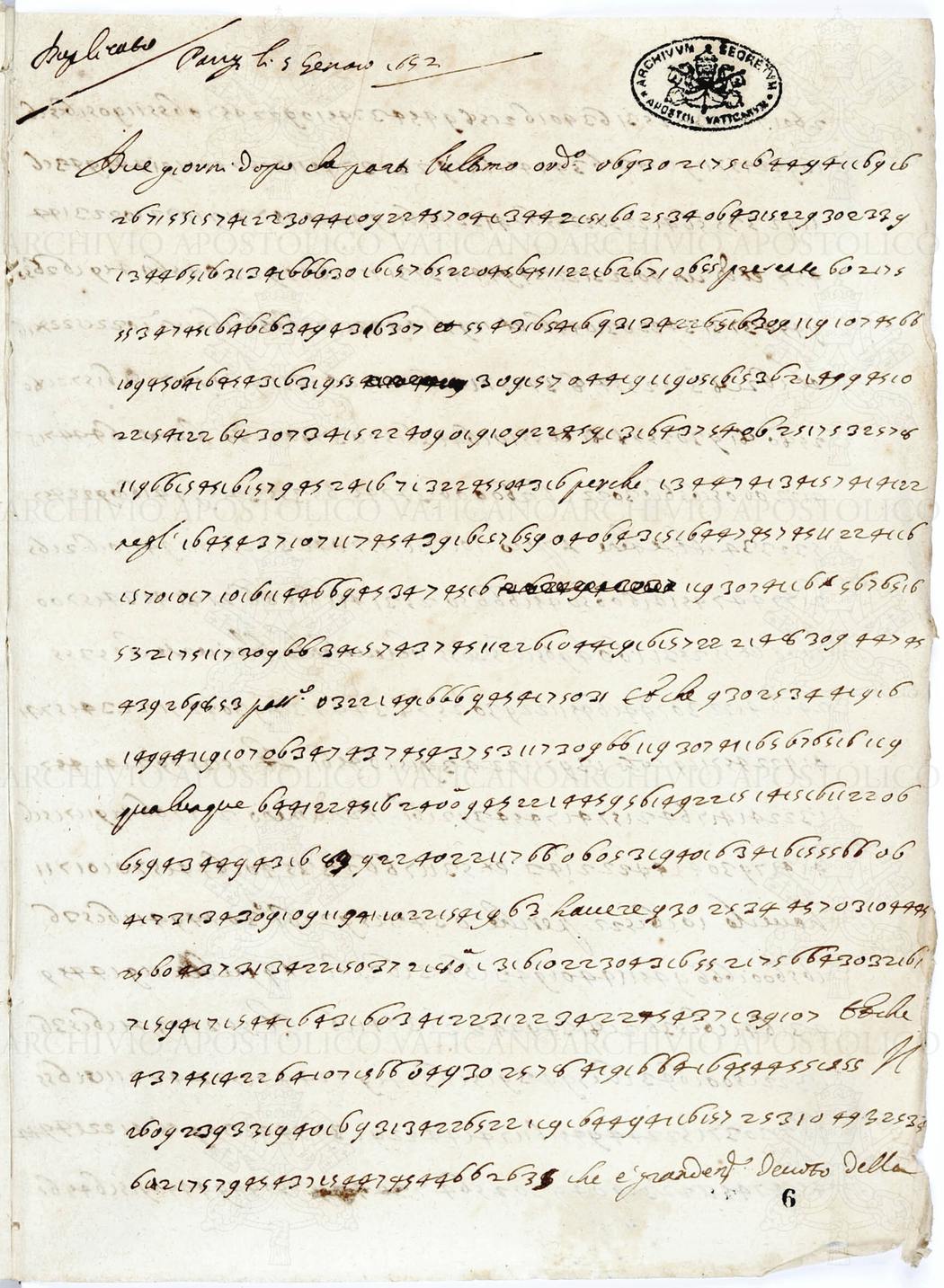
DECODE’s five images are fols. 5r, 6r, 6v, 7r and 7v of Archivio Apostolico Vaticano, Segreteria di Stato, Francia 104. The first leaf gives Paris and 5 January 1652. The next four are dense rows of decimal figures, broken occasionally by clear Italian words such as et, perche, hauerà, huomo and prudenza. The hand is legible, but spaces are inconsistent and the figures sometimes touch.
02 Why the Francia 346 key fails
The reconstructed key used for the 1632 Barberini–Ceva letters in Francia 346 is a mixed-width homophonic and syllabic nomenclator. In it the one-digit figure 6 separates groups and does not occur inside any code. Here, pairs and triples of sixes occur throughout the manuscript. Splitting at every six creates empty separators, orphan digits and groups absent from the table. A checked line passed through the Francia 346 decoder gives malformed groups and no Italian.
This excludes that table whatever the quality of the OCR or the language-model scores. It does not identify the 1652 system.
03 What was searched
- The exact shelfmark and every neighbouring DECODE record: R5617–R5621 are older Francia 32 material; R5623 is Ranuzzi’s 1684–85 correspondence in Francia 173; R5625 onward is Francia 346. None is a clear copy or a same-key sibling.
- DECODE’s document and transcription lists: R5622 has neither an attached document nor a transcription for any image.
- The shelfmark, correspondent, date and route in catalogues and print: no edition of this despatch was located. The published Guidi di Bagno study concerns 1647–50; Neveu’s Acta Nuntiaturae Gallicae 10 concerns the later Ranuzzi material.
- Possible Roman office copies and decifrati: no digitised 1652 register or Paris nunciature key was found.
04 Why there is no transcription
Whole-line OCR, character segmentation and glyph clustering were tried on all four cipher pages. Touching figures, variable spacing, bleed-through and changes in the hand generated too many substitutions and omissions. In a mixed-width nomenclator a dropped or added digit shifts every later group boundary, so a noisy digit stream cannot be used. The OCR output was discarded.
05 What is needed
- A line-by-line manual transcription of ff. 6r–7v, checked independently against the scans.
- The Secretariat’s register decipherment or the Paris nunciature key for 1652, probably requiring work in the AAV.
- Alternatively, more letters from Francia 104 shown to use the same key, giving enough clean material to infer group boundaries and rebuild the nomenclator.
06 Sources
- Archivio Apostolico Vaticano, Segreteria di Stato, Francia 104, ff. 5r–7v, images and metadata via DECODE R5622.
- Julien Régibeau, “Incarner l’idéal du padre comune au milieu de la guerre civile. L’action diplomatique du nonce Niccolò Guidi di Bagno face à Mazarin durant la Fronde” (2021), background on the correspondence of 1647–50 only.
- Barberini to Ceva, 1632, for the Francia 346 table tested and excluded here.
Research notes and machine-readable profile: bagno1652/.