At a glanceKey from adjacent plaintext · partial (96% of the cipher)
- The telegrams
- Four domestic Army telegrams: Chief of the General Staff Ōyama in Osaka to Lieutenant-General Terauchi and to Major-General Fukushima (March 1902); the 12th Division at Kokura to the General Staff, and division commander Inoue, also from Kokura, to the War Minister (January 1904).
- Where
- National Institute for Defense Studies, via JACAR: C09122911500, C09122909900 (General Staff telegram file, 1902), C09123116600 (General Staff, 1904), C03020059400 (Army Ministry 満密大日記, January 1904).
- The cipher
- A coordinate table: the first digit is the vowel row of the syllabary, the second the consonant column counted backwards; 10 is ン.
- How it was solved
- The table was inferred from one telegram’s twelve pairs against the readings pencilled on its outgoing draft, then tested on telegrams found later, one of them with no translation at all.
- Credit
- Harumi-Matsuba, with Claude, Codex and Sonnet (issue #58, kagigo1901-public, October 2026).
- What it says
- “Until I return to Tokyo, please handle the business of the General Staff as you see fit”; “please lend the required maps of Korea”, six days before the Russo-Japanese War began.
- Still open
- C09122909900 enciphers a noun phrase, not prose. In C03020059400 two of the twelve pairs are one digit off the table, and three characters of its filed translation are illegible. Three pairs that are one digit off the translations, probably slips by the writer; a 1901 telegram in another method; which Army cipher this table belongs to. No person has checked the transcriptions.
01 The table
Each kana is two digits. The first gives the vowel, the second the consonant:
| ア 9 | カ 8 | サ 7 | タ 6 | ナ 5 | ハ 4 | マ 3 | ヤ 2 | ラ 1 | ワ 0 | |
|---|---|---|---|---|---|---|---|---|---|---|
| a 0 | ア 09 | カ 08 | サ 07 | タ 06 | ナ 05 | ハ 04 | マ 03 | ヤ 02 | ラ 01 | ワ 00 |
| i 1 | イ 19 | キ 18 | シ 17 | チ 16 | ニ 15 | ヒ 14 | ミ 13 | リ 11 | ||
| u 2 | ウ 29 | ク 28 | ス 27 | ツ 26 | ヌ 25 | フ 24 | ム 23 | ユ 22 | ル 21 | |
| e 3 | エ 39 | ケ 38 | セ 37 | テ 36 | ネ 35 | ヘ 34 | メ 33 | レ 31 | ヱ 30 | |
| o 4 | オ 49 | コ 48 | ソ 47 | ト 46 | ノ 45 | ホ 44 | モ 43 | ヨ 42 | ロ 41 | ヲ 40 |
A voiced kana adds 5 to the first digit and takes the column of its voiced row: ガ 9, ザ 8, ダ 7, バ 6, so ガ = 59, ジ = 68, デ = 37 + 50 = 87, ブ = 76. ン is 10, and a final 80 closes the message. The consonant columns run backwards through the syllabary, from ア at 9 to ワ at 0. The Army’s coordinate ciphers of 1874 and 1894 described on Cryptiana use iroha order instead. The same table is used unchanged from Osaka in March 1902 to Kokura and Moji in January 1904. It may be the Army’s 鑰号 (Yakugō, in use 1901–04) written without its key, or the numeric part of 特号; nothing found so far settles which.
02 The four telegrams
| JACAR | date, route | pairs | reading | check |
|---|---|---|---|---|
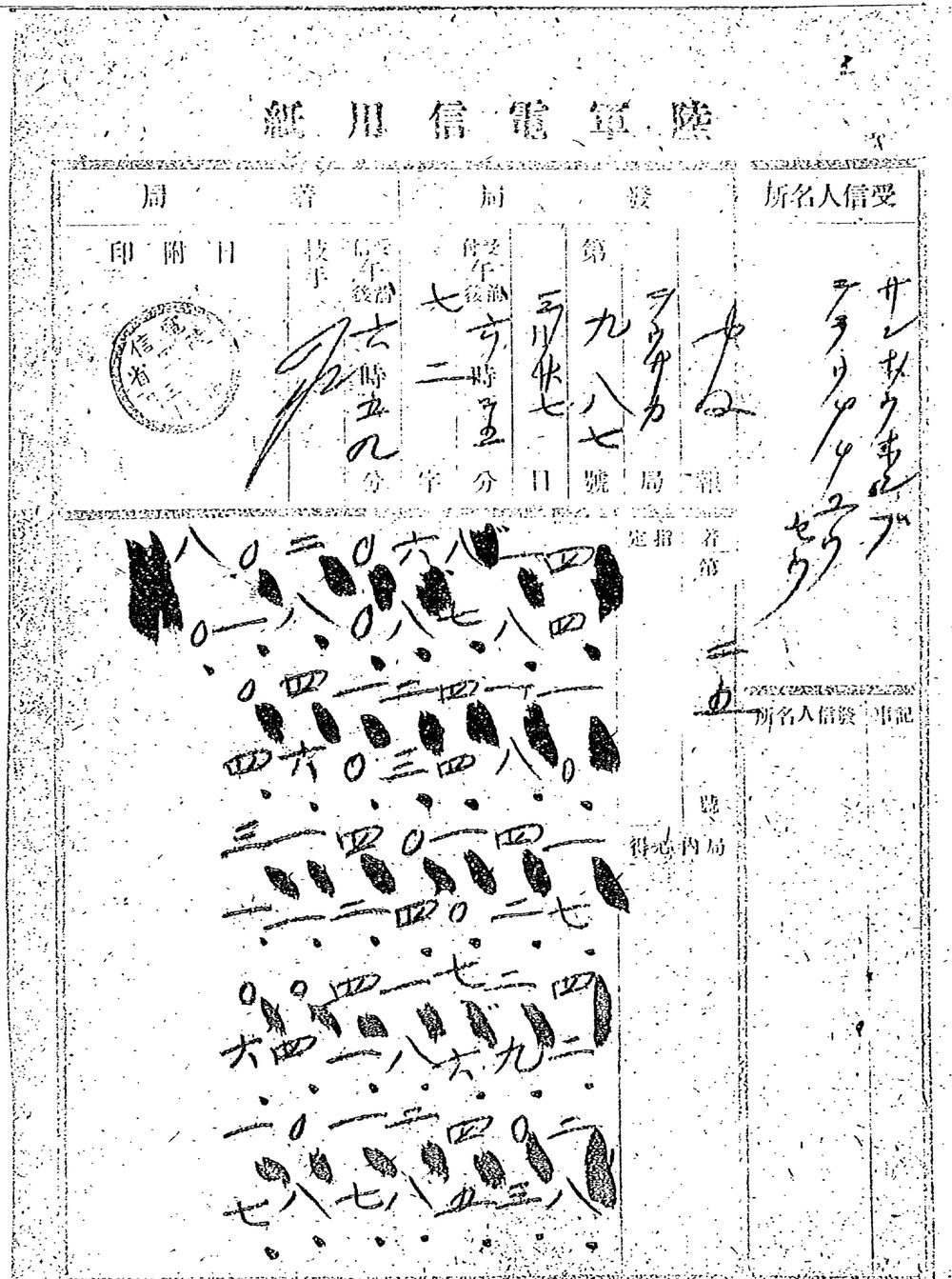
| C09122911500 | 27 Mar 1902, Osaka: Ōyama → Terauchi | 35 + 80 | ホンシヨクキキヨウマデホンブノジムハキクワンヨロシクトリハカラハレタシ | 35/35 with the filed translation |
| C09123116600 | 25 Jan 1904, Kokura → Iguchi, General Staff | 13 | ヨヨウノカンコクチズダイヨ + clear サレタシ | no translation; the reply draft sends maps |
| C09122909900 | 28 Mar 1902, Osaka: Ōyama → Fukushima | 12 | カシグンエンシウケンガク | 11/12 with the draft’s furigana |
| C03020059400 | 18 Jan 1904, Kokura: Inoue → War Minister | 12 | シンテイハクゼウシレイブ | 12/12 with the filed translation (pair 5 04, as Tomokiyo reads the image; ゼウ for 場) |
C09122911500 is the whole telegram: 本職帰京迄本部ノ事務ハ貴官宜シク取計ハレタシ, “until I return to Tokyo, please handle the business of the General Staff as you see fit”. C09122909900, sent the next day, enciphers only カイグンエンシウケンガク, the observation of the naval exercise, inside a clear message granting permission. C03020059400 enciphers only the unit name, 辛碇泊場司令部 (Anchorage Command Shin), with 場 spelt ジウ; the rest of the telegram is in clear kana. On 23 October 2026 the JACAR item turned out to hold the filed contemporary translation (訳文) of the whole telegram on frame 0118: 辛碇泊場司令部ニ要スル下士以下及器具材料ハ門司補給廠支廠長ニ交付済。[…]ノ結了ハ支廠長ヨリ直接報告ノ筈。, “The NCOs and men and the equipment and materials needed by Anchorage Command Shin have been handed over to the head of the Moji branch supply depot. The completion of […] is to be reported directly by the head of the branch depot.” Ten of the twelve pairs agree with it; the telegram is deciphered with the translation carrying the two off-table pairs.
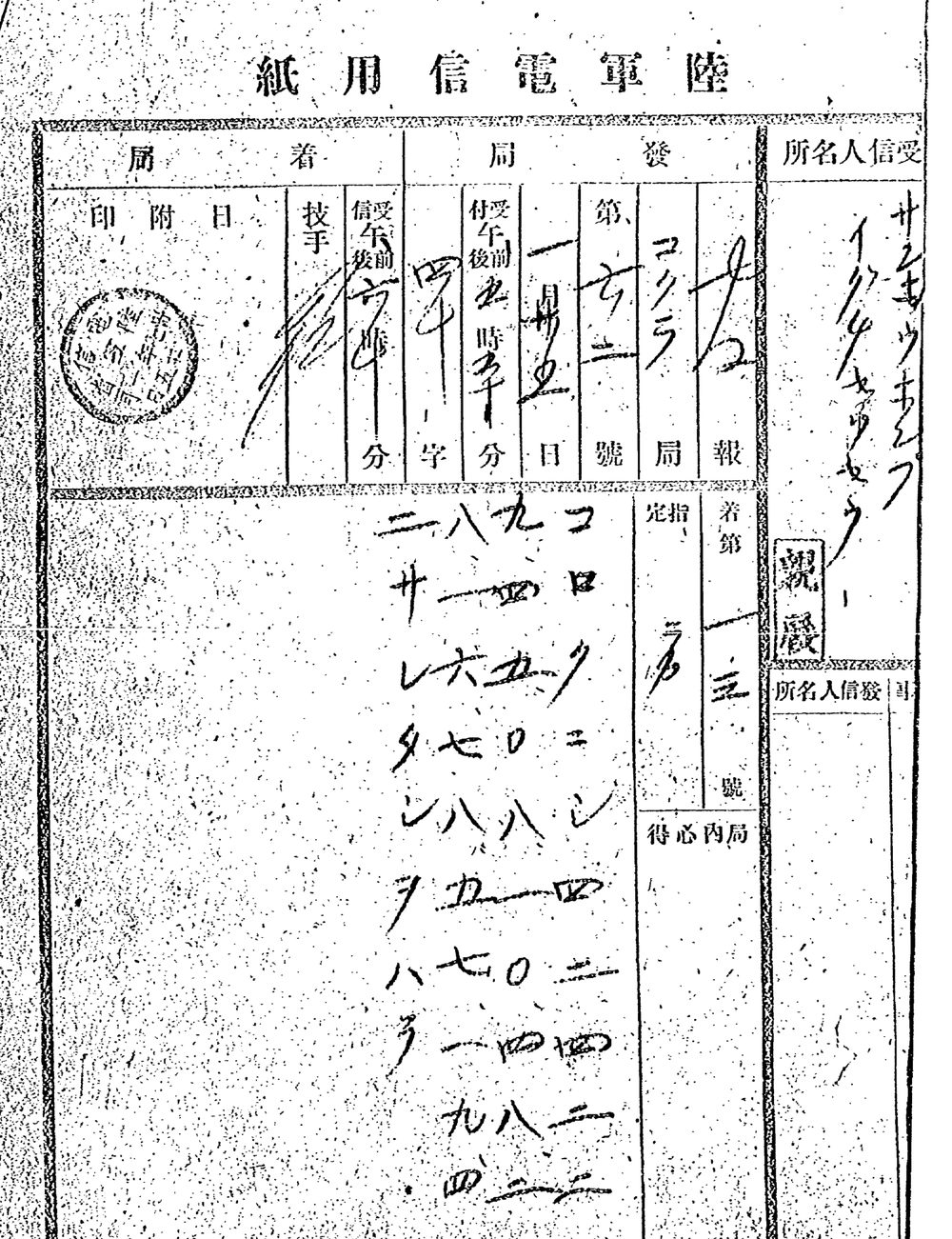
C09123116600 has no translation and is the real test of the table. Its thirteen pairs read ヨヨウノカンコクチズダイヨ, 要用ノ韓国地図貸与, and with the clear サレタシ that follows, “please lend the required maps of Korea”. The reply drafted in Tokyo two days later, in the same file, sends fifty copies of the 1:50,000 map of Korea and twenty of the 1:1,000,000 map of Korea and Manchuria. Two spellings are off: ヨヨウ for ヨウヨウ and ダイヨ for タイヨ. The contributor takes them as the sender’s. The telegram is from 25 January 1904; Japan broke off relations with Russia on 6 February.
03 How the table was found
Harumi-Matsuba’s search began with two telegrams in the General Staff’s 1901–02 files that mix clear kana with runs of digits. The outgoing draft of C09122909900 has furigana on the words that were to be enciphered, カイグン and エンシウ. Against them the twelve pairs show the pattern: ン is 10 three times; the first digit, modulo 5, follows the vowel; it reaches 5 or more only for voiced kana; and ア, カ, サ are 9, 8, 7. The rest of the table follows from that rule. Two telegrams found afterwards then read with it, C09122911500 against its translation and C09123116600 against its reply.
The 35 of 35 is not a wholly independent test. The table’s shape was completed with C09122911500 in view, and the バ column, 6, was fixed from its ブ = 76. The independent test is the Kokura telegram, which was found by searching the catalogue for runs of digits and has only thirteen pairs. A permutation control supports the table: with its row and column digits shuffled, 1,000 tables never come near the real agreement.
A fifth telegram, Hiroshima, 18 February 1901 (C09122806100), has fifteen pairs that this table does not read: the same ニ is written 91 and 69. It uses another method and is not part of this entry. The contributor tried the 1902 table with periodic additives and other rules, and nothing fits.
04 What was checked here
- A decoder was written here from the stated table alone (
decode.py). The four telegrams decode exactly as claimed: 35/35, 11/12, 10/12 (12/12 since 25 October 2026, with pair 5 read 04 after Tomokiyo), and ヨヨウノカンコクチズダイヨ. - Shuffled-digit control, 1,000 tables per telegram: the best scores are 16, 6 and 6, against 35, 11 and 10 for the real table, and no shuffled table reaches the real score.
- The JACAR forms of C09122911500 and C09123116600 were fetched and every digit read against the transcription, column by column: all agree. One glyph of frame 0110 looks like 九 but must be 五, ノ in ホンブノ, as the contributor reads it.
- One discrepancy inside the contributor’s repository. Its
data/transcription.txtandtelegrams.tsvgive the Osaka telegram as 34 pairs, without the second 18, reading ホンシヨクキヨウ. Its README and READING give 35 pairs, with キキヨウ = 帰京. The form shows 一八一八 at the head of the second column, and 35 pairs and the 80 make the 72 characters counted on the form, so the 35-pair version is right. - C09122909900 was not re-read here. The contributor calls it and C03020059400 partial readings because their blind second transcriptions agreed only 84.6% and 87.5% with the first. The digits of C03020059400 were re-read on frame 0119 on 23 October 2026: pair 5 ends in a glyph unlike the 九 two rows above it (九 or a cursive 四), and pair 7 is written 八八 where ジ needs 六八.
Every transcription was made by AI (Claude Opus 5.5, checked against Codex and Claude Sonnet). No person has checked them against the forms.
05 Still open
- C09122909900, pair 2: 17 (シ) where the draft has イ (19). The form shows 七; a slip by the writer or in transmission.
- C03020059400, pairs 5 and 7: 09 (ア) for ハ (04) and 88 (ゼ) for ジ (68), each one digit off; the translation carries ハ and ジ. The 九 might be a cursive 四, which only the original form can settle. Three cramped characters of the translation are illegible on the scan.
- The name of the cipher (鑰号, or the numeric part of 特号), and the 1901 Hiroshima telegram in another method.
Full texts
The transcription and the decryption of every document on this page, so that the reading can be used and checked. Short files are shown here; all are in the repository.
27 Mar 1902, Osaka
Chief of Staff Ōyama in Osaka to Lt-Gen. Terauchi: until he returns to the capital, Terauchi is asked to handle the business of the General Staff (本職帰京迄本部ノ事務ハ貴官宜シク取計ハレタシ).
Transcription
# Japanese Army numeric kana cipher, 1902-04: the enciphered digit runs, in two-digit pairs, in reading order
# (columns right to left, top to bottom). Plain kana around the runs are given after "|" and are not counted.
# Source of the digits: Harumi-Matsuba, kagigo1901-public docs/READING.md (issue #58). The pairs of C09122911500 and
# C09123116600 were checked here against the JACAR images on 21 Oct 2026 (every column); the other two were not.
# NB the contributor's data/transcription.txt and telegrams.tsv give C09122911500 without the second 18 (34 pairs);
# the image shows 一八一八 at the head of column 2, as in READING.md (35 pairs + 80, 72 digits = the form's count).
== C09122911500 fr. 0110, Osaka 27 Mar 1902, Oyama -> Terauchi (whole text)
44 10 17 42 28 18 18 42 29 03 87 44 10 76 45 68 23 04 18 28 00 10 42 41 17 28 46 11 04 08 01 04 31 06 17 80
Decryption
# Japanese Army numeric kana cipher, 1902-04: decryptions of the four telegrams

The table section below is copied verbatim from NOTES.md ("The telegrams"); the block after it is decode_out.txt, the saved output of decode.py.

### The telegrams (one table, four telegrams)

| JACAR | frame | date, route | pairs | reading | against |
|---|---|---|---|---|---|
| C09122911500 | 0110 (translation 0108) | 27 Mar 1902, Osaka: Chief of Staff Ōyama → Lt-Gen. Terauchi | 35 + 80 | ホンシヨクキキヨウマデホンブノジムハキクワンヨロシクトリハカラハレタシ (本職帰京迄本部ノ事務ハ貴官宜シク取計ハレタシ) | 35/35 |
| C09123116600 | 0026 (reply draft 0025) | 25 Jan 1904, Kokura → Maj.-Gen. Iguchi, General Staff | 13 | ヨヨウノカンコクチズダイヨ + clear サレタシ ヲハラ (要用ノ韓国地図貸与サレタシ) | no translation; reply draft sends maps of Korea |
| C09122909900 | 0079 (translation 0078) | 28 Mar 1902, Osaka: Ōyama → Maj.-Gen. Fukushima | 12 | カシグンエンシウケンガク (カイグン…, naval exercise observation) | 11/12: イ written 17 (シ), table 19 |
| C03020059400 | 0119 | Jan 1904, Div. commander Inoue → War Minister | 12 | シンテイハクゼウシレイブ (辛碇泊場司令部) | 12/12: pair 5 04 (ハ) per Tomokiyo 24 Oct 2026; ゼウ = 場 (issue #97) |

Not included: C09122806100 (18 Feb 1901, Hiroshima, Manabe → Tamura), 15 pairs in four runs that the 1902 table does
not read (the same ニ is 91 and 69). A different method, so by the one-key rule it is not part of this target; the
contributor's OPEN.md lists what was tried. Unread.

## decode.py output (decode_out.txt)

```
C03020059400: 12 pairs  シンテイハクゼウシレイブ  | agrees 12/12 (pair 5 = 04 per Tomokiyo; ゼウ = 場)
C09122909900: 12 pairs  カシグンエンシウケンガク  | agrees 11/12 1:17=シ/イ
C09122911500: 36 pairs  ホンシヨクキキヨウマデホンブノジムハキクワンヨロシクトリハカラハレタシ|  | agrees 35/35
C09123116600: 13 pairs  ヨヨウノカンコクチズダイヨ
```
Reading
# C09122911500, frame 0110: Chief of Staff Ōyama (Osaka) to Lt-Gen. Terauchi, 27 March 1902: reading

Written 23 Oct 2026 (Claude Opus 5.5, verification 4) from `../decode_out.txt` (the 1902 kana table, `../decode.py`, on
`../ct_C09122911500.txt`, every digit re-read on frame 0110) and the **contemporary translation** filed with the
telegram (frame 0108), which the decode matches at 35 of 35 pairs. The cipher has no word division; the kana are
divided at the words of the translation, and the translation's kanji text is given under them. Nothing is supplied.

## Reading

ホンシヨク キキヨウ マデ ホンブ ノ ジム ハ キクワン ヨロシク トリハカラハレタシ。

(本職帰京迄本部ノ事務ハ貴官宜シク取計ハレタシ。)
Translation
# C09122911500: English

Translation of `C09122911500_reading.md` (23 Oct 2026).

## Translation

Until I return to the capital, I ask Your Excellency kindly to manage the business of the General Staff.
25 Jan 1904, Kokura
A request from Kokura to Maj.-Gen. Iguchi of the General Staff for the loan of the needed maps of Korea (要用ノ韓国地図貸与サレタシ); the reply draft in the same file sends maps of Korea.
Transcription
# Japanese Army numeric kana cipher, 1902-04: the enciphered digit runs, in two-digit pairs, in reading order
# (columns right to left, top to bottom). Plain kana around the runs are given after "|" and are not counted.
# Source of the digits: Harumi-Matsuba, kagigo1901-public docs/READING.md (issue #58). The pairs of C09122911500 and
# C09123116600 were checked here against the JACAR images on 21 Oct 2026 (every column); the other two were not.
# NB the contributor's data/transcription.txt and telegrams.tsv give C09122911500 without the second 18 (34 pairs);
# the image shows 一八一八 at the head of column 2, as in READING.md (35 pairs + 80, 72 digits = the form's count).
== C09123116600 fr. 0026, Kokura 25 Jan 1904 -> Iguchi, General Staff (plain コロクニシ before, サレタシ ヲハラ after)
42 42 29 45 08 10 48 28 16 78 57 19 42
Decryption
# Japanese Army numeric kana cipher, 1902-04: decryptions of the four telegrams

The table section below is copied verbatim from NOTES.md ("The telegrams"); the block after it is decode_out.txt, the saved output of decode.py.

### The telegrams (one table, four telegrams)

| JACAR | frame | date, route | pairs | reading | against |
|---|---|---|---|---|---|
| C09122911500 | 0110 (translation 0108) | 27 Mar 1902, Osaka: Chief of Staff Ōyama → Lt-Gen. Terauchi | 35 + 80 | ホンシヨクキキヨウマデホンブノジムハキクワンヨロシクトリハカラハレタシ (本職帰京迄本部ノ事務ハ貴官宜シク取計ハレタシ) | 35/35 |
| C09123116600 | 0026 (reply draft 0025) | 25 Jan 1904, Kokura → Maj.-Gen. Iguchi, General Staff | 13 | ヨヨウノカンコクチズダイヨ + clear サレタシ ヲハラ (要用ノ韓国地図貸与サレタシ) | no translation; reply draft sends maps of Korea |
| C09122909900 | 0079 (translation 0078) | 28 Mar 1902, Osaka: Ōyama → Maj.-Gen. Fukushima | 12 | カシグンエンシウケンガク (カイグン…, naval exercise observation) | 11/12: イ written 17 (シ), table 19 |
| C03020059400 | 0119 | Jan 1904, Div. commander Inoue → War Minister | 12 | シンテイハクゼウシレイブ (辛碇泊場司令部) | 12/12: pair 5 04 (ハ) per Tomokiyo 24 Oct 2026; ゼウ = 場 (issue #97) |

Not included: C09122806100 (18 Feb 1901, Hiroshima, Manabe → Tamura), 15 pairs in four runs that the 1902 table does
not read (the same ニ is 91 and 69). A different method, so by the one-key rule it is not part of this target; the
contributor's OPEN.md lists what was tried. Unread.

## decode.py output (decode_out.txt)

```
C03020059400: 12 pairs  シンテイハクゼウシレイブ  | agrees 12/12 (pair 5 = 04 per Tomokiyo; ゼウ = 場)
C09122909900: 12 pairs  カシグンエンシウケンガク  | agrees 11/12 1:17=シ/イ
C09122911500: 36 pairs  ホンシヨクキキヨウマデホンブノジムハキクワンヨロシクトリハカラハレタシ|  | agrees 35/35
C09123116600: 13 pairs  ヨヨウノカンコクチズダイヨ
```
Reading
# C09123116600, frame 0026: Kokura to Maj.-Gen. Iguchi, General Staff, 25 January 1904: reading

Written 23 Oct 2026 (Claude Opus 5.5, verification 4) from `../decode_out.txt` (the 1902 kana table on
`../ct_C09123116600.txt`, every digit re-read on frame 0026). Thirteen enciphered pairs, then clear kana サレタシ (and the
sender's name). No translation is filed with it; the reply draft in the same file (frame 0025) sends maps of Korea,
which confirms the sense. Two spellings are irregular and kept as the figures give them: ヨヨウ for ヨウヨウ (要用), ダイヨ
for タイヨ (貸与). Word division follows the kanji reading given below.

## Reading

ヨヨウ ノ カンコク チズ ダイヨ サレタシ。

(要用ノ韓国地図貸与サレタシ。)
Translation
# C09123116600: English

Translation of `C09123116600_reading.md` (23 Oct 2026).

## Translation

Please lend [us] the maps of Korea that are needed.
28 Mar 1902, Osaka not prose
Ōyama in Osaka to Maj.-Gen. Fukushima about observing the naval exercise (カイグン…エンシウケンガク).
Transcription
# Japanese Army numeric kana cipher, 1902-04: the enciphered digit runs, in two-digit pairs, in reading order
# (columns right to left, top to bottom). Plain kana around the runs are given after "|" and are not counted.
# Source of the digits: Harumi-Matsuba, kagigo1901-public docs/READING.md (issue #58). The pairs of C09122911500 and
# C09123116600 were checked here against the JACAR images on 21 Oct 2026 (every column); the other two were not.
# NB the contributor's data/transcription.txt and telegrams.tsv give C09122911500 without the second 18 (34 pairs);
# the image shows 一八一八 at the head of column 2, as in READING.md (35 pairs + 80, 72 digits = the form's count).
== C09122909900 fr. 0079, Osaka 28 Mar 1902, Oyama -> Fukushima (plain ソ(ノ)ケンキヨカス 80 after)
08 17 79 10 39 10 17 29 38 10 59 28
Decryption
# Japanese Army numeric kana cipher, 1902-04: decryptions of the four telegrams

The table section below is copied verbatim from NOTES.md ("The telegrams"); the block after it is decode_out.txt, the saved output of decode.py.

### The telegrams (one table, four telegrams)

| JACAR | frame | date, route | pairs | reading | against |
|---|---|---|---|---|---|
| C09122911500 | 0110 (translation 0108) | 27 Mar 1902, Osaka: Chief of Staff Ōyama → Lt-Gen. Terauchi | 35 + 80 | ホンシヨクキキヨウマデホンブノジムハキクワンヨロシクトリハカラハレタシ (本職帰京迄本部ノ事務ハ貴官宜シク取計ハレタシ) | 35/35 |
| C09123116600 | 0026 (reply draft 0025) | 25 Jan 1904, Kokura → Maj.-Gen. Iguchi, General Staff | 13 | ヨヨウノカンコクチズダイヨ + clear サレタシ ヲハラ (要用ノ韓国地図貸与サレタシ) | no translation; reply draft sends maps of Korea |
| C09122909900 | 0079 (translation 0078) | 28 Mar 1902, Osaka: Ōyama → Maj.-Gen. Fukushima | 12 | カシグンエンシウケンガク (カイグン…, naval exercise observation) | 11/12: イ written 17 (シ), table 19 |
| C03020059400 | 0119 | Jan 1904, Div. commander Inoue → War Minister | 12 | シンテイハクゼウシレイブ (辛碇泊場司令部) | 12/12: pair 5 04 (ハ) per Tomokiyo 24 Oct 2026; ゼウ = 場 (issue #97) |

Not included: C09122806100 (18 Feb 1901, Hiroshima, Manabe → Tamura), 15 pairs in four runs that the 1902 table does
not read (the same ニ is 91 and 69). A different method, so by the one-key rule it is not part of this target; the
contributor's OPEN.md lists what was tried. Unread.

## decode.py output (decode_out.txt)

```
C03020059400: 12 pairs  シンテイハクゼウシレイブ  | agrees 12/12 (pair 5 = 04 per Tomokiyo; ゼウ = 場)
C09122909900: 12 pairs  カシグンエンシウケンガク  | agrees 11/12 1:17=シ/イ
C09122911500: 36 pairs  ホンシヨクキキヨウマデホンブノジムハキクワンヨロシクトリハカラハレタシ|  | agrees 35/35
C09123116600: 13 pairs  ヨヨウノカンコクチズダイヨ
```
Jan 1904
Division commander Inoue to the War Minister, Jan 1904: the NCOs, men, equipment and materials needed by Anchorage Command Shin (辛碇泊場司令部, the enciphered words) have been handed to the head of the Moji branch supply depot, who will report completion directly. Read with the contemporary translation filed with it (frame 0118).
Transcription
# Japanese Army numeric kana cipher, 1902-04: the enciphered digit runs, in two-digit pairs, in reading order
# (columns right to left, top to bottom). Plain kana around the runs are given after "|" and are not counted.
# Source of the digits: Harumi-Matsuba, kagigo1901-public docs/READING.md (issue #58). The pairs of C09122911500 and
# C09123116600 were checked here against the JACAR images on 21 Oct 2026 (every column); the other two were not.
# NB the contributor's data/transcription.txt and telegrams.tsv give C09122911500 without the second 18 (34 pairs);
# the image shows 一八一八 at the head of column 2, as in READING.md (35 pairs + 80, 72 digits = the form's count).
== C03020059400 fr. 0119, Jan 1904, Division commander Inoue -> War Minister (kana follow)
# pair 5: 04, read by Tomokiyo on the image (cryptiana meijiarmy2.htm, 24 Oct 2026; the contributor follows him, issue #97);
# read 09 here and in the first transcription. Pair 7 stays 88 as written.
17 10 36 19 04 28 88 29 17 31 19 76
Decryption
# Japanese Army numeric kana cipher, 1902-04: decryptions of the four telegrams

The table section below is copied verbatim from NOTES.md ("The telegrams"); the block after it is decode_out.txt, the saved output of decode.py.

### The telegrams (one table, four telegrams)

| JACAR | frame | date, route | pairs | reading | against |
|---|---|---|---|---|---|
| C09122911500 | 0110 (translation 0108) | 27 Mar 1902, Osaka: Chief of Staff Ōyama → Lt-Gen. Terauchi | 35 + 80 | ホンシヨクキキヨウマデホンブノジムハキクワンヨロシクトリハカラハレタシ (本職帰京迄本部ノ事務ハ貴官宜シク取計ハレタシ) | 35/35 |
| C09123116600 | 0026 (reply draft 0025) | 25 Jan 1904, Kokura → Maj.-Gen. Iguchi, General Staff | 13 | ヨヨウノカンコクチズダイヨ + clear サレタシ ヲハラ (要用ノ韓国地図貸与サレタシ) | no translation; reply draft sends maps of Korea |
| C09122909900 | 0079 (translation 0078) | 28 Mar 1902, Osaka: Ōyama → Maj.-Gen. Fukushima | 12 | カシグンエンシウケンガク (カイグン…, naval exercise observation) | 11/12: イ written 17 (シ), table 19 |
| C03020059400 | 0119 | Jan 1904, Div. commander Inoue → War Minister | 12 | シンテイハクゼウシレイブ (辛碇泊場司令部) | 12/12: pair 5 04 (ハ) per Tomokiyo 24 Oct 2026; ゼウ = 場 (issue #97) |

Not included: C09122806100 (18 Feb 1901, Hiroshima, Manabe → Tamura), 15 pairs in four runs that the 1902 table does
not read (the same ニ is 91 and 69). A different method, so by the one-key rule it is not part of this target; the
contributor's OPEN.md lists what was tried. Unread.

## decode.py output (decode_out.txt)

```
C03020059400: 12 pairs  シンテイハクゼウシレイブ  | agrees 12/12 (pair 5 = 04 per Tomokiyo; ゼウ = 場)
C09122909900: 12 pairs  カシグンエンシウケンガク  | agrees 11/12 1:17=シ/イ
C09122911500: 36 pairs  ホンシヨクキキヨウマデホンブノジムハキクワンヨロシクトリハカラハレタシ|  | agrees 35/35
C09123116600: 13 pairs  ヨヨウノカンコクチズダイヨ
```
Reading
# C03020059400, frames 0118-0119: Division commander Inoue to the War Minister, January 1904: reading

Rests on: the telegram form (frame 0119, received 18 Jan [1904], from Kokura; JACAR PDF of the item, fetched 23 Oct 2026
through the viewer's `raw/` path) and the **contemporary translation** filed with it (frame 0118, 訳文, stamped 満密受第
八二號, "大臣宛 井上師団長"). The enciphered run is the twelve digit pairs at the head of the message (`../ct_C03020059400.txt`,
re-read on frame 0119: columns 1-3 "一七一〇三六一九〇?" "二八八八二九一七三一" "一九七六", then kana in clear); the rest of the
telegram is clear kana, carried here by the translation. Cipher run under the 1902 table: シ ン テ イ ハ ク ゼ ウ シ レ イ ブ,
the translation's 辛碇泊場司令部 at 12 of 12 pairs: pair 5 is 04 (ハ), as Tomokiyo reads the glyph after 〇 (24 Oct 2026; read
九, ア, here before), and pair 7, written 八八 (ゼ), gives ゼウ, a kana spelling of 場 (Harumi-Matsuba, issue #97). `[…]` =
illegible in the translation.

## Reading

辛碇泊場司令部ニ要スル下士以下及器具材料ハ門司補給廠支廠長ニ交付済。[…]ノ結了ハ支廠長ヨリ直接報告ノ筈。

## Notes

- The cipher covers only the unit name 辛碇泊場司令部 ("Anchorage Command Shin", the eighth of the anchorage commands
  designated by the ten stems); everything after it is clear in the telegram.
- Pair 5: the glyph after 〇 at the foot of column 1 is unlike the 九 two rows above it; Tomokiyo reads it 四 (04 = ハ),
  which the translation's 泊 needs. Pair 7: both digits are 八 (ゼ); ゼウ is taken as a kana spelling of 場 rather than a
  slip for ジ (68).
- `[…]`: three cramped characters after the ○ (前 and two more: 隊/陽, 半/準?); "前項" or "前隊" is possible, not
  settled.
- Read from the translation, not from the kana of the form: the clear kana are cursive and were not transcribed here.
Translation
# C03020059400 (January 1904): English

Translation of `C03020059400_reading.md` (same holes).

## Translation

To the Minister, from Division commander Inoue. The NCOs and men and the equipment and materials needed by Anchorage
Command Shin have been handed over to the head of the Moji branch supply depot. The completion of […] is to be
reported directly by the head of the branch depot.
Key: key.md
06 Sources
- JACAR (Japan Center for Asian Historical Records), National Institute for Defense Studies holdings: C09122911500 (frames 0108–0112), C09123116600 (0025–0026), C09122909900 (0078–0079) with the draft C09122909800, C03020059400 (0118 translation, 0119 form), and the unread C09122806100.
- Harumi-Matsuba, kagigo1901-public (documents and data CC BY 4.0, code MIT), and issue #58, 20 October 2026.
- S. Tomokiyo, Japanese Army ciphers of the Meiji and Taishō eras, Cryptiana (the 1874 and 1894 coordinate ciphers).
Decoder, digit pairs and control output: targets/army1902/ (python decode.py, python decode.py control).