01 The document
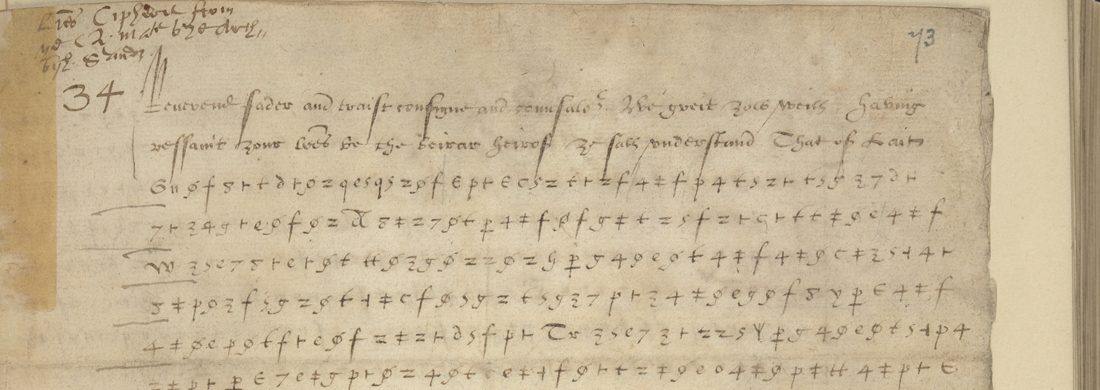
Two leaves. f. 73r opens with three lines in clear, then 36 lines of cipher. f. 73v has 26 more lines of cipher, a clear passage about the commission Hamilton wanted for Argyll, Eglinton, Cassillis and Boyd, the date and Mary’s autograph subscription. A later hand at the head of f. 73r notes “Lre Cyphered from ye Q. with the decifer”. ff. 74r–v hold the decipherment, 53 lines in Scots in a different secretary hand; the dorse is endorsed “Recept [x]xiiij Januar”.
02 The cipher
A letter-for-letter substitution with invented signs, one sign for th or y (a thorn, as Tomokiyo suggests), word signs for and and to, and a few code signs for persons and states. The key is Tomokiyo’s, filed on DECODE R8347. On the first cipher line it gives “ϕf … ∂ɼϕz qesqsϕf” = it … bein proposit, word for word the start of the decipherment, “it had bein proposit to me”. Tomokiyo also found the same cipher in Cotton Caligula B IX f. 315b, Mary to a bishop, Bolton, 9 September 1568, printed by Labanoff.
03 The decipherment
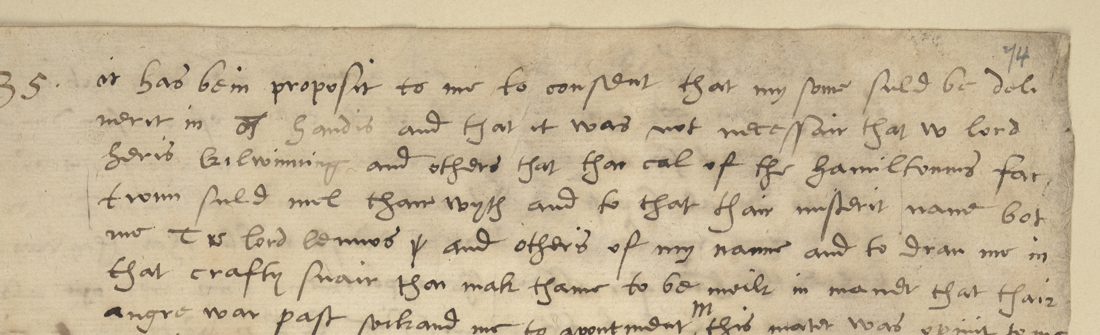
Line breaks follow f. 74; ⟨ ⟩ marks a code sign the decipherer left as a sign, [?] a doubtful word. Spelling is the decipherer’s.
it had bein proposit to me to consent that my sone suld be deliverit in ⟨E⟩ handis and that it was not necessair that ye lord Heris, Kilwinning and otheris that thai cal of the Hamiltonnis faction suld mel thairwyth, and to that thai inserit name bot me, the lord Lennox ⟨¥⟩ and otheris of my name; and to draw me in that crafty snair thai mak thame to be meik in maner that thair angre war past, seikand me to apointment. In this mater was opinit to me to feil my opinioun, quhilk I wald not ansor on to the tyme the same war spokin to me in ⟨Ꝗ⟩ name; and than I am deliberat to schaw hir that I am content to put my self in hir handis without the advis of my gud subiectis, and wil not do the lyk of my sone for mony ressonis, and that the same behuvit to be spokin to thame first afoir me.
I pray zow not to communicat to ony man except to thais of quhome ze ar assurit, and in the meane ze haif al reddi begun that ze mak sik demonstration as it may be knawin that ze nor the rest of my faithful subiectis wyl never condescend to the purposis. As to the appointment that thai desire, I am not of thais that forgettis not, bot I am resolut afoir the hiring of ony conditiounis thai sal find na thing in prejudice of my honour or ony of my faithful subiectis quhome thai haif trettit wyth thair braging; and to the rest thai sal find nathing bot my esteim, and trew sal likwyse remain hayl, for I wil not leif thame that hes not left me and schawis thame selfis loyal and faithful, as thai salbe knawin for the same, and the otheris as thai deserve.
⟨Mn⟩ As to the secors of ⟨B⟩ ⟨p⟩ ⟨sp⟩ I hoip to get of thaym bayth or the moneth of marche, at ye lest of ane of thame, for that hes bein offerid to me reddy ten thousand and ma gyf I haif ado. … ⟨X⟩ schawis that scho wilbe agains thame bayth, is ane interpriser amangis to empesche the support that the rebellis wald haif of hir, and I beleif be the principal occasion that thai seik appointment, … be the said queins [?] mand, quha feiris na thing sa that scho haif peace wyth my realme, or that scho may be assurit thairof in ony sort or wyse.
I allow gretumly zor proclamationis, and schawing heirof be in sik sort that thai may be na wyse witnessing that the same cummis of me, in cais that ony man wald peradventure sa[y] or cheif to do me displesour thairby, for the danger that I may fal in, beyng as I am in the [pu]issance ⟨X⟩. I pray zow to speik of hir Mtie contray wyth sik respect as thai may not find mater to mak thair profyt agains ⟨Ƒ⟩. As to ⟨X⟩ I sal wryt yt delygence bayth to ⟨Fr⟩ and to Sp, and haist als weil the support of mony as victualis and of munitioun to ⟨X⟩ in abyding the supplie. ⟨Mn⟩ For sen ze ar assemblit, I wald or ze sinderit the nobles that ze did sum notable act agains the rebellis in taking sa mony housis as ze can, bot that thai haif, as the castel of Glasgow, Dunglas or sic otheris; for als gyf the materis cummis to apointment, as it is lyk to do, al bipast dedis wil cum undir oblivion.
I wald that in tyme my faithful subiectis did sa mekle that thay war not behind the hand, for albeit the appointment cum not alwayis, than thay sal haif the advantage. As to the ciphre, we fear not that ony man had gottin ye copy thairof. As to the gyft of eschet that ze craif for ⟨k⟩, ze sal ressave the same in forme as ze desire.
The clear close on f. 73v: “As concerning the commissioun ze desire us to send to the erlis of Argyle, Eglingtoun, Cassillis and Boyd, we knaw not in quhat maner ze desire the same, for we understand to haif alreddy ane generall Lieutenent … send us the same quhilk we sall subscryve and put ony day the dait … Off Bowtoun the [xviij] of Januar 1568. Zour gud Cusines and asuryd frinde, Marie R.” The line-by-line transcription of all four pages is in hamilton1569/reading.md.
04 Method
The Add MS 33531 folio number was looked up in the archive.org text of Bain’s volume ii, which gave the letter, its date and the existence of a decipherment. The four DECODE images were fetched at full resolution and the decipherment was transcribed from strip crops. Tomokiyo’s key was checked against the first cipher line. The cipher itself was not transcribed sign by sign, because the contemporary decipherment covers all of it.
05 What remains uncertain
- ⟨E⟩ in “deliverit in ⟨E⟩ handis” is Elizabeth by Bain’s footnote and by the sense (C). ⟨Ꝗ⟩ in “spokin to me in ⟨Ꝗ⟩ name … to schaw hir” is probably Elizabeth too (M).
- ⟨B⟩ ⟨p⟩ ⟨sp⟩ is France and Spain, Bain’s conjecture, supported by the later “to Fr and to Sp” (C).
- ⟨¥⟩, ⟨Mn⟩, ⟨X⟩, ⟨n⟩, ⟨k⟩, ⟨m⟩, ⟨Ƒ⟩, ⟨Ɡ⟩ and a recurring separator-like sign are left as signs by the decipherer and are not resolved here. ⟨X⟩ recurs where a person or a place is meant (“as to ⟨X⟩ I sal wryt”, “munitioun to ⟨X⟩”).
- The day of the date on f. 73v is partly illegible on the image; 18 January is Bain’s reading. A few words of the decipherment are marked [?] in the transcription.
06 Sources
- British Library, Add MS 33531 ff. 73–74; images on DECODE R8347 (login).
- Joseph Bain (ed.), Calendar of the State Papers relating to Scotland and Mary, Queen of Scots, vol. ii (Edinburgh, 1900), no. 966 [second of the number], p. 604 (archive.org).
- Satoshi Tomokiyo, “Mary-Hamilton Cipher (1569)”, cryptiana, mary.htm; key image on the DECODE record.
Notes, transcription and profile: hamilton1569/ in the repository.