01 The documents
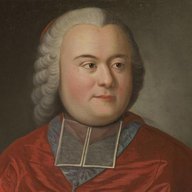
Louis-Auguste d’Affry (1713–1793), a Swiss officer in French service, was Louis XV’s envoy and then ambassador at The Hague from 1755 to 1762. His despatches went by the Dutch post, and the stadholder’s cabinet had them opened, copied and given to Pierre Lyonet (1706–1789), the naturalist who was also the Republic’s cipher secretary. Karl de Leeuw’s history of the Dutch black chamber (2000) records that Lyonet broke d’Affry’s first code in June 1756 and then “two more French ones”. The decipherments were copied for the Princess Governess and the regents. One set is in the Nationaal Archief (Stadhouderlijke Secretarie, 1.01.50 inv. 221 and 223, “grouped by the cipher used”, not digitised). Robert Fruin excerpted it in the 1850s, and Bussemaker printed his excerpts in 1906, as Dutch summaries with some verbatim French sentences.
Another set is inv. 192 of the Prins Willem V archive in the Koninklijk Huisarchief, catalogued on DECODE as nineteen records, R1052–R1076 and R2067. Each record is one letter: the intercept copy of the cipher, with the clear passages of d’Affry’s original written in. Seven are marked “solved by Dutch codebreakers, the solution written on separate sheets”, and eleven as not decrypted. The eleven are this target:
| DECODE | Date, number | To | Groups |
|---|---|---|---|
| R1072 | 6 Jan 1757, no. 123 | Rouillé | 556 |
| R1076 | 7 Jan 1757, no. 124 | Rouillé | 403 |
| R1073 | 25 Jan 1757, no. 133 | Rouillé | 312 |
| R1064 | 1 Feb 1757, no. 136 | Rouillé | 1,249 |
| R1065 | 3 Feb 1757, no. 137 | Rouillé | 1,082 (has a decipherment; see below) |
| R1067 | 1 Apr 1757, no. 161 | Rouillé | 1,481 |
| R1068 | 26 Apr 1757, no. 172 | Rouillé | 60 |
| R1054 | 19 Jul 1757 | “B.” (Bernis; DECODE reads Bonnac) | 372 |
| R1070 | 22 Jul 1757, no. 210 | “B.” | 400 |
| R1071 | 4 Aug 1757, no. 485 | Stainville (Choiseul), Vienna | 760 |
| R1074, R2067 | 17 Jan 1758, no. 283 | “B.” / d’Usson | 538 + two pages |
02 Lyonet’s decipherments among the images
A first pass took the DECODE note literally and treated the siblings’ solutions as lost. The attack started from cribs: Bussemaker’s verbatim sentence of 19 July placed “des précautions” (800 698) in R1054 by its repeat twelve words apart, and “le danger de la religion” turned up in the 22 July letter. That showed a word-and-syllable nomenclator, but cribs and a language-model solver got no further than a few dozen groups.
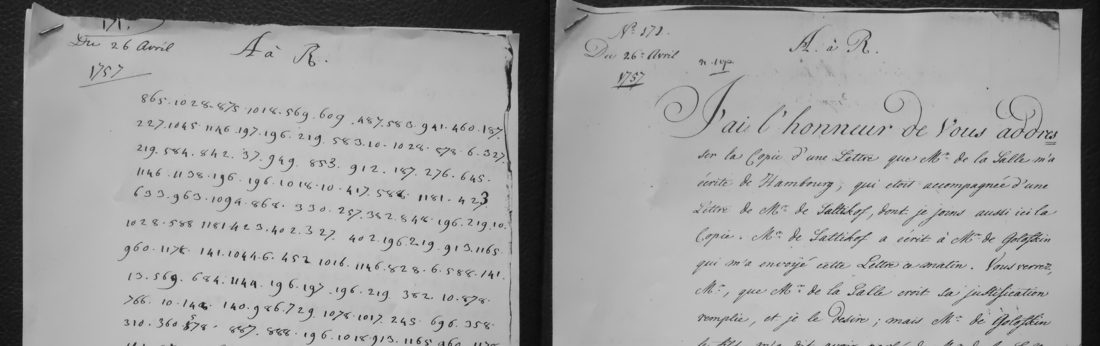
The clear pages among the images are Lyonet’s decipherments. On R1066 (17 February) the clear page 5578, headed “N° 142 … D’A. à R.” with a clerk’s mark, begins with the same sentence as the intercept (“Mon courrier n’est arrivé que le 15 au soir”). It then goes on, where the intercept switches to figures, with “J’ai vu Mr de Slingerland chez moi ce matin”. It is Lyonet’s decipherment of the whole letter. The same mark heads clear copies in R1052, R1053, R1062, R1063, R1065, R1069 and R1075. Their openings fit their ciphers group for group: J’ai l’honneur de vous… = 865 1028 875 1018 569.
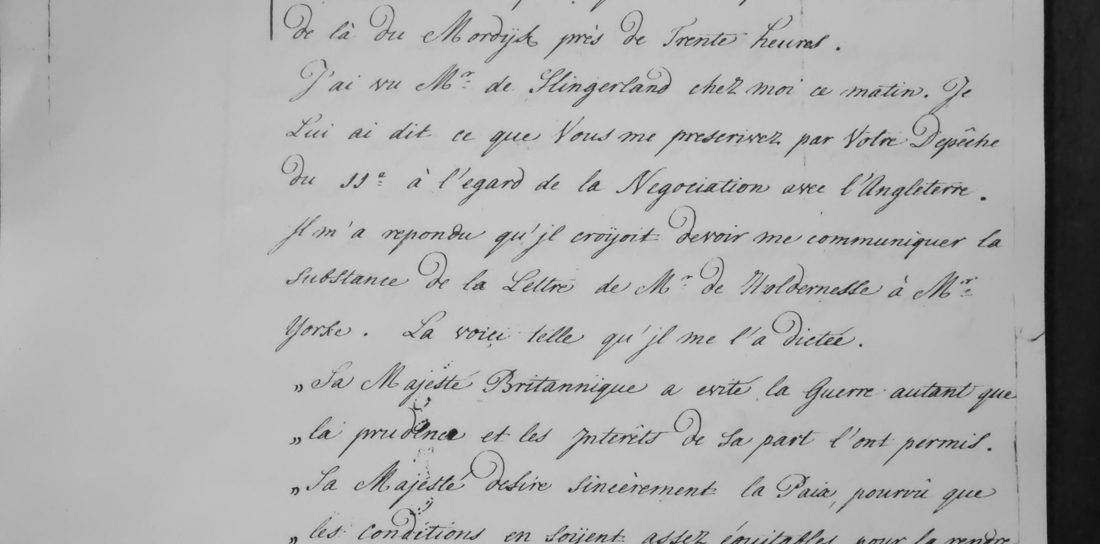
R1065, listed as not decrypted, is one of them. Its cipher is cut into thirteen numbered paragraphs that alternate between two sets of pages, and its clear copy is on four others. DECODE had noted a clear letter “whose relation to the ciphered periods is unclear”.
03 The key
The clear copies were transcribed from the scans and aligned with their ciphers one group at a time, each group graded H (forced by the text on both sides or repeated) or M. The seven letters were R1052, R1053, R1062, R1063, R1065, R1066 and R1069, plus the ciphered parts of R1075, about 3,300 groups. The alignments were made letter by letter and cross-checked; a vote over all of them gives the key. It is a two-part code: the numbers are not in alphabetical order. It has about 1,200 groups for letters, syllables, words and names, with homophones for the common ones (de 219, 1018, 1138; la 583, 382, 10; que 197, 194, 31). Some examples: 13 is a full stop, and 105, 107 and 797 are usually nulls. Leurs Hautes Puissances is 399 627 261. Le Roi de Prusse is 16, Hollande 294, Reischach 488, Sa Majesté 22, religion 578. The Jan–Feb and Apr–Jul letters differ in their habits (which homophones the clerk favoured) but not in the code.
The DECODE transcriptions needed correcting on the way. Two copyists wrote 8 as a looped figure that the transcribers read as 0, so 056 is really 856 and 099 is 899. This affects R1064, R1067, R1072 and R1075. Elsewhere groups are run together (58291 = 582 91) or lines dropped or repeated.
04 The decrypted letters
Each letter was decrypted with the key, and the few groups missing from the key were inferred from context and recorded with their evidence. Inferred values are in braces in the working files. The full French decryptions are in the repository; extracts follow.
6 January 1757 (R1072, no. 123): the Italian
The whole letter concerns “the Italian”, a spy who wants to be paid for earlier warnings of English designs on the French possessions in the two Indies. For a hundred louis and a pension he offers to leave at once for England and report on the English forces by land and sea, the secrets of the London cabinet, their intrigues in foreign courts, the plans for the 1757 campaign, and England’s correspondents in France. D’Affry thinks the money well spent if the man is sound. This is the weakest decryption (about two thirds in sense), and Bussemaker has no entry for this date. The Italian reappears on 3 February, when d’Affry pays him the hundred louis and he leaves for Helvoet.
7 January 1757 (R1076, no. 124): convoys and herring
A convoy the Dutch feared for had arrived: four ships were to escort it, and the storm kept two of them in port. D’Affry expects the navy to be enlarged sans augmentation dans les troupes de terre, and he expects the case to be pressed harder now that people see the English respect Dutch shipping only as far as it is protected. So every convoy through the Channel must be strongly escorted. In Amsterdam he talked with a regent about the herring. Bussemaker’s summary (no. 56): enlarge the navy without the army, protect trade, herring privileges for the republicans.
25 January 1757 (R1073, no. 133): a false rumour
It was said that d’Affry had given the States-General a memorial calling any increase of the land forces a breach of neutrality. The rumour was quashed, but he went to see the Grand Pensionary. He told him the King neither wished to meddle nor ever had, but as a friend would regret seeing the Republic take on heavy expenses. Steyn answered that the increase would meet many difficulties. If its opponents could not stop it, he said, they could at least get a declaration made first to Versailles, Vienna and London.
1 February 1757 (R1064, no. 136): taxes and herring
The States of Holland had adjourned until the 20th, when the augmentation comes up. The war funds were no larger than usual, and the means proposed (a sixth added to the house tax, a general rise in excises, interest on public funds cut to 2%) were so heavy that the augmentation looked unlikely. D’Affry then argues for a temporary favour to the Dutch herring fishery while France lacks sailors. It could be revoked when no longer deserved, and it would widen the quarrel between the Republic and England. He asks for it only if Holland blocks the augmentation. Then comes intelligence on suspects travelling through Antwerp, Breda and Liège. Bussemaker’s no. 59 gives the first part point by point and leaves out the agents, as Fruin said he did.
1 April 1757 (R1067, no. 161): the Gouvernante
The Maastricht convoy crisis. D’Affry found the Pensionary “fort embarrassé”: ce qui se passe ici aujourd’hui n’est […] que pour le perdre. The same afternoon he read the King’s declaration to the Princess Governess:
«… tu n’es pas ministre; faut-il que ce soit moi qui favorise les moyens de faire du mal à mon père?» Je lui ai répondu que S.A.R. savoit jusqu’à quel point le Roi mon maître a cherché à éviter la guerre … Je demande à S.A.R. d’employer non seulement ses bons offices, mais son crédit et son pouvoir pour déterminer une réponse prompte et telle que le Roi a droit de l’espérer.
Coquelle quoted the Governess’s words in 1904 from the Paris original, with the day given as 5 April. The piece that Bussemaker’s no. 67 quotes about Wassenaer (“son fils cadet a actuellement un employ en Frise, dont la nomination dépend de Mme la Gouvernante”) is piece no. 7 of this letter. The numbered pieces follow the page order, not the number order.
26 April 1757 (R1068, no. 172)
Il a passé hier au soir un courrier de Vienne à Londres. Vous savez mieux que moi ce dont il est chargé. M. de Colloredo doit faire passer à M. d’Aremberg ce qu’on lui aura répondu. The DECODE note asked whether this note was left undecrypted because a different code was used. It was not: it is the same code as no. 171, which Lyonet deciphered.
19 July 1757 (R1054, to Bernis)
Nobody knows the purpose of the Gouvernante’s journey to The Hague. If it is to push an augmentation of the land forces, d’Affry asks for orders at once:
… il me paroit qu’il seroit essentiel aux intérêts du Roi de m’envoyer des ordres sur le champ [de demander] une confirmation de tout ce que les Etats-Généraux ont promis à Sa Majesté, et en même tems une déclaration de leur part qu’ils ne feront camper aucun corps sur leurs frontières. Je sens la dureté de cette proposition …
The passage runs from group 145 to group 351, and Bussemaker’s French agrees with it word for word except in four places. The cipher has “M. le maréchal d’Estrées” where Fruin wrote “M. le Cte”. It has “de sa communication” for “de la communication du Royaume”. It spells out Leurs Hautes Puissances, and it has “des ordres” for “ordre de demander”. The page ends with an attack of gout.
22 July 1757 (R1070, no. 210, to Bernis): Ostend
The Gouvernante is said to be going to the States of Holland to speak for her father George II, pointing to the danger to the Protestant religion. D’Affry doubts she will: if she proposes land troops, the other side will propose ships. Her party protested at the French occupation of Ostend and Nieuport. D’Affry notes that sensible people see the other side of it: with Ostend closed to the English, Amsterdam and Rotterdam will take over the trade England did with the Low Countries. Then Bussemaker’s sentence, group for group: Il y a quelques villes où quelques ministres hollandois ont prêché sur le danger de la religion, mais le peuple n’en paroit pas animé. If the Princess takes the Ostend affair as a pretext, he will ask her for an audience without waiting for orders.
17 January 1758 (R1074, no. 283, and R2067)
The first part is an extract from a correspondent’s letter. A French loan of two millions had been tried in England by “des gens si maladroits” that the ministry heard of it and a new law followed. It could still be got round: four millions at four or four and a half per cent at most, given “un profond secret, une parfaite connoissance du pays”. D’Affry adds that a Sieur Mac[donald] of the Bulkeley regiment has passed through on his way from France to England, and he suspects him of carrying commissions for the enemy. Some Scots and Irish in French service are spies, he writes, but to act would throw suspicion on the rest. The companion letter of the same day to d’Usson (R2067) has no DECODE transcription. It was transcribed from the images and decrypted at about 91%. It is d’Affry’s own letter of the same number, covering the extract. He thinks money operations in England useless: if found out, they would make France’s needs look greater than they are and put the English on their guard. Englishmen will still lend in France when the interest is right, and some already hold French life annuities. He adds that two or three Englishmen are at The Hague, one of them Mac…, and that two Spaniards from Paris, one a secretary of the Spanish embassy, are on their way to London.
05 What remains open
- R1071 (4 August 1757, to Stainville in Vienna) is in a different code and is not decrypted.
- Per letter, 5–12% of groups stay open (listed as [n] in each decryption file). R1072 gives only about two thirds in sense: its copy is the worst transcribed.
- Grades: values forced by a decipherment are H; values inferred from context in the letters without a decipherment are M or ? and listed with their evidence in
read/R*_new.tsv. 56 groups of the key are ambiguous between two values (amb_M.json). - The eight decipherments themselves are Lyonet’s. The contribution here is the key and the decryption of the nine letters that have none on DECODE.
06 Sources
- Koninklijk Huisarchief, The Hague, Prins Willem V, inv. 192, via DECODE (de-crypt.org), records R1052–R1076 and R2067, with the DECODE transcriptions (2019–2020).
- Th. Bussemaker (ed.), ‘Uittreksels uit de brieven van D’Affry aan de Fransche regeering (December 1755–Mei 1762), uit de papieren van R. Fruin’, Bijdragen en Mededeelingen van het Historisch Genootschap 27 (1906), on DBNL.
- P. Coquelle, L’alliance franco-hollandaise contre l’Angleterre, 1735–1788 (Paris, 1902), ch. V.
- K. de Leeuw, Cryptology and statecraft in the Dutch Republic (thesis, Amsterdam, 2000).
- Nationaal Archief, 1.01.50 Stadhouderlijke Secretarie, inv. 221 and 223 (the contemporary decipherments; not consulted, not digitised).
Transcriptions, alignments, the key and the full decryptions are in affry1757/.