01 The documents
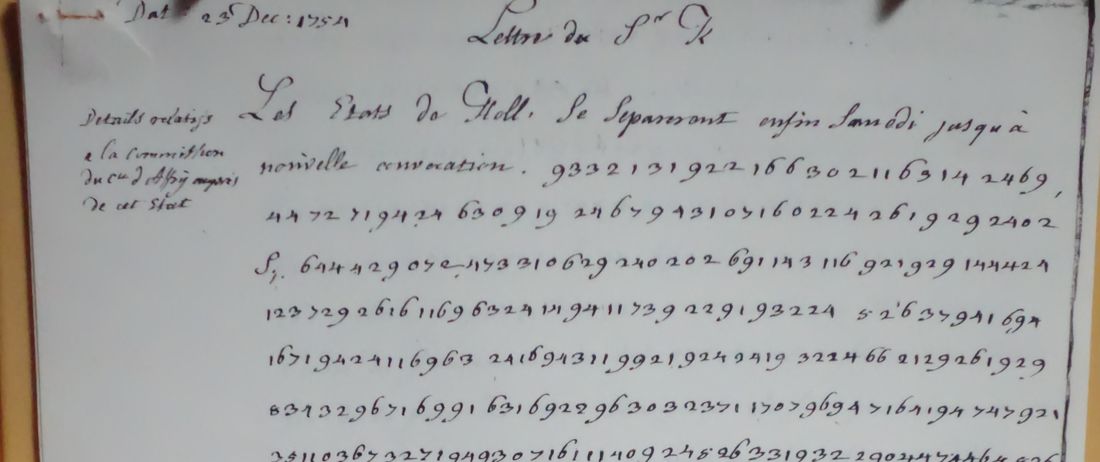
Kauderbach (1707–1785) served the Saxon legation at The Hague from 1739 for almost thirty years; his despatches went to Count Brühl in Dresden (“Votre Excellence”). The Dutch post office copied them for the Stadtholder’s cabinet, and the copies are in the Koninklijk Huisarchief, Prins Willem V inv. 201, beside the d’Affry intercepts of inv. 192. Most are wholly in clear. DECODE catalogued the ten with figures, from photographs, and transcribed three.
| DECODE | Date | Pages | Cipher groups | Transcription |
|---|---|---|---|---|
| R2078 | 23 Dec 1754 | 5 | 1,231 | DECODE |
| R1958 | 20 Jun 1755 | 2 | 542 | this project |
| R2079 | 6 Jul 1755 | 2 | 558 | this project |
| R2080 | 22 Jul 1755 | 4 | 1,260 | this project |
| R1959 | 5 Aug 1755 | 2 | 391 | this project |
| R2081 | 12 Aug 1755 | 3 | 802 | this project |
| R2082 | 15 Aug 1755 | 2 | 425 | this project |
| R1044 | 29 Sep 1755 | 3 | 628 | DECODE |
| R1954 | 16 Mar 1756 | 4 | 1,621 | this project (weak) |
| R1043 | 25 May 1756 | 5 | 1,054 | DECODE |
DECODE dates R1959 to 5 August 1758; its heading reads 5 Aout 1755, and its content (the rumoured negotiation of Prussia, the Staroste of Warsaw leaving for London) belongs to that summer. Group counts are after removing nulls, measured on cipher/R*.txt: 8,512 groups in all. R1954 is a photocopy in a different hand, with letter-like figures; its transcription infers many digits from the pair rules and is the weakest.
02 Splitting the figures
The Hague cabinet’s note on DECODE gives the reason for their failure: “the codegroups are not separated, by blanks or dots as is usually the case.” A first count showed no preferred period of two or three figures from the start of a passage, and the copyists’ spacing is not systematic. Two figures behave differently from the rest. 5 and 8 are rare (135 and 78 in the first 6,096 digits), never follow 5 or 8, and typically stand next to the clear sigla (…254 M./., J./. C./. 8095…). Deleting them as single figures restores a clean two-figure phase (index of coincidence 0.027 against 0.021 for the shifted reading; for four-figure windows 0.155 and 0.161 at offsets 0 and 2, 0.103 at 1 and 3). A short Viterbi pass over the pair frequencies then repairs the places where a copyist dropped or doubled a figure. What is left is a table of about sixty two-figure groups: first figure 0, 1, 2, 3, 4, 6, 7 or 9, second 1, 2, 3, 4, 6, 7 or 9, never 0, 5 or 8. Every letter shows the same frequency profile, so one key served from 1754 to 1756 at least.
A homophonic solver failed on that table. A hill-climbing solver that decrypts synthetic French in the same form (sixty codes, two per cent noise, nulls, realignment) at 98% produced nothing on the real stream, in French, German, Dutch or Italian, with nulls or merged look-alike figures. The statistics of the stream still looked like language (entropy, vowel alternation 0.63, long exact repeats such as 19 29 14 44 nineteen times), so the units were not single letters.
03 The key
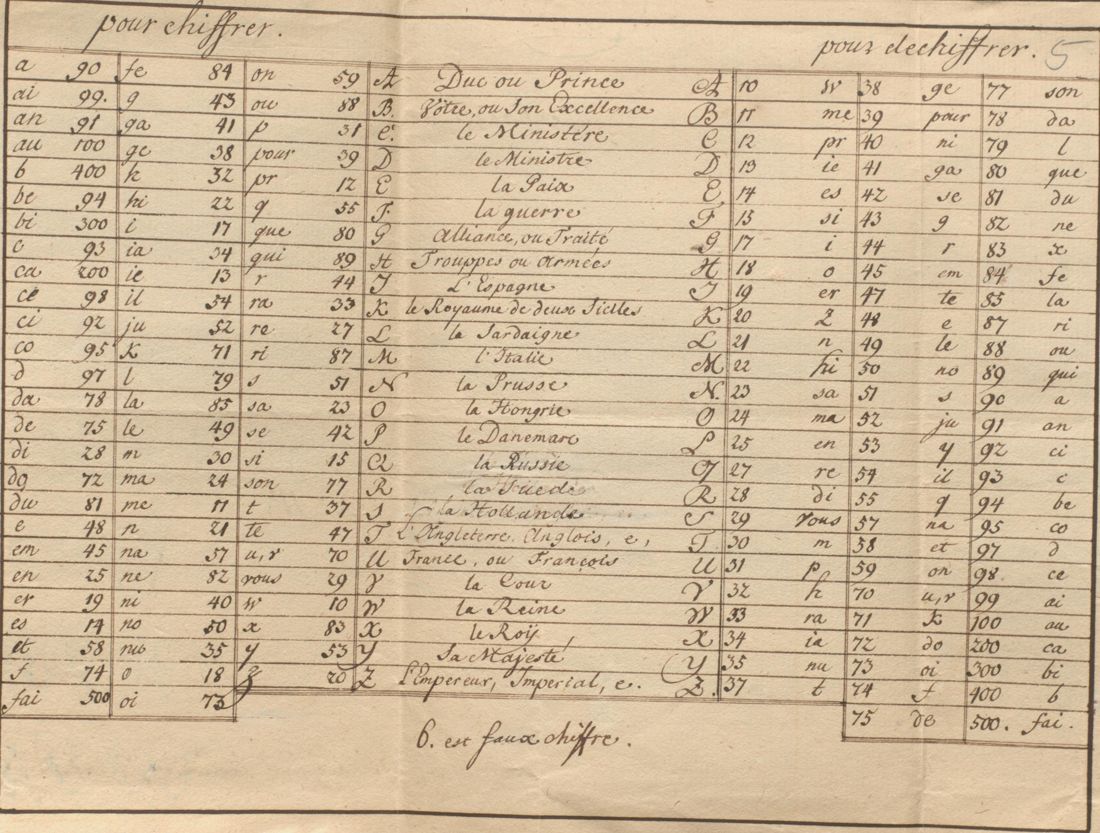
DECODE also holds the Dresden chancery’s cipher register, and one of its leaves is the key made for Kauderbach in 1761. It explains the 1754 system at once: a null figure, capitals in clear for the names, and a single number for each of about seventy letters and syllables. It is not the same key (its numbers use 5 and 8), but a successor of the same design. So the problem became an assignment: each 1754 code to a different item of the 1761 vocabulary. A simulated-annealing search over such assignments, scored by a four-letter French model built from contemporary diplomatic letters, reached the same key from two independent starts (seeds 22 and 24, −3.85 per letter, against −3.95 for true French on the same model), and the result was French. Reading the decryption then settled what the 1761 vocabulary lacked or the search had misplaced: 27 in (principales, provinces, interet), 91 ou, 33 qu, 79 st, 17 par, 22 pas, 46 qui, 66 pour, 23 fai, 76 ke (Yorke, Kniphausen), 77 z (treize, declarez), and the exchange of 01 oi and 12 ai, found independently by both readers (avoit, etoit, croire; raisons, mais, Pais Bas).
01 oi · 02 de · 03 re · 04 au · 06 ie · 07 le · 09 ne · 10 z? · 11 p · 12 ai · 13 y (re) · 14 i · 16 e · 17 par · 19 a · 20 fe? · 21 ce · 22 pas · 23 fai · 24 s · 26 et · 27 in · 29 t · 30 an · 31 b · 32 n · 33 qu · 34 du · 36 si · 37 en · 39 pr · 40 em? · 41 la · 42 ra · 43 c · 44 on · 46 qui · 47 f · 49 sa · 60 ent · 61 h · 62 que · 63 u/v · 64 d · 66 pour · 67 se · 69 l · 71 te · 72 g · 73 o · 74 ci · 76 ke · 77 z · 79 st · 90 k? · 91 ou · 92 r · 93 il · 94 m · 96 co · 97 x · 5, 8 nulls
04 The decrypted letters
Word division, accents and the bracketed sigla are editorial; spelling is Kauderbach’s. […] marks an undecrypted stretch, [?] a doubtful word. The clear passages are summarised in brackets.
R2078, 23 December 1754 (about 90%)
[Clear: the Estates of Holland will separate on Saturday until a new convocation.] Il n’y a pas eu depuis longtems une assemblée des etats de Holl. dont les objets de deliberations aient eté plus importans et en meme tems plus embarassans pour cet etat. D’un coté l’ouverture faite par le comte d’Affry presente mille epines, et quant au fond et quant a la forme des conferences a entamer …; de l’autre coté le colonel Yorke, qui ne s’endort pas dans ces circonstances, demande dans un memoire … des explications sur ce a quoi l’on peut se tenir relativement aux engagemens … The overture is to go through commissioners, conferences auxquelles le marquis de Bonnac agira et parlera comme chef de l’ambassade; the opponents of England font assez connaitre que le principal but est de negocier un [traité] de neutralité.
R1958, 20 June 1755 (about 90%)
Le colonel Yorke m’a de nouveau assuré que sa cour est tres disposée au renouvellement du [traité] de subside, et qu’il ne doutoit pas que Mr le comte de Fleming … ne s’affectionnat a cette affaire a son arrivée a Hanovre. Yorke himself, dans des momens d’impatience, se sentoit incliné pour le sisteme des anticontinentistes; Kauderbach thinks Hanover the right place pendant qu’on y est encore dans l’incertitude des evenemens en Amerique.
R2079, 6 July 1755 (about 97%)
Mr Haslang mande au resident de Baviere qu’il a la parole du duc de Newcastle que son [Y./.] sera renouvellé. Les apparences pour l’augmentation des [Z./.] diminuent de jour en jour … mais j’ai de fortes raisons de croire qu’il n’en sera que mieux pour nos affaires: Amsterdam would sooner renew the subsidies than vote an augmentation, qui dans leurs principes en est une pour le pouvoir du stadhouder.
R2080, 22 July 1755 (about 97%)
Les principales raisons qu’on a alleguées dans les debats qu’il y a eu sur ce sujet dans l’assemblée de [S./.] se reduisent en substance aux suivantes. Primo, que si le danger dont les Pays Bas sont menacés est tel que le lord Holderness l’a fait connaitre ici, une augmentation de trente mille hommes n’est pas suffisante pour le detourner. Secundo, qu’il faut constater avant toutes choses si le danger est reel pour la republique … Tertio, Holland cannot carry the burden alone while Zeeland, Utrecht, Friesland and Groningen plead exhaustion; quarto, dans le cas de necessité … tous les bons patriotes devroient sacrifier jusqu’au dernier sol et combattre pro aris et focis; mais qu’il faudroit auparavant s’expliquer avec [Q./.]. If it must be, new taxes and encore un cinquantieme denier.
R1959, 5 August 1755 (about 95%)
Le bruit que [E.M.] est en negociation avec [P.] ne paroit pas etre entierement sans fondement, et l’on assure que l’on a fait reellement quelques demarches aupres de ce prince, qui auroit promis a certaines conditions de se tenir tranquile tant que la [J./. C./.] ne remueroit pas. The ambassador of [Q./.] m’a sondé plusieurs fois sur les dispositions de [J./.] pour un [traité] de subside avec la sienne, a quoi je lui ai repondu constamment que je n’etois pas instruit, et que nous avions un [ministre] a Paris auquel il etoit plus naturel de s’adresser qu’a moi.
R2081, 12 August 1755 (about 93%)
Les [P.] sont aussi peu contens de [J./. C./.] que des [S./.]. Il me paroit qu’ils soupconnent [U./.] de ne vouloir pas elle meme au fond embrasser ces choses … Ils disent savoir positivement que le baron de Kniphausen declame plus fortement a Compiegne contre les [P./.] que [Q./.] meme. The rumoured negotiation with [M./.] is now denied: an attempt was made three months ago mais qu’elle n’a pas pris.
R2082, 15 August 1755 (about 95%)
L’ambassadeur de [Q./.] assure que [E.M./.] a ecrit au roi son maitre une lettre de sa propre main … qu’il avoit une armée de cent cinquante mille hommes a son service. [P./.] says openly that if the Dutch will not arm, [P./.] abandonnera le continent, et qu’elle ne sacrifiera pas … la seule occasion decisive d’humilier [Q./.] a la pitoyable conduite de [S./.], qui apres avoir eté assez avertie se tirera d’affaire comme elle pourra.
R1044, 29 September 1755 (about 85%)
L’on n’entend que des plaintes des membres contre [P.I.] de ce qu’ils font tant de prises en Europe sans en donner aucune raison au public; England had taken pour plus de vingt millions de prises sur les sujets de l’Etat in the last war, qu’on recommençoit deja ce train. [Clear: Bolza’s power useless; Kauderbach’s arrears.]
R1954, 16 March 1756 (about 65%)
On the demand for a secours de six mille hommes: [S./.] ne peut refuser ce secours sans rompre entierement avec [B./.], qui prendra ce refus pour une infraction …; if the neutrality party loses, le peuple s’animera … et entrainera l’Etat malgré lui dans la querelle. Many gaps: the transcription is weak.
R1043, 25 May 1756 (about 85%)
On a aujourd’hui des avis certains et positifs que le [traité] dont on parle depuis si longtems a eté signé a Versailles le deux de ce mois, et selon ce qu’on m’a [fait] conter confidemment, il a pour objet primo la neutralité des Pais Bas, secundo il doit y etre stipulé qu’aucune puissance ne donnera aucun secours a l’ennemi de l’autre … et tertio … de ne pas lui etre contraire relativement a l’election d’un Roi des Romains. Cette nouvelle a causé une consternation extraordinaire ici parce qu’on croit qu’il y a des articles secrets qui vont encore plus loin. Then Bonnac and d’Affry’s visit to an ambassador’s country house, et l’on a dit aussi beaucoup de reflexions sur cette demarche. The First Treaty of Versailles was signed on 1 May 1756.
05 What remains open
- The sigla. The capitals with ./. (S, Q, P, U, J, C, M, E, Y, Z, W, B, G) are names written in clear, as in the 1761 key, but their 1754 meanings differ from it. S is almost certainly Holland (the Estates, the provinces), Y a subsidy treaty, Z troops; the rest are identified from context only and marked as sigla in the decryptions.
- Rare codes. 10, 20, 40 and 90 occur twelve times in all and are guesses; 13 stands for y and apparently also re (membres, reflexion); 66 may stand for er inside some words.
- R1954 (four pages in a letter-like hand) decrypts only at about 65%; a second transcription would improve it.
- Transcription slips. The DECODE transcriptions and the new ones both drop or double figures; the decryption files list those found. The clear passages were transcribed quickly and are summarised, not edited.
- The percentages are the readers’ estimates of the share of the ciphertext that gives sense; 99.9% of the groups carry a key value.
06 Sources
- Koninklijk Huisarchief, The Hague, Archief Prins Willem V, inv. 201: images and records on DECODE, R1043, R1044, R1954, R1958, R1959, R2078, R2079, R2080, R2081, R2082; DECODE transcriptions of R1043, R1044 and R2078.
- Sächsisches Hauptstaatsarchiv Dresden, 10024 Geheimer Rat, Loc. 08236/11 Bl. 5, “Kauderbach in Den Haag – Saxony 1761”: DECODE R936, key image and transcription.
- “Kauderbach, Johann Heinrich”, Sächsische Biografie.
- No printed or earlier decipherment of these letters was found.
Transcriptions, the split code stream, the key, the solver scripts and the full readings are in kauderbach1754/.