01 The documents
JACAR B03050738800 is a Foreign Ministry file of 29 April – 11 May 1916 on Sun Yat-sen's cipher telegrams. It contains (i) five telegrams from Sun in Tokyo to a policeman of the Hankow consulate, in four-figure groups — the "+111" code that Tomokiyo has already read; (ii) a despatch, 機密送第一號, from Foreign Minister Ishii to the acting consul at Swatow, himself named Tanaka, asking who this "Tanaka" was, why he wired Sun, whether he was misusing the consul's name, and "if at all possible" to decode the telegram; (iii) the telegram; and (iv) the Hankow consul-general's report of 11 May on Sun's next scheme (five-figure groups, digits reversed, 111 subtracted). Nothing in the file reads the Swatow telegram.
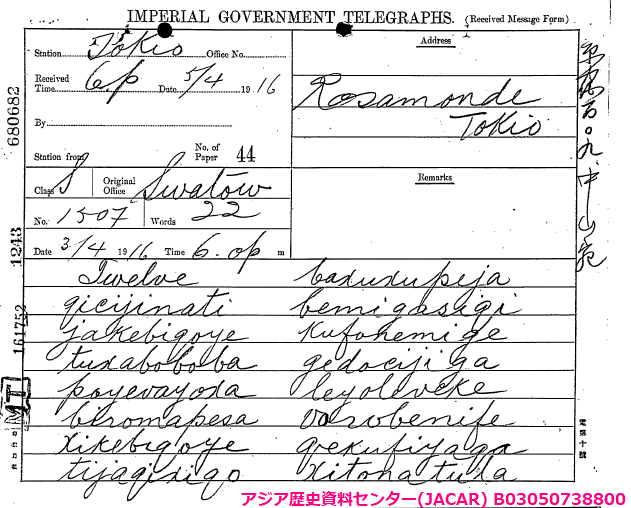
Twelve  baxuxupeja qicijinati bemigasiqi jakebiqoye kufohemige tuxaboboba gedocijiga poyevayoxa
        leyoleveke biromapesa vorobenife xikebiqoye qekufiyaqa tijaqixiqo xitonatula xopavajejo
        ropezpo ngobunibai   tanaka
As read from the form. Tomokiyo's transcription has gedoeijiga and xitohatula; the handwriting is c and n, and the decipherment requires exactly that.
"Twelve" is the table indicator (Yamada's telegrams begin "Sixtyfour" for his 六十四號 table).
02 Structure
- Alphabet. Consonants b c d f g h j k l m n p q r s t v x y z (twenty, no w) and vowels a e i o u — the 20 × 5 = 100 syllables of a two-digit code condenser: each syllable stands for a pair of digits, two syllables for one four-figure codebook group, and the syllables are run together and cut into ten-letter "words" to be charged as one word each. 177 letters → 88 syllables → 44 groups, one letter lost.
- Vowel u is rare (7 of 89 syllables against ~20 each for the others). In a column-major table each vowel owns a block of twenty numbers; the block 81–99, 00 is almost never a page number in the codebook (which stops in the 80s), so u is the high block. That already fixes the layout type.
- Known condensers. Yamada's Guoshiguan table runs x y z b c … v across rows and u o i e a down, numbered 01–99, 00 row by row; his Michigan table runs b … z alphabetically and o u a e i, numbered column by column from 00. Both are pure rule tables. The natural hypothesis for "table twelve" is another member of the same family: a rotation (or reversal) of the alphabetical consonants, a permutation of the vowels, either fill order, either origin, perhaps an additive as in Sun's own telegrams.
03 The key
All 40 × 120 × 2 × 2 × 3 = 57 600 keys of the family were applied to the clean syllable runs and the resulting four-figure groups scored with a traditional-Chinese character frequency model (unknown codes penalised). The winner — consonants rotated to begin at l, vowels e a i o u, column-major, 01-based, no additive — scores −360.6 where the population mean is −553.6 with s.d. 23.8; the runner-up is 49 points behind. Read off, the table is:
| e | a | i | o | u | |
|---|---|---|---|---|---|
| l | 01 | 21 | 41 | 61 | 81 |
| m | 02 | 22 | 42 | 62 | 82 |
| n | 03 | 23 | 43 | 63 | 83 |
| p | 04 | 24 | 44 | 64 | 84 |
| q | 05 | 25 | 45 | 65 | 85 |
| r | 06 | 26 | 46 | 66 | 86 |
| s | 07 | 27 | 47 | 67 | 87 |
| t | 08 | 28 | 48 | 68 | 88 |
| v | 09 | 29 | 49 | 69 | 89 |
| x | 10 | 30 | 50 | 70 | 90 |
| y | 11 | 31 | 51 | 71 | 91 |
| z | 12 | 32 | 52 | 72 | 92 |
| b | 13 | 33 | 53 | 73 | 93 |
| c | 14 | 34 | 54 | 74 | 94 |
| d | 15 | 35 | 55 | 75 | 95 |
| f | 16 | 36 | 56 | 76 | 96 |
| g | 17 | 37 | 57 | 77 | 97 |
| h | 18 | 38 | 58 | 78 | 98 |
| j | 19 | 39 | 59 | 79 | 99 |
| k | 20 | 40 | 60 | 80 | 00 |
Green: cell confirmed by a word that reads (41 cells). Amber: used only in a doubtful group. Dim: not used in this telegram. Note the u-column: k-u = 00 is confirmed twice (亦 0076, 力 0500), fixing the whole column.
04 Reading
Codebook = 電報新編 / 明密碼電報書 numbering (identical to the modern standard telegraph code for these characters). Dotted = emended letter · red = unresolved
ba xu · xe pe · ja qi · ci ji · na ti · be mi · ga si · qi ja · ke bi · qo ye · ku fo · ne mi · ge tu · xa bo · bo ba · ge do
3390    1004    3945    5459    2348    1342    3747    4539    2053    6511    0076    0342    1788    3073    7333    1775
潮      城      由      莫      擎      宇      獨      立      我      軍      亦      光      復      汕      頭      後

ci ji · ga po · ye va · yo xa · le yo · le ve · ke bi · ro ma · pe sa · vo ro · be ni · fe xi · ke bi · qo ye · qe ku · fi ya
5459    3764    1129    7130    0171    0109    2053    6622    0427    6966    1343    1650    2053    6511    0500    5631
莫      率      大      隊      來      令      我      退      出      鎮      守      府      我      軍      力      薄

qa ti · ja qi · xi qo · xi to · na tu · la xo · pa va · je jo · ro pe · [zpo ngobunibai]
2548    3945    5065    5068    2388    2170    2429    1979    6604
暫      由      翼      □       支      持      文      慧      返      …
潮城由莫擎宇獨立。我軍亦光復汕頭。後莫率大隊來,令我退出鎮守府。我軍力薄,暫由翼□支持。文慧返……
The events. On 26 March 1916 Mo Qingyu (莫擎宇), a regimental commander at Chaozhou under Long Jiguang's Chao-Mei garrison, was won over by Chen Jiongming, Lin Hu, He Haiming and the local revolutionaries; on the 27th he occupied Chaozhou city and wired the provincial authorities "率師占領潮城,宣布獨立" — 潮城, the very word of the telegram. On the 30th the Swatow guard troops declared for him and he formally proclaimed independence with his headquarters at Swatow. Sun's own Chinese Revolutionary Party men had meanwhile taken the town's garrison headquarters (鎮守使署); "Tanaka", one of the Japanese adventurers serving with them, reports on 3 April that Mo, arriving in force, has ordered them out, that they are too weak to resist, and that someone is returning — presumably to Tokyo to report. The Ministry's suspicion that the sender was trading on the Swatow consul's name is a nice irony: the consul was also a Tanaka.
05 What remains uncertain
- 城. The form reads
baxuxupeja→90 04, and no codebook has page 90. One vowel-stroke away isxe pe= 1004 城, which the history all but dictates (潮州 1558, 潮梅 2734 and 潮汕 3073 are unreachable from the letters). The second u is probably an e. - 翼□ (5065 5068). Both syllables of 翼 are confirmed elsewhere; the second group's
tois not, and 5068 (翿) is not a word. A name or a unit that "supported" the revolutionaries once Mo displaced them — the Swatow guard? a ship of Tang Tingguang's squadron? — is expected here. - 文慧 (2429 1979). Sent as read; presumably a person who "returns". 文 is also Sun Wen's signature character.
- The tail. After 返 the form has
zpo ngobunibai: a seven-letter "word" cannot occur in this system, andng,aiare not syllables. An exhaustive search of all strings within three plausible edits (h/n, u/n, c/e confusions, dropped letters) yields no decoding into valid codes. Roughly three characters — a place or a request — are lost unless the second sheet of frame 680682 can be read at higher resolution. - The two h syllables of the transcription (
he,ha) both decode as nonsense and both read as n on the form (光, 支). The h row of the table is therefore unattested, but the layout leaves it no other place.
06 Method
- The JACAR file was read page by page (the archive's image server refuses automated access; the PDF was supplied by hand) for context and to check the letters.
- Syllable statistics: the 20 + 5 alphabet and the deficit of u pointed to a systematic, column-major condenser.
- Brute force over the whole systematic family (57 600 keys) with a character-unigram score over the standard codebook (Unihan telegraph tables; the 1916 numbering verified on Tomokiyo's decoded Sun telegrams).
- Four doubtful groups examined by one-letter alternatives; the readings 光復, 支持, 莫, 潮城 chosen by sense and then found in the handwriting.
- Edit-distance search over the garbled tail (negative). Historical check against the 26–30 March chronology of Mo Qingyu's rising.
07 Try the key
Type condenser letters (spaces ignored). Each consonant–vowel pair becomes two digits from the table above; pairs of syllables become codebook groups and are looked up in the standard telegraph code.
08 Sources
- JACAR (Japan Center for Asian Historical Records), Ref. B03050738800, 外務省記録: 孫逸仙ト電報往復ノ件 / 孫逸仙宛電報ニ関スル件 (April–May 1916), reel 1-0959, frames 0288–0298.
- S. Tomokiyo, "Chinese Cryptography: 1871–1945" (cryptiana), for the two Yamada condensers, the +111 telegrams and the telegram image; "Sun Yat-sen's Coded Telegram (1916)", blog, 12 Dec 2021.
- Unicode Unihan database, fields kTaiwanTelegraph / kMainlandTelegraph (via kirklin/chinese-telegraph-code) for the standard telegraph code.
- 黃浩瀚, 「百年前莫擎宇在汕宣布反袁獨立」, 汕頭特區晚報, repr. 辛亥革命網, 6 Dec 2017 — the chronology of 26–30 March 1916 and Mo's telegram.
Analysis scripts, the codebook tables and the language model are in the repository (sunyatsen/).