01 The documents and the key
| DECODE | Folios | Pages | What |
|---|---|---|---|
| R190 | 92r–95r | 5 | Includes a passage headed “Al conte di Desmon[d]”, on the soldiers of His Holiness in Ireland. Decrypted by Lasry. The author is not established: the folios lie between the Sauli and Riario runs. |
| R191 | 98r–101r | 6 | Ortiz; the “distruttione di quelli poveri Italiani”; the soldiers’ pay. Decrypted by Lasry. |
| R192 | 195–197 | 6 | Riario: an audience with Idiáquez “li 4”; pp. 5–6 a “Copia” dated 29 November 1580 |
| R193 | 236–238 | 3 | Riario to the Cardinal of Como, Badajoz, 2 [October?] 1580; p. 3 a clear decifrato from Elvas, December 1580, signed A. Card.le Riario |
| R194 | 281 | 2 | Riario (by hand and subject); undated. The Irish captains, money, Flanders first, the truce |
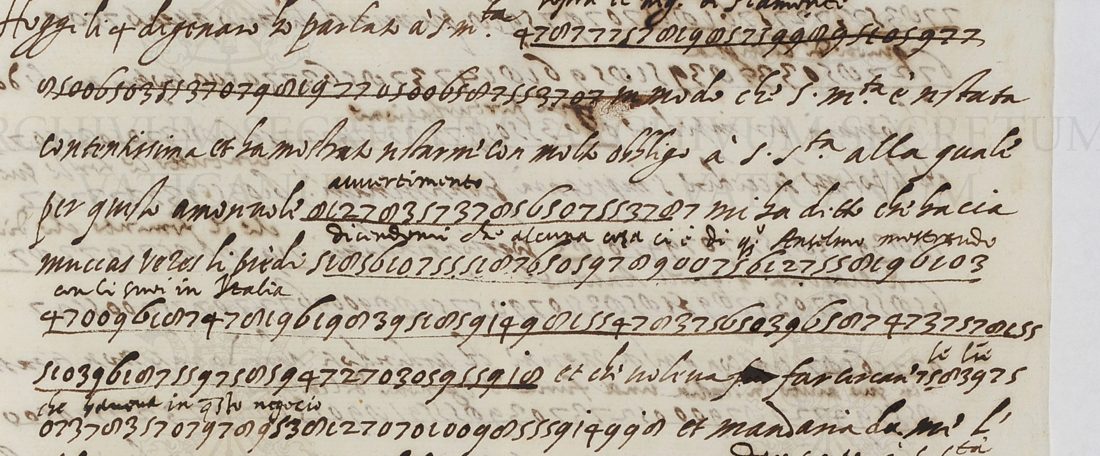
The key is Lasry’s reconstruction: fixed two-digit homophones (a 00 81, e 07 83, i 05 85, o 03 87, l 25 75, u/v 01 27, one number for each other letter), a few words (78 che, 84 per, 24 quell, 14 quest, 44 ancora, 28 M.tà) and the single digit 9 as a word separator. No group begins with 9, so a digit string splits in only one way. Numbers are left as plain numerals between separators (“4 mesi”, “1300”).
02 What the ciphers say
R192, Riario. Riario spoke with the King “sopra il negotio di Piamonte”. Philip II was very pleased with the avvertimento and much obliged to His Holiness. Idiáquez then came to report that the King had taken the warning in good part. Cipher passages name the Marquis of Ayamonte, formerly governor of Milan, the Anselmi, and Ugonotti of the Dauphiné who were to help them in Italy. The King promised that nothing would disturb Italy. Further on: the Italian soldiers were to be sent with artillery, munitions and four months’ pay under the name of S.S.tà. Going on in plain danger, they would all be killed, because the Queen of England’s ships and men were waiting. The appended copy of 29 November 1580 answers the King’s ministers. The English enterprise must wait until Flanders is pacified. The Italians are embarked on the river at Lisbon with victuals for three months and are to be sent back toward Italy.
R193, Riario to the Cardinal of Como, Badajoz. The impresa d’Inghilterra: the King lacks the means and wants Flanders subdued first. It also covers galleys, Italian infantry, and 1,300 badly armed soldiers in need of “aiuti, armi et munitioni”. The third page, a clean decipherment from Elvas, says of the President that he “è pietra scandali et mal sodisfatto della Corte romana”.
R194. The Irish captains; the King needs a “gran provisione di dinari” and must settle Flanders before “questa impresa”; the truce; la Religione Catolica in Fiandra.
Per-passage digit strings, decrypts and glosses are in the repository (transcription_R192.md, transcription_R193_R194.md).
03 Method
The five records, their 22 page images and DECODE’s attachments were fetched. The attachments are Midas’s 2017 transcription of R190–R191, Lasry’s key and his decryption. That decryption covers only ff. 92–101, so R192–R194 had key but no text. Two image-reading passes transcribed the digits of each cipher passage on those eleven pages and copied the interlinear gloss. A table decoder applied Lasry’s key. Where a digit was ambiguous in this hand (3/5/8, 0/6, 1/7), the value that gives Italian was kept. That makes the decrypt a check on the gloss rather than an independent decryption. Groups that decrypted to nothing in the key were lined up with their glosses to recover code words.
04 What remains uncertain
- 20 and 28 are hard to tell apart in this hand. One is glossed S.M.tà and the other Italiani, probably 28 and 20 respectively; not settled.
- 72 is glossed denari twice. On R192 p. 4, “la 72 82” is glossed la Reg.a d’Inghilt.a navi, so 72/82 are not settled (Lasry has 82 = “Hune”).
- 10 is glossed Italia three times, but once apparently V.S. Ill.ma, which may be a misread 18.
- Four-digit groups 6371, 7771, 7361 and 7761 stand before several phrases in R193–R194 and are never glossed. They may be nulls or a code.
- Religione cattolica in R194 p. 2 is enciphered by a short group that could not be made out.
- On R192 p. 1 the tail after “dubbio che ha S.S.tà” (“0?9 32 0 9 75 71 63”) has no gloss and was not decrypted.
- Letter dates: R193 p. 1’s month and R194’s date are not established; R190–R191 were not re-examined here (Lasry’s decryption stands).
05 Sources
- DECODE records R190, R191, R192, R193, R194 (images, transcription, Lasry’s key and decryption; login).
- Archivio Apostolico Vaticano, Segreteria di Stato, Portogallo 8.
- No edition of Riario’s legation letters was found.
Notes, decoder and transcriptions: sauli1579/.