01 The strip
ACA Reserva 12 is a single strip of paper about three times as wide as it is high, written edge to edge in a round chancery cursive of the early fifteenth century, with slashes every few words and a dot in the left margin every five or six lines. Below the text, in the same hand, is a dateline (en Barchinona ha ii de mag), and to the right two short notes in clear. A later hand has endorsed the strip “2 mayo”. The address on the back, which Salas printed, is Sacre Regie Aragonum Majestati.
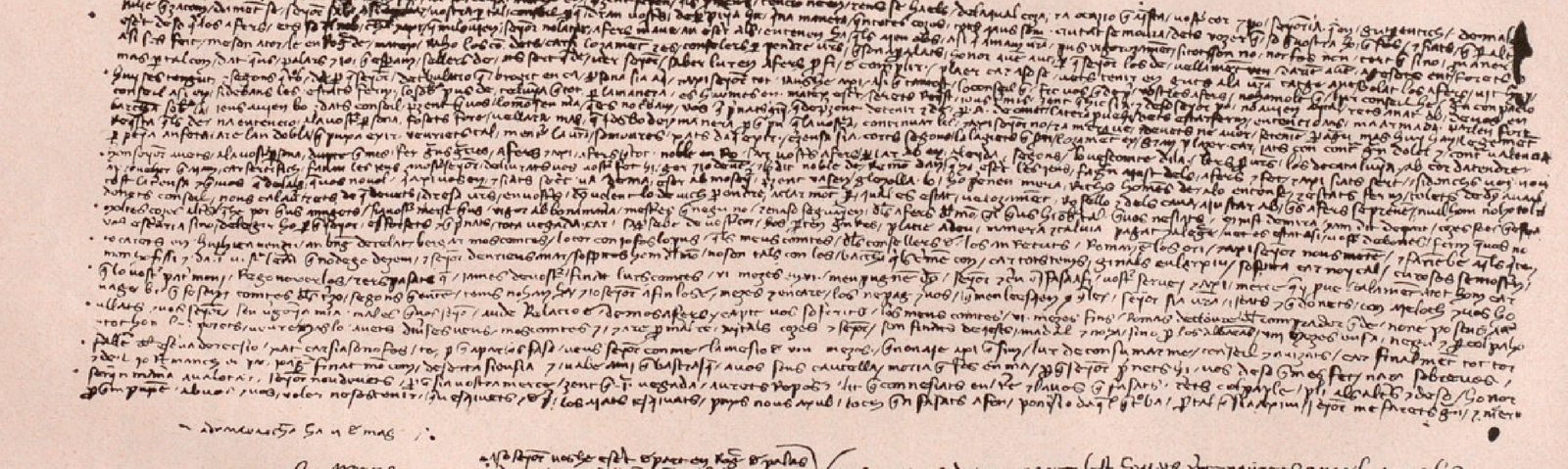
Read along the lines it is nonsense, but nonsense made of Catalan words: Senyor jous / pus compli / escriua ja / auem fet / tot son densa / met ho en / present segen … That is what put it on DECODE as a cipher. The record gives the symbol set as “graphic signs, alphabet, numerical”, the language as Spanish, the cipher type as unknown and the status as non-decrypted, and under References it lists Salas.
02 The system
Salas gave the rule in a sentence. The letter is read from top to bottom, by columns: along a line until the first slash, then down to the next line, and so on to the last line of the block, which the marginal dot marks; then back to the first line for its second chunk. If the lines are 1, 2, 3 … and the chunks a, b, c …, the order is 1a, 2a, 3a, 4a, 1b, 2b, 3b, 4b. The writer enciphered by writing the letter down the columns of a block and then went on to the next block.

The check made here is the first block, lines 1 to 5, read from the DECODE image without reference to the printed text, then set against Salas:
| Line | Chunk a | Chunk b | Chunk c |
|---|---|---|---|
| 1 | Senyor jous | pus compli | escriua ja |
| 2 | auie q(ue)zacom | dament se | senyor sab |
| 3 | escrit de so q(ue) | los afers | ets so q(ue)l nob |
| 4 | asi ses feit | me son acor | le en Rog(er) de Palars |
| 5 | mas p(er) tal com | dat que us | e jo |
Down the columns: Senyor, jo us auie quezacom escrit de so que asi s’és feit, mas per tal com pus complidament sé los afers me són acordat que us escriua. Ja, senyor, sabets so quel noble en Roger de Palars e jo … That is Salas’s opening word for word. The chunks break words wherever the column happens to end (compli/dament, acor/dat, nob/le), which is what makes the lines look enciphered.
The writer said as much himself, in clear, at the foot of the strip: No us anugets de legir, car con lest ho ajats prazer n’aurets e no playarets l’afany, do not be put off reading it, for once you have read it you will be pleased and will not regret the effort. He asks for the reply under the King’s ring seal, per tal que pus sacretament ho puxats fer. Salas remarked on the ingenuousness of a note that warns the reader there is a difficulty and then leaves the slashes and the dots in place.
03 The date
The strip carries a day and no year. Salas dated the hand to about 1420, which is the date DECODE prints, but placed the content earlier: the writer reminds the King that not long ago people se tenien per agrauiats con contra lur conseil herets anat ab mà armada, held themselves aggrieved that against their advice he had marched in arms, which Salas read as Ferdinand I’s campaign against the count of Urgell in 1413. That makes the last months of 1413 the earliest date and Ferdinand’s death on 2 April 1416 the latest, since the letter is to the king who did the marching. The archive filed it under Alfonso, Ferdinand’s successor, which is where DECODE’s date comes from. Salas left the year open, and it is left open here. The wider setting fits Ferdinand’s last years: the King in Valencia, unwell, the corts in suspense, and Barcelona and Perpinyà being sounded for support.
04 What the letter says
The writer is a royal financial officer stationed in Barcelona who keeps accounts (mos comtes) and closes them every six months; he writes on behalf of himself and of the noble Roger de Pallars. Salas’s text runs to about nine hundred words. In outline:
- Barcelona and Perpinyà. He and Roger de Pallars have done what they could in Barcelona and await the King’s letter of credence daily, so that the consellers have grounds to put the matter to the council. The pròmens of Perpinyà have written to the consellers to learn their intentions and offer to do whatever is needed. A council was held that day on the Perpinyà request, and those who were well disposed before are doubly so now.
- Leave the city. The King should take counsel for his person and get out of the trouble he is in; once he is out of it, he will see such a stir in Catalonia that the whole world will marvel, but while he stays where he is nothing can be set in motion. The writer has already advised, through A. de Canet, that the King should hold and continue the corts as soon as his credence arrives.
- The mood has turned. Not long ago people were aggrieved that the King had marched in arms against their advice; now they grieve for him, take his part and speak sharply against València. Tomorrow he and Roger de Pallars meet the bishop of Vic; Pallars then goes to Claramunt to speak with Ramon d’Anglesola, who has been at Lleida; the viscount of Illa is gathering the barons and knights of Roussillon to join those of Catalonia. Let the King be steadfast and keep his affairs secret, que tot uostre fet hi ua.
- His own office. Just de Miravet has brought word from the King that his post is safe. But a royal letter has come to Berenguer de Relat ordering that his accounts not be released, as if he were the most suspect man in the world; the originals stay in the archive, so there is nothing to fear. Those so anxious for the patrimony should have the past treasurers’ accounts examined, which have never been closed, whereas he closes his every six months and is still harassed. His accounts are closed to Christmas, save for the purchaser’s vouchers, which he has not been able to get for eight months through the fault of the clerk of receipts. He asks the King to look into it and to make an example of whoever is found at fault.
The close, in Salas’s reading
… e de so senyor me farets gran honor e mercè. Dada en Barchinona ha ii de mag. Así, senyor, uos he escrit de part en Roger de Palas e de mi septat so que toque a mon hofissi. No us anugets de legir car con lest ho ajats prazer n’aurets e no playarets l’afany, e aje nostre resposta sagelade ab l’aneil nostre per tal que pus sacretament ho puxats fer. Sacre Regie Aragonum Majestati.
05 Why it was looked at
The oldest ciphered letter read in this project is from 1497. The community’s oldest previously unread ciphertext to be broken is from 1449. DECODE has some six hundred records dated before 1497, nearly all of them keys, and this strip is the oldest one with an image that can be fetched without a login. It was the third of four pre-1450 candidates, and the memo that ranked them already noted that it read like abbreviated Catalan rather than a substitution. It came off the list within an hour: the References field of the record named the 1931 article, the Biblioteca de Catalunya’s ARCA portal has the volume, and the article has the text. The lesson is the same as with Sástago 1495–96, which DECODE lists as undeciphered although Parisi printed it in 2004: read the record’s references before its status.
The remaining candidates are Queen María’s letter to Alfonso V of 5 August 1435 (ACA Cancilleria reg. 3225 f. 59r, forty signs in four runs), the four pages of Luis Fernández from Rome in April 1424 (RAH 9/31), and the Heidelberg alchemical cipher of 1426 with its key on the first leaf.
06 Sources
- Arxiu de la Corona d’Aragó, Reserva 12. DECODE record R10170, image public.
- Xavier de Salas Bosch, “Una lletra xifrada en català”, Estudis Universitaris Catalans XVI (1931), pp. 374–377 and fig. 7. Digitised by the Biblioteca de Catalunya: ARCA, vol. XVI (the article is at images 384–389 of the volume).
- A. Lange and E.-A. Soudart, Traité de cryptographie (Paris, 1925), the nomenclature Salas used.
Salas’s article and transcription, the candidates memo and the notes are in the repository (oldest/). The archive’s image is not committed. The reading is Salas’s; the check of the rule on the image is this project’s.