
01 The documents
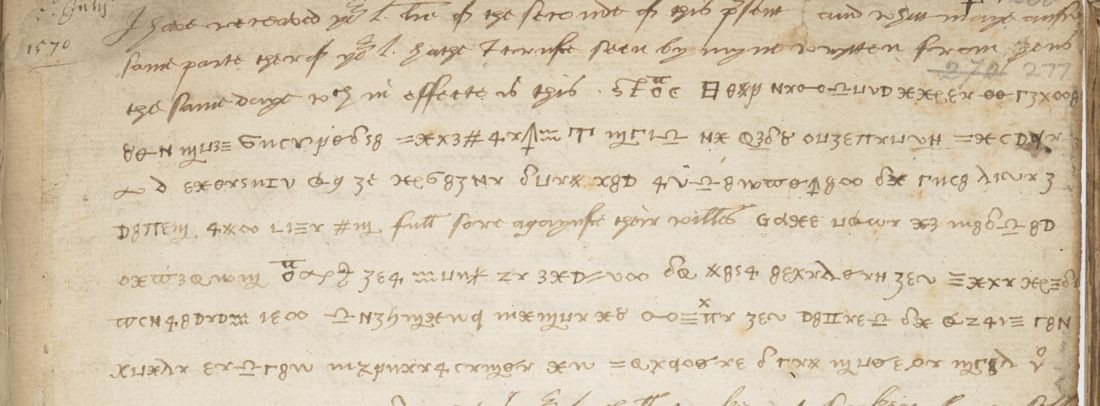
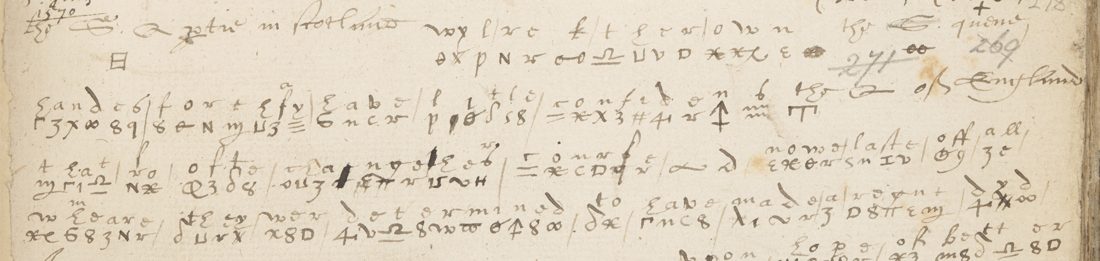
f. 277r–v is the letter in Randolph's hand, signed and dated at the foot of the verso. f. 278 is a half-leaf docketed "5 July 1570". On it the cipher words are copied out with strokes between them and the plaintext written above, and the three short runs are deciphered in clear at the foot. DECODE has the two leaves as separate records: R4931, with no decipherment, and R4932, marked as decrypted. The record it links as the key, R4930, reuses the images of f. 277 alongside Caligula C II ff. 76–77. Those two leaves are Burghley's notes on the Norfolk and Bishop of Ross letters, and no cipher key is there.
02 The cipher
This is a word-divided substitution. Its signs are Latin letters, figures and invented marks, with two or three signs for the common vowels, and some signs stand for persons or phrases. The signs are ⊟ = "the S. Q. partie in Scotland", θθ = "the S. Queene", ΠΠ = "the Q. of England", and a struck +++ for the Earl of Morton. The values the glosses confirm include: = c, c u/v, D r, q s, ɛ n, δ t, ϙ o, Ӿ o, 4 d, # i, 8 e, ʒ a, 3 f, Π g, ⍏ n, U h, Ω t, ϖ m, λ m, ≡ i, Γ h. Tomokiyo's pages do not list this key. His Randolph ciphers are the 1559–60 Sadler–Croft ones.
03 The text
The clear text is in roman type and the deciphered text in italics. The deciphered wording is the f. 278 clerk's, checked word by word against the cipher on f. 277.
f. 277r, ll. 1–10. I have receaved your L. lre of the seconde of this present, and what maye answer some parte thereof your L. hathe I trust seen by myne wrytten from hens the same daye, wch in effecte as this. The S. Q. partie in Scotland wyl reke ther owne […] the S. queene handes […] fortefy, have litle confidens [in] the Q. of England, that so ofte changeth her course; and now of late of all, whereas they were determined to have made a regent, dyd staye it full sore agaynst their willes, upon hope of better comfort, and shall be forced to yeld [to] ennemies, and [be] conforted [with] murderers and traytors, bothe of kyng and regent, and to obbey her whome nether by lawe, duetie or conscien they thinke them selves bounde unto. This your L. shall reyde not spoken of my selfe, but this is a great parte of their greif, and all most everie mans speche, and preached in pulpet in playner wordes then I lyste to wryte.
f. 277r, ll. 16–18. …to be sorte wth your L. it thinke utterlye undon, what so ever be come of us. I have spoken with therle of Morton, who is of that mynde that before I have wrytten, and in verie playne speche lamentethe the state of his countrie…
f. 277r, l. 27. …the mony, whiche I knowe will marveylouslye discomforte him, as it dothe also some other…
f. 277r, l. 29. …that the soldiars may be continewed in pay untill the Convention be ended.
f. 277v, l. 14. I knowe he loketh not [for] the S. Q. home cumming.
04 Method
The two images of R4931 are byte-identical to two of R4930's, so the "key" record was checked first and found to hold no key. Boyd's abstract, made from Sussex's clear copy, was lined up with the cipher runs. The runs were transcribed into symbol tokens, and a solver (simulated annealing) fitted the key against an English n-gram model (en-1640s), keeping the word divisions. With no crib fixed, it already produced "murtherers and traitors", "regent", "whome … nor conscience they thinke them selves … unto". With the crib words fixed as known plaintext, about 70% of the text came out. The rest would not converge, because several signs that look alike on the page (plain, curly and barred x; 3 against a tailed ʒ) carry different values. A sweep of the DECODE records from the same volume then found R4932, the decipherment, one leaf on. Every value recovered earlier agrees with it.
05 What remains uncertain
- Three words of the clerk's first gloss line are faint or odd: "wyl reke ther owne", "handes", "fortefy" (C). The cipher under them is not otherwise confirmed, and the sense of that opening phrase stays doubtful in the original decipherment too.
- The bracketed [in], [to], [be], [with], [for] are words the clerk left out of the gloss (M).
- Everything else is deciphered and agrees with the key values (H).
06 Sources
- British Library, Cotton MS Caligula C II f. 277 (DECODE R4931) and f. 278 (DECODE R4932); R4930 = ff. 76–77.
- W. K. Boyd (ed.), Calendar of the State Papers relating to Scotland and Mary, Queen of Scots iii (1903), no. 339, the enclosure to Sussex to Cecil, 7 July 1570 (archive.org).
Notes, token transcription and solver runs: randolph1570/.