01 The documents
BnF fr. 2984 is volume 8509 of the Béthune collection, the Court’s file of correspondence from Rome in 1526. Gallica has it as a black-and-white microfilm
(ark btv1b90598430, 85 views, every canvas labelled “NP”). Eight items are in cipher:
| no. | page | date 1526 | to | cipher | read where |
|---|---|---|---|---|---|
| 6 | 25 | 1 Aug | Montmorency | last 7 lines | contemporary interlinear decipherment on the leaf |
| 7 | 29–31 | 13 May | Montmorency | p. 29 whole, p. 30 whole, p. 31 upper half; clear close | gloss on the first ten lines of p. 29 only; the rest read here |
| 8 | 33–37 | 9 June | the King | the whole letter | clear duplicate at p. 17 ff. (Mignet 1886) |
| 10 | 41–46 | 17 June | the King | most of the letter | interlinear decipherment; cipher parts printed by Bourrilly 1901 |
| 11 | 47–50 | 20 Aug | Montmorency | parts | cipher parts printed by Bourrilly 1901 |
| 24 | 105 | 20 Nov | Montmorency | 40 lines after 4 in clear | gloss on the first dozen lines; the rest read here |
| 28 | 121–123 | 7 Dec | Montmorency | c. 18 lines | dense interlinear decipherment on the leaf |
| fr. 3091 no. 11, 12 Aug 1529, is DECODE 3696, decrypted, in Raince’s second key. | |||||

02 The key had been read off by one column
Tomokiyo set out the 1526 key in French Ciphers during the Reign of Francis I (2020) as an image: a header row of plaintext letters over up to four rows of cipher glyphs, the columns about 78 px apart. It is a monoalphabetic substitution with homophones, three nulls and three word signs. Reading which glyph sits under which letter by eye is the whole difficulty, and the first pass here slipped a column.
Doing it by measurement instead settles it. Locating the white header letters in the magenta band, then labelling the ink blobs below and assigning each to the nearest header column, every blob falls within 15 px of a column centre — a fifth of the column spacing. The measured table is:
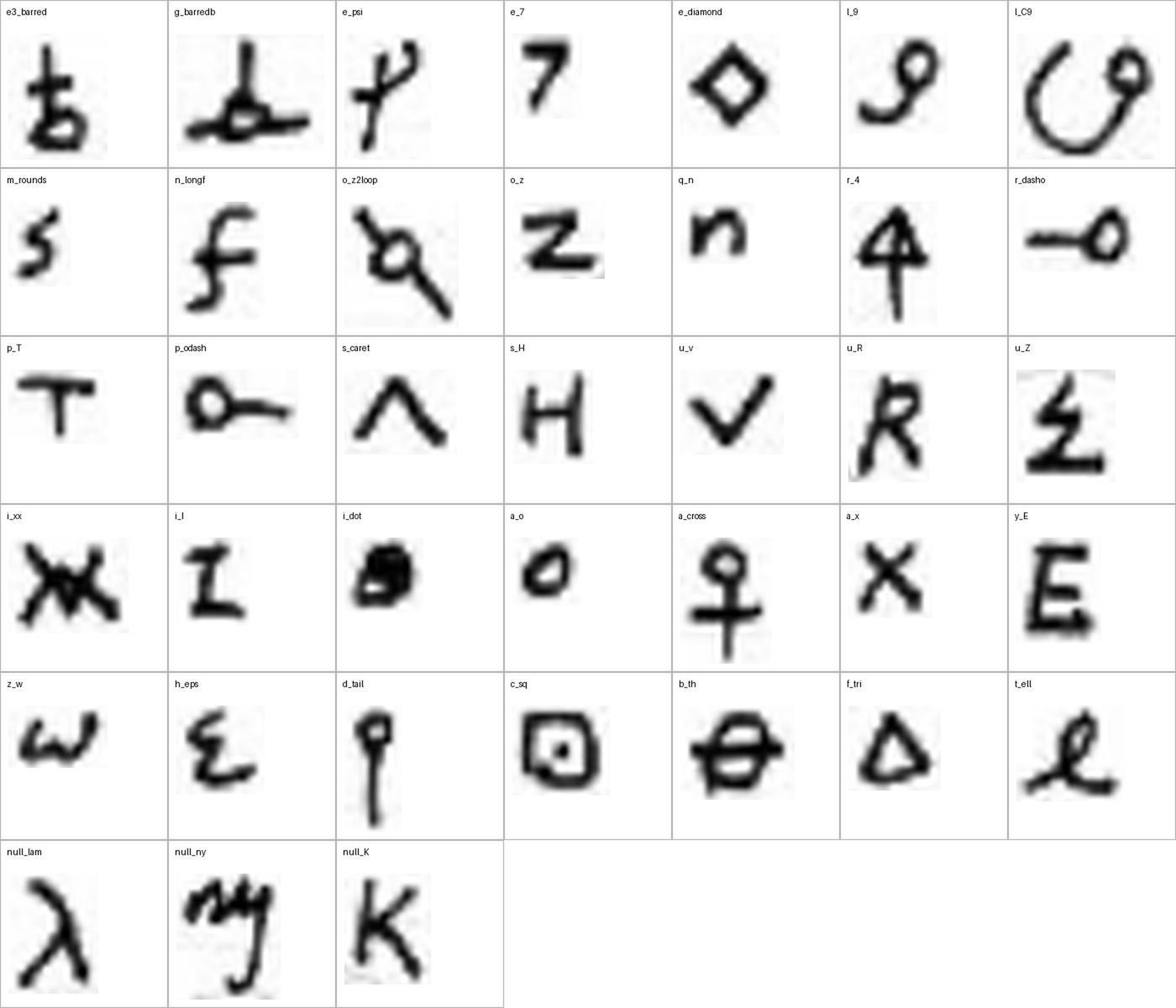
- The correction. l is the 9, not the round s; m is the round s, not the long f; n is the long f. The first pass had these one place to the left. H measures under s, not under r where it had been put.
- Why it matters. That single shift is what produced dongUeaent for longuement, egsembde for ensemble and SonseigEur for monseigneur in the first machine draft. Every file derived from the shifted table was discarded.
- Confusable pairs. p has a T and a circle with a dash to its right; r has a 4 and a dash then a circle. The two are near mirror images and are the easiest pair on the leaf to confuse. The most frequent single glyph, a circle at the foot of a barred stem, is an e.
- Word signs. A looped L with a tail = con; two small circles joined by a curve underneath = l’empereur; a cursive y with a descender = le pape. The letter y is E, so a y-shaped glyph is the word sign, not the letter.
The control. With the measured table, p. 29 line 20 resolves glyph for glyph and leaves nothing over:
∧ λ n v ✕✕ 7 ∧ ℓ ꝛ I ℓ 7 f 9 o ⊡ ꝛ v 4 ℓ ϝ 7 ∧ o R ꝛ E ψ ny 7 ∧ ℓ T o 4 ℓ E T ꝛ v 4 R 7 f ✕✕ 4 I ⊡ E
→ s [null] qui estoit en la court de Savoye [null] est party pour venir icy
The line uses a, c, d, three of the four e homophones, two of the three i, l, n, o, p, q, r, s, t, u/v, y, and two of the three nulls. That is the evidence the table is right.
03 pp. 29–31, not ff. 29r, 30v, 31r
The numbers written on successive Gallica views run 29, 31, 33, 35, 37 — two apart, not one. Read as folio numbers that would mean half the volume’s openings were never filmed, and every letter in it half missing. They are page numbers, written on odd pages only: view n shows pages 2n−4 and 2n−3, 85 views cover about 167 pages, and the digitisation is complete. So the 13 May letter is three consecutive pages, 29, 30 and 31, and the 20 November one is p. 105.
The text settles it independently. Page 29 ends … et n’est possible … monstrer plus a[ffe]- and page 30 opens -ction. Both halves of that join were read glyph by glyph before it was noticed.
04 Reading a microfilm
The film is legible at about 2× but the ink is grey and the hand is small, so the difficulty is not the cipher but the transcription. Three things made the reading possible.
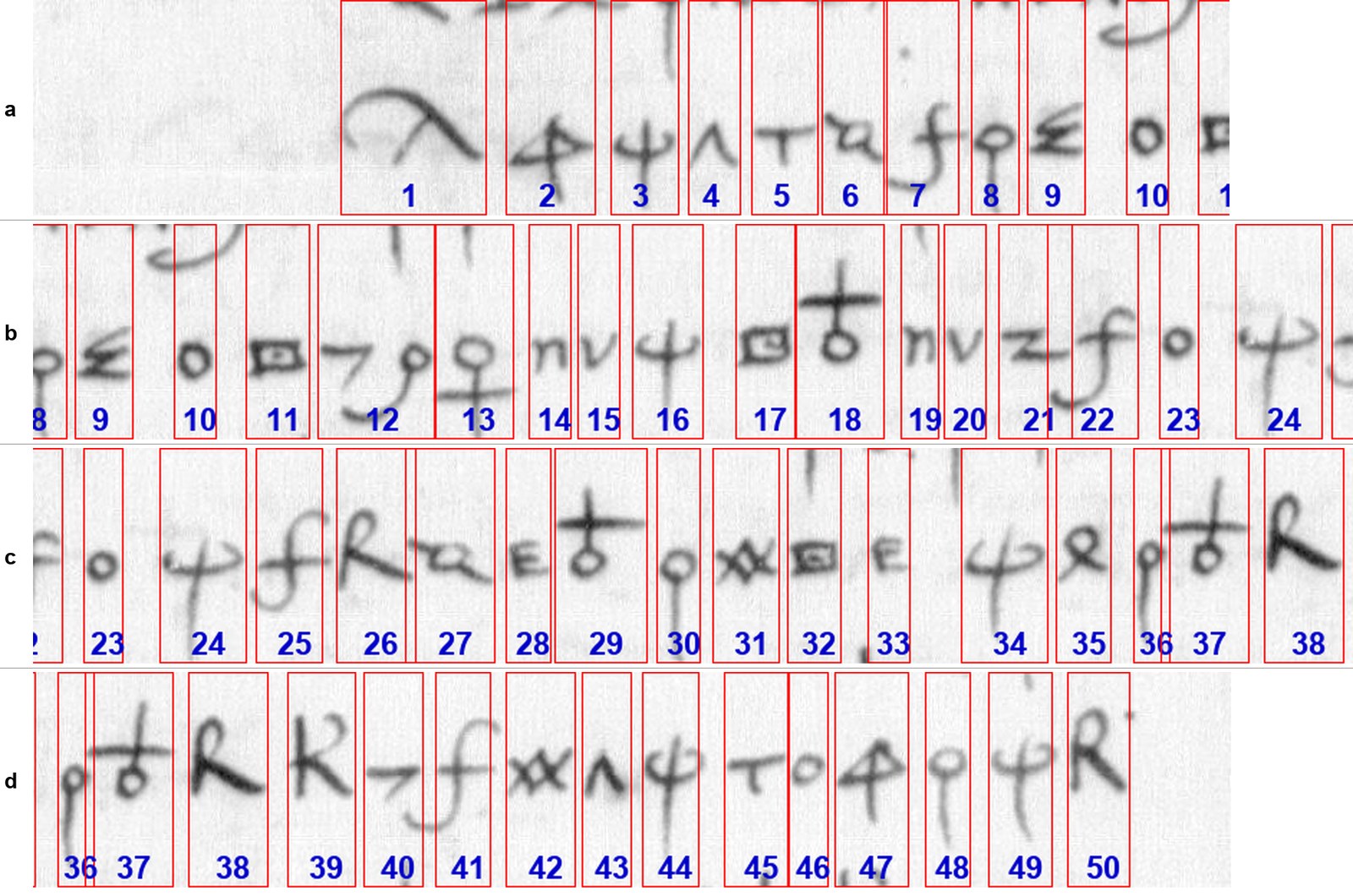
- One image per manuscript line, cut into four overlapping quarters and stacked, so a whole line is read in one view without losing magnification.
- Numbered tokens. Connected-component segmentation gives 5,629 glyph tokens; drawing each token’s box on the line and numbering it means a hand reading is written as one character per token and lands aligned to the segmentation with no guesswork. Every line was checked against its token count before it was kept.
- A scaffold, not a reading. A classifier over the token images, combined with a space-free period-French 6-gram beam, proposes a letter for every token. It is right on about 85–90 % of them, which is enough to speed a hand reading and nowhere near enough to be one.
Where the ceiling is, measured. The hand readings double as training data, so the classifier can be scored honestly by leaving one hand-read line out at a time:
| training data | leave-one-line-out per-token accuracy |
|---|---|
| the map’s own confident tokens only | 0.840 |
| + hand labels, weight 1 | 0.856 |
| + hand labels, weight 8 | 0.901 (peak, at 32 hand-read lines) |
| + hand labels, weight 30 | 0.860 |
That is the whole argument for doing it by hand. At 0.90 per token a six-letter word survives at 0.53, which is why only about a third of the machine text segments into real French words however the decoder is tuned. The residual confusions are between glyphs that really are similar at this resolution — ψ (e) against 4 (r), the cursive ℓ (t) against 9 (l) against the lollipop (d), the caret (s) against the vee (u) against × (a) — not between glyphs the key leaves ambiguous. More labels will not fix that; better images would.
05 The letter of 13 May 1526
Nine days before the League of Cognac was signed. The clear close on p. 31, transcribed here for the first time, dates and signs it — De Rome, ce xiij jour de may, 15c xxvj … Nicolas Rainse — and reports that Rome expects Andrea Doria at Civitavecchia that day or the next, with six galleys and two brigantines. The three ciphered pages that precede it read, in part:
- … ne cessera jamais qu’il n’ayt destruict ledict seigneur … — and, a line later, d’autres propo[s] … ains de vert[u] et mensonges.
- … ont receu … de Castille, qu’ilz disent …; ensemble … les bourguignons; and, of a great lord, les castilliens li[sent] au (con)traire que lesdessusdict[z] sont …
- … delib-eré prendre le chemin de Valence … à ceste fin, et qu’il ne voul-oyent qu’il feust … si grant seigneur.
- … et qu’il[z] seront cause de la destruction, de la part d’avoir faic-t capituler avec … — the likeliest referent being the Treaty of Madrid of January 1526, though the letter does not name it.
- Ledict He[rr]er[a](?) doit partir de dans deux ou troys jours pour s’en retourner — the name is not settled —; and …s qui estoit en la court de Savoye est party pour venir icy.
- p. 30: (L’empereur) est esbay de ce que … n’a escript autrement, aucune part deça, depuis son retour … en son royaume; et m’en a parlé plusieurs fois.
- … que mondict seigneur l’Admiral luy av-oit dict que seroit celuy qui y tiendroit. J’ay tousiours respondu à ce que ce qu’on a envoyé d’icy et de Venise par devers ledict seigneur …
- … deux ou trois fois qui a[voit] deu venir à Rome … disant prendre tout pour le mieul[x] … Bien est vray, monsei-gneur…
- p. 31: … la peste qui est au logis …; …s foys escript des advis qui viennent aux imperiaulx par leu[rs] …; … es grant dommaige en toutes les sortes qu’on pourroit …; [il] y ayt grant obligation pour les dommaiges qu’ilz disent ledict avoir…
- and, near the end, a named man: …t un jour, en plaine place pres du palais, un nommé Pietro Anthonio … secretaire ou serviteur dudict, qui estoit icy pour luy … followed by propos … quel estoit cause de tout le mal … deux ou trois fois.
06 The letter of 20 November 1526
Two months after the Colonna raid on the Vatican, and five months before the Sack. The ciphered part turns on the Pope:
… qui a … peust … faire s[e]cre[te]ment · et … pontif-icat seroit la cause de la totale(?) ruine de sa maison, de-…
With, in the same passage, …me, et s’en fuire; et que encores … luy feist … la grace; … et que … l’on penseroit … y respondre de part de nature; …t jamais pensé que les choses … prinst, et le for[t]-; sincerement … qu’il estoit … en besoing; … et que l’i[n]convenient … peril à qu[oy] …; and et aussi qu’il estoit … bien cler que n’estoit … dicte de. “Sa maison” is the Medici, and the pontificate is Clement VII’s.
07 What remains open
- Twenty lines of the 106 carry only the machine decode. They are kept, marked, in
trans/reading.txtand left out of the edited text rather than dressed up as a reading. - Gaps inside the 86. The edited text leaves
…wherever the glyphs did not resolve. Nothing is supplied by conjecture; a wrong confident reading would be worse than a hole. - One glyph is in no published table: a bold vertical stem crossed by two horizontal bars, the lower one longer and projecting right. It occurs ten times across
all four pages and every occurrence falls at a clause boundary — between plaisirs and qu’il, between lectres and qui est,
opening a sentence. It is not the barred-b g, not the barred-stem e, and not any of the three nulls. Most likely a point or a fourth null; it is written
·in the edited text. - The p. 29 / p. 30 join reads …monstrer plus a[ffe]- + -ctio?e, where the glyph after ctio measures as a plain triangle (f) rather than the n the sense wants. Left with a query.
- Two personal names are not settled: messire Ca?in, who appears twice on p. 30, and the agent read He[rr]er[a] on p. 29.
- What would finish it is not modelling but light. The Gallica item is a black-and-white microfilm; reader’s photographs of pp. 29–31 and 105 would let the segmentation run clean, and the measured ceiling above says that is worth more than any further training data.
08 Method
- Key measured, not read. Header letters located in the key image, ink blobs labelled and assigned to the nearest column, every assignment within 15 px of a column centre. Contact sheet of every labelled glyph kept.
- Verified on the leaf against a control line that resolves with nothing left over, using sixteen of the alphabet’s letters and two of its three nulls.
- Segmentation by connected components on a background-normalised binarisation, tokens assigned to lines by a y-histogram, x-overlapping components merged; 5,629 tokens over the four pages.
- Cluster-to-letter map hill-climbed against a space-free period-French 6-gram, with each cluster restricted to the letters its glyph shape allows. Restricting the moves is what stops the collapse into a degenerate map that defeats an unconstrained solver on a stream with this much segmentation noise.
- Hand reading line by line against numbered-token images, one character per token, length-checked against the segmentation.
- Honest scoring by leave-one-line-out over the hand-read lines, since a model trained on its own output otherwise scores itself.
09 Sources
- BnF Français 2984 (Béthune 8509), Gallica ark
btv1b90598430, microfilm, 85 views. - S. Tomokiyo, French Ciphers during the Reign of Francis I, cryptiana.web.fc2.com, first posted 2 November 2020: the 1526 key (
francisRaince.png) and the 1529 key, crediting Desenclos (HistoCrypt 2018) with locating the letters. He gives no plaintext. - DECODE records 4228 (fr. 3040 f. 21, 1526) and 3696 (fr. 3091 f. 19, 1529), both decrypted. Nothing from fr. 2984 is in DECODE.
- F.-A. Mignet, Rivalité de François Ier et de Charles-Quint, 2nd ed. 1886, t. II p. 211 n. 1: the 9 June letter “l’original en chiffres f. 33 … le déchiffrement f. 17”. His “f.” are the same numbers written on the leaves, which section 03 shows to be pages.
- V.-L. Bourrilly, “La première défection de Clément VII à la ligue de Cognac”, Bulletin italien 1 (1901) pp. 213–229, appendix II: the ciphered passages of the 17 June and 20 August letters, which he read himself.