

Summary. The two pages hold Burghley’s letter to Walsingham of 5 July 1572, written at Westminster. The letter is clear English with one short ciphered passage, about a rumour that the French King was pulling back from the Flanders enterprise. The passage uses boxed name codes ([2], [3], [4], [5]), a monogram, the single letters A and F, and a five-letter run “m o R. d A.”. Dudley Digges printed the letter and Walsingham’s reply of 13 July in The Compleat Ambassador (1655) with the codes left in cipher. The Calendar of State Papers Foreign does not include either letter. The setting and Walsingham’s reply identify [3] as the French King. Nothing else can be fixed: each of the other items occurs once or twice, and no key for this correspondence survives. Of 15 cipher tokens, the 2 uses of [3] are identified; the rest are not deciphered.
01 The record
Harley MS 260 is a fair-copy letter-book of Walsingham’s embassy in France, 1570–73, the book Digges printed from. DECODE R8358 has two images, in reverse order:
- f. 262r (DECODE P2): the end of an earlier Burghley letter (“I am sorry for them, and so would you also yf you thought the suspicion to be true”), signed William Burleigh and addressed “To his very frend Mr Frauncis Walsingham Esquire Ambassador Resident for the Queenes Matie in Fraunce”. Then the ciphered letter begins: “My Lord Ambassador, this day my Lord Admirall came to the Queenes speech”.
- f. 262v (DECODE P1): the end of the letter, “From Westminster the 5th of July 1572”, signed “Yor assured frend William Burleigh”. Then the address of Walsingham’s reply to Burghley, which begins “Your Lordship’s of the second and 5th of July”.
02 The cipher
I am sorry that the opinion groweth here of the French King’s recoil from the Flanders enterprise; it breedeth coldness here. Some that are come home bear us in hand that [3] reneweth the m o R. d A. [4] whereby the last matter ⅋B [5] is hindered. I marvel much thereof; indeed [3] is more given to Milan [4] then to [2]. … I see no means by worldly means A but Florence with F. [2]; God send it some way.
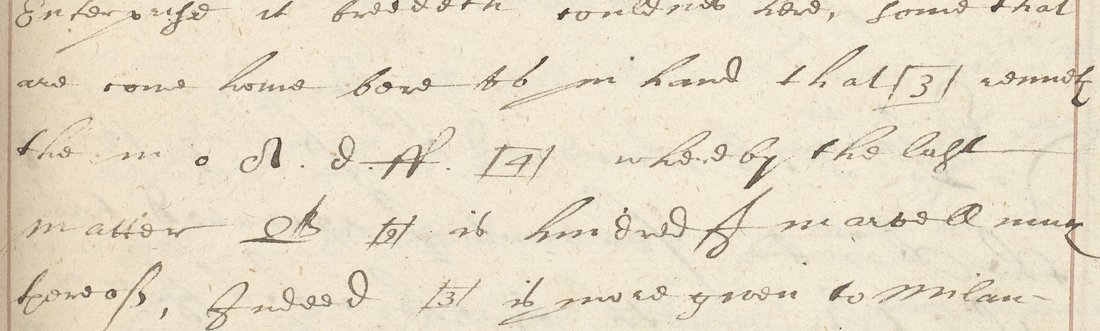
Digges set the same passage as “[3 | reneweth the in o A. D. F. [4] whereby the last matter Bl5! is hindred … indeed 3| is more given to Millane 4] thentoſs|”. The transcription counts 15 cipher tokens of 11 kinds.
03 What was identified
- [3] is the French King, Charles IX (grade C). Both uses come in the paragraph that opens with “the French King’s recoil from the Flanders enterprise”. Walsingham, writing from the French court on 13 July, answers: “I find the conjectures touching the [3] reneweth the … altogether false and vain, whereof I am assured of the contrary many ways”. Digges misprints “vain” as “Fain”.
- “Milan [4]”. In this book a box written after a word marks a cover-name (see the November 1572 letter-book pages). So “Milan” is probably a cover-name, perhaps for Spain, and [4] its marker. This is not graded.
04 What was tried
- Print. Digges 1655 prints both letters with the cipher as figures. CSP Foreign x, July 1572 (nos. 452–492), includes neither letter. The signed originals were not seen.
- Keys. There is no key record from Harley 260 on DECODE. Tomokiyo’s survey of Elizabethan ciphers has no key for Walsingham’s Paris embassy. The Cecil–Norris table of 1568 already failed on a sibling group (Walsingham to Burghley, January 1573).
- Siblings. Records R8356–R8364 from the same volume are being worked in this project. None of them holds a key or a gloss.
- Context. Every token was regraded against the letter, the reply and the rule for cover-names. Only [3] is fixed.
05 What remains open
- “m o R. d A.” is not deciphered. It is five letters of an unknown cipher, too short for cryptanalysis without a key. It is probably what [3] was said to “renew”.
- [2], [4], [5], the monogram ⅋B, A and F are not deciphered. They need the lost key, or Burghley’s signed original with a clerk’s decipherment, if one survives in SP 70 or at Hatfield.
06 Sources
- British Library, Harley MS 260 f. 262: DECODE R8358 (images by login; one crop of f. 262r reproduced above).
- Dudley Digges, The Compleat Ambassador (London, 1655), July 1572: archive.org.
- Calendar of State Papers, Foreign, Elizabeth, x (1572–74), July 1572: British History Online.
- S. Tomokiyo, “Ciphers in Elizabethan England”, cryptiana (elizabeth.htm).
Notes, the transcription and the profile are in r8358/.