01 The four records
| Record | Folios | What it is |
|---|---|---|
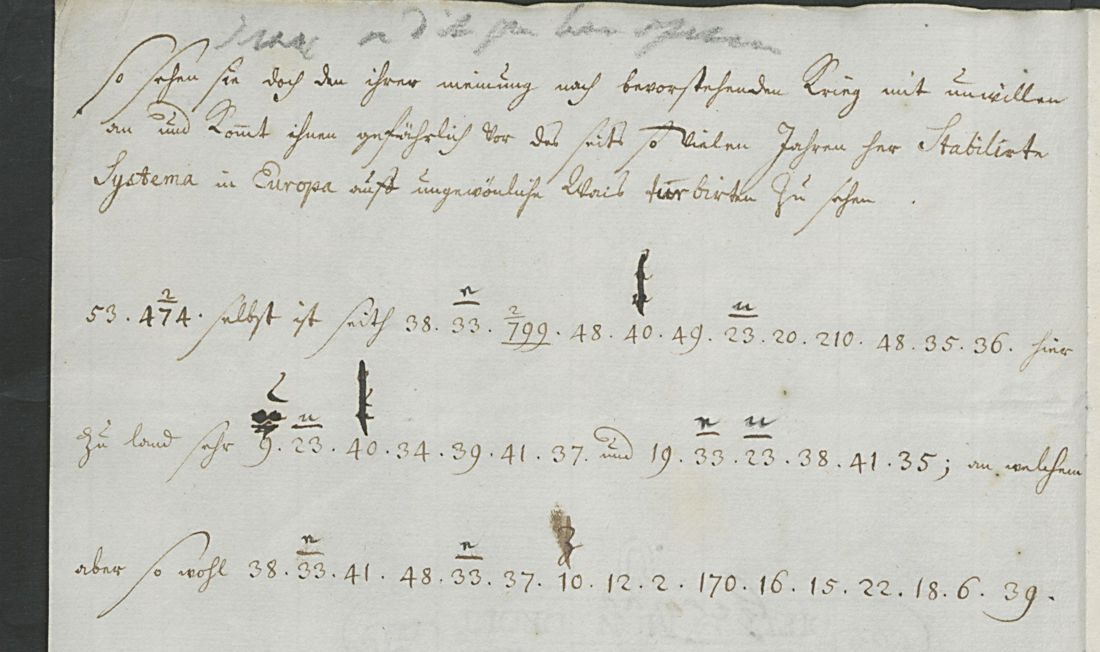
| R7927 | ff. 16–17 | Docket “Palm & Staremberg / German”. A letter fragment in German with 14 ciphered passages. Images 1 and 4 show only the other side of the leaf through the paper. |
| R7928 | f. 18 | “Count Windischgrätz & Ct Staremberg”: a letter key 1–50 with about 30 values filled in (2 b, 5 n, 8 u, 9 c, 10 i, 20 o, 40 r …). |
| R7929 | ff. 19–40 | The Emperor to Starhemberg, 42 pp., marked “Decrypted”. No images on DECODE. |
| R7930 | f. 41 | Cover “Palm to Visconti 1727 … Visconti to Palm”. On the verso is a decipherer’s tally grid, 1–500 (Addresse 21, Hollande 109, Italie 120, Traité 215, syllables in the 300s and 400s, several nulls). This is a different system, and no ciphertext is imaged. |
02 The cipher of R7927
162 letter tokens across 47 values (2–79) and 23 code tokens across 10 values: 124, 138, 170 (five times), 210 (three), 230 = der (six), 380, 423, 432, 474 and 799. The glosses, in German Kurrent script, give 33 = e, 23 = n, 10 = d, 15 = t, 40 = ſ, and probably 9 = u and 4 = z. The clear text concerns how England saw the war then coming over Gibraltar and the Hanover alliance, and the rumours that a rupture would bring (“dass im Fall es zu einer Ruptur kommen solte, man …”). One passage ends in … d ſ ? e t z e n zu bringen.
03 What was tried
- The R7928 key applied to the passages: it gives 40 = r and 23 = u where the glosses have ſ and n. Ruled out.
- Simulated annealing on the letter values (the project’s
de-modern5-gram model), with the codes drawn from a list of German words and syllables and the clear context kept for scoring. With and without the gloss values fixed, the output was not German. - A control on synthetic German of the same shape (162 letter tokens over 47 values), with the true values of the six commonest symbols fixed, recovered only 44–50% of the tokens. At that rate the text cannot be made out, so a text of this length cannot be deciphered without the key.
- A web search for a printed decipherment of Palm’s 1727 intercepts found nothing.
04 What remains
None of the fourteen passages was deciphered. With about two homophones per letter and only 162 letter tokens, a ciphertext-only attack has too little to work on. What is needed: Palm’s Imperial cipher (Vienna, HHStA, England, Berichte 1727), the Deciphering Branch’s clear copy (other Willes volumes, SP 107), or images of R7929.
05 Sources
Transcription, glosses and solver scripts: palm1727/.