At a glanceKnown key applied · partial (92% of the cipher)
- The letters
- Marshal Jourdan, King Joseph’s chief of staff, to Marshal Soult, commanding the Army of the South, Madrid, 28 May 1812; and Marshal Marmont, commanding the Army of Portugal, to Jourdan, Salamanca, 1 June 1812. Both were intercepted and survive in Spanish copies that keep the cipher passages as numbers.
- Where
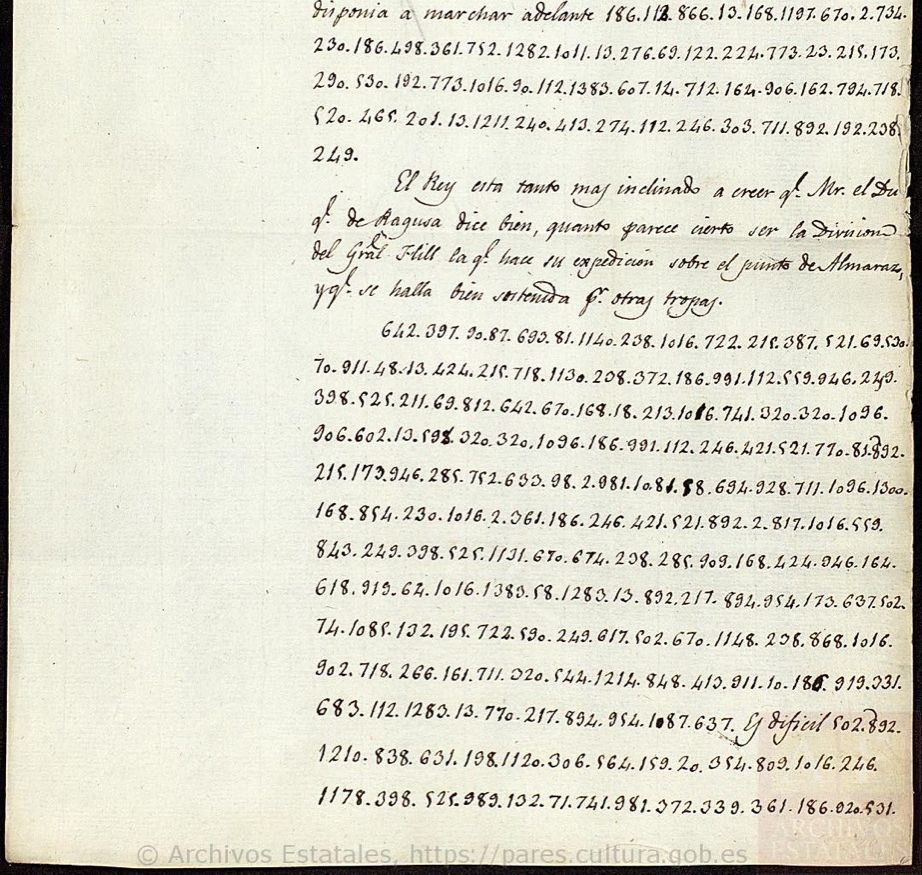
- Archivo Histórico Nacional (Madrid), Diversos-Colecciones 134, N.34 (Jourdan’s letter, in a Spanish translation of the time, PARES 3156392, images 2–3) and N.73 (Marmont’s, PARES 3109832, images 2–3; catalogue no. 751 here).
- The cipher
- The Grand Chiffre of 1812, which the British called the Great Paris Cipher: a table of numbers for letters, syllables, words and names, extended to 1,400 with additions for Spain (1300 Lord Wellington, 1383 the Tagus), with several numbers for frequent words.
- How it was deciphered
- With the French deciphering table of the time (Service historique de la Défense, “B n° 30”), whose cells Brice Dudout read on Jean-François Bouchaudy’s photographs and froze before decoding. Jourdan’s letter was kept out of that work: decoded with the frozen entries, it scores above 998 of 1,000 tables with the values shuffled.
- What they say
- Jourdan orders Soult to reinforce Count d’Erlon’s corps so that it can beat General Hill on the Guadiana or, if Wellington calls Hill back, to send it over the Tagus at the bridge of the Arzobispo to cover Madrid. Marmont writes that only certainty and great operations begun in the South could outweigh an operation in the North.
- Still open
- In Jourdan’s letter, eight numbers that do not give the expected value and are restored from the sense. In Marmont’s, about 26 of 176 numbers: the Spanish copy has too many miscopied figures. Scovell, Wellington’s cipher officer, deciphered Marmont’s letter in 1812; his decipherment was never printed.
- Credit
- Brice Dudout (Europe chiffrée), working with Claude Opus 5.5: the table cells read and frozen, both transcriptions, the held-out test, the French text and the English translation. His write-up. The deciphering table of the time is kept at the Service historique de la Défense; the photographs of it are Jean-François Bouchaudy’s.
01 The two letters
On 19 May 1812 General Hill took and destroyed the forts and the pontoon bridge at Almaraz, the only solid crossing of the Tagus between Marmont’s Army of Portugal and Soult’s Army of the South. Joseph, now commander-in-chief in Spain, with Marshal Jourdan as his chief of staff, was trying to bring into action the corps of Count d’Erlon (General Drouet), detached from Soult’s army. Eight weeks later, on 22 July, Wellington beat Marmont at Salamanca.
The Archivo Histórico Nacional keeps, in the Depósito de la Guerra papers of its Diversos-Colecciones, French despatches of that year that fell into Spanish hands. Two of them are in the Grand Chiffre:
- Diversos-Colecciones 134, N.34: a Spanish translation, made at the time, of Jourdan’s letter to Soult (“el Mariscal Duque de Dalmacia”), Madrid, 28 May 1812, initialled “Monsalud”. The translator put the clear parts into Spanish and copied the three cipher passages as numbers, 267 in all, without deciphering them.
- Diversos-Colecciones 134, N.73: a copy of Marmont’s letter to Jourdan, Salamanca, 1 June 1812, in a Spanish hand, with its cipher passages as numbers, 176 in all. Catalogue no. 751 here.
A third piece of the same collection, Colonel Jardet to Marmont, Paris, 6 March 1812 (133, N.29; catalogue no. 724), is in a different cipher and needs no work: it is a copia descifrada conforme, the Spaniards’ full decipherment, with their reconstruction of its key attached, 48 numbers built on a line of Voltaire’s Tancrède, “À tous les cœurs bien nés que la patrie est chère”, with the numbers from 49 up as nulls. It is also no. 1 of George Scovell’s file of intercepted ciphers (Oman, A History of the Peninsular War V, appendix XV).
02 The cipher and its table
The Grand Chiffre of 1812, which the British called the Great Paris Cipher, is a repertory of 1,200 numbers for letters, syllables and words, extended to 1,400 with additions for Spain: 1211 l’armée du Centre, 1214 l’armée anglaise, 1300 Lord Wellington, 1383 le Tage. Frequent words have several numbers. The groups are written with points between them, and words are spelled out of syllables where the table has no entry: 909 168 424 946 is Mi-ra-ve-te, 217 894 954 173 637 Ar-zo-bi-s-po.
The French deciphering table survives at the Service historique de la Défense (“B n° 30”), and Jean-François Bouchaudy has published photographs of it. Brice Dudout had already read 226 of its entries to decipher a letter of King Joseph of December 1812 (his edition); for these letters he read the cells they needed. The entries used are in targets/marmont1812/key_1812_entries.tsv, each with the source of its reading; the photographs are not reproduced.
03 How it was deciphered
No cryptanalysis. The numbers 2–1400 of Army of Portugal traffic in 1812 pointed to the Grand Chiffre, and the first line of Marmont’s letter, decoded with the 226 entries already read, gave French. The rest is applying the table of the time unchanged.
A frozen table and a held-out letter. Both transcriptions were frozen with a SHA-256 hash. The cells needed for Marmont’s letter were transcribed from the photographs and frozen; Jourdan’s letter was kept out of that work and decoded only afterwards. Each decoding, taking the main value of every entry with no correction by the sense, was scored with a French letter-trigram model learnt on an independent text (Marmont’s Mémoires, vol. IV) against 1,000 tables in which the same values are given to the numbers at random. Jourdan’s letter scores −2.184 with the frozen entries, against −2.217 at the 99th percentile of the shuffled tables, and only 2 of the 1,000 score higher; after seven cells were looked at again on the table (424, 132, 276, 1120, 525, 320, 642, kept in a separate list), none does. Marmont’s letter passes narrowly with the frozen entries (−2.248 against −2.249) and clearly after the re-readings. Two word-coverage scores tried afterwards did not separate the real table from the shuffled ones, because long multi-word entries flatter the shuffled tables, and they are not used.
The text. Every number was then given its value and the French built into sentences, checked against Jourdan’s parallel letter to Marmont of the same day, printed in Marmont’s Mémoires, and his order to d’Erlon of 7 May 1812 (Du Casse, Mémoires du roi Joseph IX, p. 6), which use some of the same words.
04 Jourdan to Soult
Brice Dudout’s text of the three cipher passages; the clear parts of the letter, which the Spanish copy gives in translation, are summarised. {x} probable reading; [x] restored from the sense.
The letter opens in clear: the King has received a letter of the 26th from Marmont (the Duke of Ragusa), who reports that Wellington is north of the Tagus with his whole army except Hill’s division, that the English army will have moved against him by about the 8th, and that two divisions have already crossed the Douro. Then the first cipher passage:
le duc de Raguse a rappelé à lui la division {Foy}, de manière qu’il ne va plus rester dans la vallée du Tage que trois bataillons et environ huit cents chevaux de l’armée du Centre, sous les ordres du général Treillar[d].
The Duke of Ragusa has recalled Foy’s division to him, so that there will remain in the Tagus valley only three battalions and about eight hundred horse of the Army of the Centre, under the orders of General Treillard.
A clear paragraph follows: the King believes Marmont all the more because it is Hill’s division that has made the expedition against the bridge of Almaraz, well supported by other troops. Then the orders, in cipher:
Vous sentez, monsieur le maréchal, que dans cette circonstance vous deve[z] renf[or]cer le corps du comte d’Er{lon} autant que cela vous sera possible, afin de le me{tt}re en état de [ba]{tt}re le corps du général Hill s’il reste sur la Guadiana. Si [au] contraire lord Wellington rappelle à lui le général Hill, alors le comte d’Er{lon} doit se porter sur Miravete et venir pas[ser] le Tage au pont de l’Arzobispo, pour co[u]vrir Madrid ou pour se porter sur le flan[c] droi{t} de l’armée anglaise, suivant les circonstances. Le passage du pont de l’Arzobispo es difícil pour l’artillerie, mais il n’est pas impraticable. Le général d’Er{lon} devroit me[ner] avec lui le moins el equipaje posible. Es muy importante que este general se ponga en correspondencia avec le général Treillar[d], qui va commander dans la vallée du Tage.
You will feel, Monsieur le Maréchal, that in this situation you must reinforce Count d’Erlon’s corps as much as you can, so as to enable it to beat General Hill’s corps if he stays on the Guadiana. If on the contrary Lord Wellington calls General Hill back to him, then Count d’Erlon must move on Miravete and come to cross the Tagus at the bridge of the Arzobispo, to cover Madrid or to move against the right flank of the English army, as circumstances require. The passage of the bridge of the Arzobispo [is difficult] for the artillery, but it is not impracticable. General d’Erlon should take with him as little [baggage as possible. It is very important that this general put himself in correspondence] with General Treillard, who is to command in the Tagus valley.
The words in Spanish were in clear in the original; the translator put them into Spanish with the rest of the clear text, and the English gives them in brackets. The third cipher passage, from avec le général Treillard, ends the orders; the clear closing is signed Jourdan, “Mariscal del Imperio, Jefe del E. M. de S. M. C.”
05 Marmont to Jourdan
Marmont’s letter of 1 June, from Salamanca, is in the same cipher, but the copy is poor: the Spanish copyist confused the forms of 1, wrote 3 for 9 and the reverse, and transposed figures. About 150 of its 176 numbers give a value (about 85%), and some 26 do not. The passages that build sentences, as Brice Dudout gives them, with a few words restored from the sense:
“C’est qu’il n’y a qu’une certitude absolue et des opérations capitales commencées dans le Midi qui puissent l’emporter sur les probabilités d’une opération dans le Nord”; “J’écris itérativement au général Caffarelli”; “Il serait bien désirable que le général Drouet suivît les mouvements du général Hill”; “en préparant un matériel d’artillerie à Talavera”.
“It is that only an absolute certainty and capital operations begun in the South could outweigh the probabilities of an operation in the North”; “I write repeatedly to General Caffarelli”; “It would be most desirable that General Drouet should follow the movements of General Hill”; “by preparing artillery material at Talavera”.
Wellington had this letter too. On 7 June 1812 he wrote that he had “one intercepted letter from Marmont to Jourdan; which I am endeavoring to decipher” (Gurwood, Dispatches IX). It is no. 28 of George Scovell’s file of ciphers; his manuscript decipherment of it has never been printed, and Oman gives only a one-line summary. The line-by-line decoding of what this copy gives is under Full texts below; Brice Dudout’s working notes on it are in reading_N73_partial.md.
06 The people and places
- Foy’s division, of the Army of Portugal, had been guarding the Tagus valley. Foy’s name is written 1011, a cell given as “Foi s” in Brice Dudout’s notes and as “soir” in his list of entries: the reading {Foy} is probable.
- Treillard commanded the troops of the Army of the Centre in the Tagus valley.
- Miravete is the pass and fort above Almaraz; the bridge of the Arzobispo crosses the Tagus upstream, on the Talavera road. Jourdan’s parallel letter to Marmont of the same day calls it difficult for the artillery, “but I do not think it impracticable”, and speaks of the same eight hundred horse.
- Monsalud. The Marqués de Monsalud commanded Spanish troops in Extremadura. On 11 June 1812 Wellington wrote to Hill that Monsalud believed Joseph had ordered Soult to approach the Tagus, but “did not send me the paper on which he founds this notion”. The paper may be this copy; that is only a hypothesis.
07 What remains uncertain
Jourdan’s letter. Of 267 numbers, 259 give their value in the table (97.0%): 250 certain and 9 probable. By the project’s grades the certain values are H (read from the key of the time), the probable ones M, and the restorations I. Eight numbers do not give the expected syllable and are restored from the sense: 208 renf[or]cer, 598 [ba]ttre, 88 [au] contraire, 62 pas[ser], 1085 co[u]vrir, 266 flan[c], and 981 372 me[ner]. They are copying errors by the translator, who at places confuses 1 and 7, 3 and 9, 5 and 6, or cells the photographs do not show clearly. The probable readings are 320 (a T-shaped cell), 525 lon and 1011 {Foy}.
Two observations made here on the PARES image, not part of the contributed text and not checked against the table: the number transcribed 88 (line D5) has an overwritten first figure that looks like the copyist’s 5, and 58 is aux in the table, which, read au as in line D8 (58 before pont), would give au contraire without a restoration; and the number transcribed 62 (line D8) ends in a figure shaped like the 4 of 74 on the next line, so it may be 64, a cell not yet transcribed from the table.
Marmont’s letter. About 26 of its 176 numbers are unresolved and several words are restored; the passages around them do not build sentences. The Spanish copy is the limit: a better copy would settle them, the intercepted original among Scovell’s papers or the French minute; neither has been consulted.
Earlier work. Jourdan’s letter to Soult is not in Scovell’s list (Oman V, appendix XV, where nos. 26–27 are letters of 26 May to Soult on the fall of Almaraz), nor in Du Casse’s Mémoires du roi Joseph IX, Marmont’s Mémoires IV, Jourdan’s Mémoires militaires, Wellington’s Dispatches IX or his Supplementary Despatches VII (Brice Dudout’s search, 28 October 2026). No decipherment of it was found.
Full texts
The transcription and the decryption of every document on this page, so that the reading can be used and checked. Short files are shown here; all are in the repository.
Jourdan to Soult, Madrid, 28 May 1812 (AHN DIVERSOS-COLECCIONES,134,N.34)
Eight weeks before the battle of Salamanca, Marshal Jourdan, King Joseph’s chief of staff, orders Soult to reinforce Count d’Erlon’s corps against General Hill, or to send it across the Tagus at the bridge of the Arzobispo if Wellington calls Hill back to him. The letter was intercepted: a contemporary Spanish translation survives in the Archivo Histórico Nacional, with the enciphered passages left as numbers, undeciphered. They read with the table of the 1812 Grand Chiffre.
Transcription
# AHN, DIVERSOS-COLECCIONES,134,N.34 (PARES 3156392), images 2-3: Spanish translation of Jourdan to Soult, Madrid, 28 May 1812,
# the enciphered passages left as numbers. One row per manuscript line of numbers (labels C/D/E = the three cipher passages).
# a|b = doubtful digit, first reading preferred. Transcription frozen (SHA-256 fab99409...) before the table cells were read.
C1	186 112|122 866 13 168 1197 670 2 734
C2	230 186 498 361 752 1282 1011 13 276 69 122 224 773 23 215 173
C3	290 530 192 773 1016 90 112 1383 607 14 712 164 906 162 794 718
C4	520 465 201 13 1211 240 413 274 112 246 303 711 892 192 238 249
D1	642 397 90 87 693 81 1140 238 1016 722 215 387 521 69 530
D2	70 911 48 13 424 215 718 1130 208 372 186 991 112 559 946 249
D3	398 525 211 69 812 642 670 168 18 213 1016 741 320 320 1096
D4	906 602 13 598 320 320 1096 186 991 112 246 421 521 770 81 892
D5	215 173 946 285 752 633 98 2 981 10 81 88 694 928 711 1096 1300
D6	168 854 230 1016 2 361 186 246 421 521 892 2 817 1016 559
D7	843 249 398 525 1131 670 674 238 285 909 168 424 946 164
D8	618 919 62 1016 1383 58 1283 13 892 217 894 954 173 637 502
D9	74 1085 132 195 722 590 249 617 502 670 1148 238 868 1016
D10	902 718 266 161 711 320 544 1214 848 413 911 10 186 919 331
D11	683 112 1283 13 770 217 894 954 1087 637
D11b	502 892
D12	1210 838 631 198 1120 306 564 159 20 354 809 1016 246
D13	1178 398 525 989 132 71 741 981 372 339 361 186 920 531
E1	339 186 246 303 711 521 752 238 188
E2	773 390 238 530 752 773 663 90 112 1383
Decryption
# AHN, DIVERSOS-COLECCIONES,134,N.34 (PARES 3156392), images 2-3: Spanish translation of Jourdan to Soult, Madrid, 28 May 1812,
# the enciphered passages left as numbers. One row per manuscript line of numbers (labels C/D/E = the three cipher passages).
# a|b = doubtful digit, first reading preferred. Transcription frozen (SHA-256 fab99409...) before the table cells were read.
C1	186 112|122 866 13 168 1197 670 2 734
	le · du/il · C · de · ra · gu · se · a · ra
C2	230 186 498 361 752 1282 1011 13 276 69 122 224 773 23 215 173
	pe · le · a · lui · la · division · soir · de · manière · que · il · ne · va · plus · re · s
C3	290 530 192 773 1016 90 112 1383 607 14 712 164 906 162 794 718
	ter · dans · la · va · le · E · du · le Tage · que · trois · bataille · et · en · vis · ro · n
C4	520 465 201 13 1211 240 413 274 112 246 303 711 892 192 238 249
	huit · cent · Cheval · de · l'armée du centre · sous · les · ordre · du · général · tre · J · L · la · R · D
D1	642 397 90 87 693 81 1140 238 1016 722 215 387 521 69 530
	Vous · sent · E · z · mon · si · eux · R · le · ma · re · cha · L · que · dans
D2	70 911 48 13 424 215 718 1130 208 372 186 991 112 559 946 249
	cet · circonstance · vous · de · ve · re · n · f · quel · cer · le · corps · du · compagnie · té · D
D3	398 525 211 69 812 642 670 168 18 213 1016 741 320 320 1096
	er · lon · autant · que · cela · Vous · se · ra · possible · afin de · le · me · T · T · re
D4	906 602 13 598 320 320 1096 186 991 112 246 421 521 770 81 892
	en · État · de · en · T · T · re · le · corps · du · général · hi · L · L · si · L
D5	215 173 946 285 752 633 98 2 981 10 81 88 694 928 711 1096 1300
	re · s · té · sur · la · qua · di · a · na · . · si · tenir · con · tra · J · re · Lord Wellington
D6	168 854 230 1016 2 361 186 246 421 521 892 2 817 1016 559
	ra · p · pe · le · a · lui · le · général · hi · L · L · a · lors · le · compagnie
D7	843 249 398 525 1131 670 674 238 285 909 168 424 946 164
	te · D · er · lon · dois · se · port · R · sur · mis · ra · ve · té · et
D8	618 919 62 1016 1383 58 1283 13 892 217 894 954 173 637 502
	venir · pas · ga · le · le Tage · aux · pont · de · L · ar · zo · bi · s · po · pour
D9	74 1085 132 195 722 590 249 617 502 670 1148 238 868 1016
	co · nef? · vr · ir · ma · dri · D · ou · pour · se · port · R · sur · le
D10	902 718 266 161 711 320 544 1214 848 413 911 10 186 919 331
	fla · n · Naples · dro · J · T · de · l'armée anglaise · suivant · les · circonstance · . · le · pas · sa
D11	683 112 1283 13 770 217 894 954 1087 637
	ge · du · pont · de · L · ar · zo · bi · S · po
D11b	502 892
	pour · L
D12	1210 838 631 198 1120 306 564 159 20 354 809 1016 246
	Artillerie · mais · il · ne · st · pas · im · pra · ti · ca · ble · le · général
D13	1178 398 525 989 132 71 741 981 372 339 361 186 920 531
	D · er · lon · de · vr · oit · me · na · cer · avec · lui · le · mo · ins
E1	339 186 246 303 711 521 752 238 188
	avec · le · général · tre · J · L · la · R · qui
E2	773 390 238 530 752 773 663 90 112 1383
	va · commande · R · dans · la · va · le · E · du · le Tage
Reading
# Jourdan to Soult, Madrid, 28 May 1812: established text (Spanish copy + French decipherment)

Conventions: {x} = probable reading; [x] = restored from the sense; *italics* = plain text of the copy (contemporary Spanish translation); the deciphered passages are in French, the language of the original.

*Madrid, 28 de mayo de 1812. A Mr. el Mariscal Duque de Dalmacia. Sr. Mariscal: El Rey acaba de recibir una carta del Sr. Mariscal Duque de Ragusa con fecha 26. Este Mariscal anuncia de una manera positiva que el Lord Wellington se halla al norte del Tajo con todo su ejército, excepto la división de Hill. Él sienta como cierto que sobre el día 8 todo el ejército inglés habrá hecho movimiento sobre el mismo. Ya dos divisiones han pasado el Duero, etc. Él continúa sobre Zamora a fin de apoyar al ejército de Galicia que se disponía a marchar adelante* le duc de Raguse a rappelé à lui la division {Foy}, de manière qu’il ne va plus rester dans la vallée du Tage que trois bataillons et environ huit cents chevaux de l’armée du Centre, sous les ordres du général Treillar[d].

*El Rey está tanto más inclinado a creer que Mr. el Duque de Ragusa dice bien, cuanto parece cierto ser la división del Gral. Hill la que hace su expedición sobre el puente de Almaraz, y que se halla bien sostenida por otras tropas.*

Vous sentez, monsieur le maréchal, que dans cette circonstance vous deve[z] renf[or]cer le corps du comte d’Er{lon} autant que cela vous sera possible, afin de le me{tt}re en état de [ba]{tt}re le corps du général Hill s’il reste sur la Guadiana. Si [au] contraire lord Wellington rappelle à lui le général Hill, alors le comte d’Er{lon} doit se porter sur Miravete et venir pas[ser] le Tage au pont de l’Arzobispo, pour co[u]vrir Madrid ou pour se porter sur le flan[c] droi{t} de l’armée anglaise, suivant les circonstances. Le passage du pont de l’Arzobispo *es difícil* pour l’artillerie, mais il n’est pas impraticable. Le général d’Er{lon} devroit me[ner] avec lui le moins *el equipaje posible. Es muy importante que este general se ponga en correspondencia* avec le général Treillar[d], qui va commander dans la vallée du Tage.

*Yo os pido recibáis con agrado mi consideración a vuestra persona. El Mariscal del Imperio, Jefe del E. M. de S. M. C. = Jourdan.* *[paraphe : Monsalud]*
Translation
# English translation

[Madrid, 28 May 1812. To Marshal the Duke of Dalmatia. Monsieur le Maréchal, the King has just received a letter from Marshal the Duke of Ragusa dated the 26th. This marshal states positively that Lord Wellington is north of the Tagus with his whole army, except Hill’s division. He takes it as certain that around the 8th the whole English army will have moved against him. Two divisions have already crossed the Douro, etc. He is continuing towards Zamora in order to support the army of Galicia, which was preparing to advance.] The Duke of Ragusa has recalled Foy’s division to him, so that there will remain in the Tagus valley only three battalions and about eight hundred horse of the Army of the Centre, under the orders of General Treillard.

[The King is all the more inclined to believe that the Duke of Ragusa is right, as it seems certain that it is General Hill’s division that is making its expedition against the bridge of Almaraz, and that it is well supported by other troops.]

You will feel, Monsieur le Maréchal, that in this situation you must reinforce Count d’Erlon’s corps as much as you can, so as to enable it to beat General Hill’s corps if he stays on the Guadiana. If on the contrary Lord Wellington calls General Hill back to him, then Count d’Erlon must move on Miravete and come to cross the Tagus at the bridge of the Arzobispo, to cover Madrid or to move against the right flank of the English army, as circumstances require. The passage of the bridge of the Arzobispo [is difficult] for the artillery, but it is not impracticable. General d’Erlon should take with him as little [baggage as possible. It is very important that this general put himself in correspondence] with General Treillard, who is to command in the Tagus valley.

[I beg you to accept the assurance of my consideration. The Marshal of the Empire, chief of staff of His Catholic Majesty, Jourdan.]
Marmont to Jourdan, Salamanca, 1 June 1812 (AHN DIVERSOS-COLECCIONES,134,N.73) read in part
Builds coherent sentences, but under the read bar of 95% of words read as sense; the holes are marked in the reading.
Transcription
# AHN, DIVERSOS-COLECCIONES,134,N.73 (PARES 3109832), images 2-3: copy of Marmont to Jourdan, Salamanca, 1 June 1812, with
# enciphered passages (labels A/B). a|b = doubtful digit. Transcription frozen (SHA-256 ffb8b5a5...). Read only in part (about 85%).
A1	866 229 839 718|748 507 2 513|113 372 20 235 13 1157 210 318|338 1064 314|334|354 1195 289 413 52 314 530 1036 909 98 188 432 397 521 827 674 398 285 349 891 598 934 343 895 249 1196 90 1064 530 212 142
A2	821 289 44 874 226 761 20 972 1085 365 398 402 874 1015 1112 447 1186 971 192 344 502 770 110 249 264 4
A3	4 140 349 686 224 759 1171 921|928 559 1135 1036 173 820
B1	225 1038 711 976 923 90 168 20 424 19 58 1252 502 903 109 1377 344 722 890 201 210 754
B2	1153|1193 122 670 558 57 181|188 808 69 1221 588 429 320
B3	112 246 421 770 892 971
B4	139 191 320 522 1054 361 1111
B5	906|306 370 810 1127 320 1196 722 843 1322|1522 24 1178 1210 504 1279 142 1070
B6	339 852 441 164 409 1345 436 258 810 1006 116 398 467 1134 162 495 843 498 1279 971 769 972 617 132 195 505 10 820
Decryption
# AHN, DIVERSOS-COLECCIONES,134,N.73 (PARES 3109832), images 2-3: copy of Marmont to Jourdan, Salamanca, 1 June 1812, with
# enciphered passages (labels A/B). a|b = doubtful digit. Transcription frozen (SHA-256 ffb8b5a5...). Read only in part (about 85%).
A1	866 229 839 718|748 507 2 513|113 372 20 235 13 1157 210 318|338 1064 314|334|354 1195 289 413 52 314 530 1036 909 98 188 432 397 521 827 674 398 285 349 891 598 934 343 895 249 1196 90 1064 530 212 142
	C · est · haut · n/fro · y · a · qu'un/jusque · cer · ti · tu · de · absolu · et · des/parle · opère · es/réciproque/ca · poste · ta · les · commence · es · dans · avis · mis · di · qui · puis · sent · L · em · port · er · sur · le · pro · en · ju · Corsaire · tes · D · un · E · opère · dans · Nord · ;
A2	821 289 44 874 226 761 20 972 1085 365 398 402 874 1015 1112 447 1186 971 192 344 502 770 110 249 264 4
	la · ta · Cheval · qui · annullant le précédent · par · ti · C · nef? · li · er · E · qui · m · est · impo(s)? · ce · et · la · différ e · pour · L · ennemi · D · un · succès
A3	4 140 349 686 224 759 1171 921|928 559 1135 1036 173 820
	succès · dont · le · effet · ne · tout · vent · être/tra · compagnie · pa · avis · s · 
B1	225 1038 711 976 923 90 168 20 424 19 58 1252 502 903 109 1377 344 722 890 201 210 754
	. · ¶ · J · écrit · it · E · ra · ti · ve · ment · aux · le G.al Caffarelli · pour · obten · quinze · Régiments? · différ e · ma · R · Cheval · et · qu'il
B2	1153|1193 122 670 558 57 181|188 808 69 1221 588 429 320
	./ga · il · se · roit · biens · désir/qui · able · que · G.al Drouet · suis · vit? · T
B3	112 246 421 770 892 971
	du · général · hi · L · L · et
B4	139 191 320 522 1054 361 1111
	qu'ils · fu · T · fait · pour · lui · ce
B5	906|306 370 810 1127 320 1196 722 843 1322|1522 24 1178 1210 504 1279 142 1070
	en/pas · près · par · ans · T · un · ma · te · ∅/‹1522› · il · D · Artillerie · a · Talavera · ; · car
B6	339 852 441 164 409 1345 436 258 810 1006 116 398 467 1134 162 495 843 498 1279 971 769 972 617 132 195 505 10 820
	avec · sont · Infant · et · ses · Chevaux · mande · Artillerie · par · Slo · pu · er · to · sau · vis · car · te · a · Talavera · et · ainsi · C · ou · vr · ir · Madrid · . · 
Reading
# n° 751 — lecture de travail C01 (Grand Chiffre de 1812, table SHD « B n° 30 », photos Bouchaudy)
Transcription t751_v1.txt (SHA ffb8b5a5…), entrées lues entrees_751.tsv (+ 226 entrées de joseph-napoleon-site). {x} probable, ‹x› irrésolu, [x] par le sens (souvent : chiffre mal copié par le copiste espagnol).

Contexte en clair : « La règle dont je ne me départirai pas est celle-ci. »
A1 : C'est [que]{839} n'y a qu'une certitude absolue et des opérations ca{pi}(1195)tales commencées dans [le]{1036} Midi qui puissent l'emporter sur les pro‹598 934 343›tés [probabilités ?] d'une opération dans le Nord ;
  (clair) « et je me fonde en cela sur »
A2 : la ‹289 44› [226 = « annulant le précédent »] par-ti-‹972›-{cu}(1085)-li-è-re qui m'est impo‹1186› et la différence pour l'ennemi d'un succès
  (clair) « de l'un ou de l'autre côté »
A3 : succès dont les effets ne ‹759› vent être com‹559›pa‹1036›s. 
  (clair) « … je prends toutes les dispositions qui dépendent de moi pour obtenir des succès. »
B1 : ¶ J'écris itérativement au général Caffarelli pour obtenir quinze ‹1377 344 722 890› chevaux et qu'il
  (clair) « prépare les secours dont il pourra disposer »
B2 : ‹1153›. Il serait bien désirable que [le] général Drouet (comte d'Erlon) suivît les
  (clair) « les mouvements »
B3 : du général Hill, et
  (clair) « si on n'avait pas pu établir un pont volant à Lugar nuevo »
B4 : qu'il fût fait pour lui ce
  (clair) « qui avait été prudemment fait pour moi »
B5 : en préparant un matériel [ri = 1122 pour 1322] d'artillerie à Talavera ; car
  (clair) « il pourrait se porter rapidement »
B6 : avec {son}(852) infanterie et ses chevaux ‹436› artillerie par [le]{1006} Puerto ‹1134 162› {car}te ? à Talavera, et ainsi {courir ?} ‹…› Madrid. 

Bilan : ≈ 179 groupes ; ≈ 150 lus (≈ 83 %, dont ≈ 8 corrections par le sens d'erreurs de copie probables), ≈ 26 irrésolus.
Facteurs limitants : (1) copie espagnole fautive (formes du 1 en ſ / ɤ, 3/9, chiffres transposés) ; (2) lecture des entrées sur les photos (pliures). Pas ≥ 95 %.
Translation
# Marmont to Jourdan, Salamanca, 1 June 1812 (AHN DIVERSOS-COLECCIONES,134,N.73): English translation of the working reading

DRAFT made at write-up (27 Oct 2026) from Brice Dudout's French working notes `reading_N73_partial.md`; not part of the
contributed text. Only the cipher passages and the clear phrases quoted around them in the notes are translated.
Conventions as in the notes: {x} probable reading; ‹…› unresolved; [x] restored from the sense; (clear) = a clear phrase
of the copy, as quoted in the notes.

(clear) "The rule from which I will not depart is this."

A1: It is that only an absolute certainty and ca{pi}tal operations begun in [the] South can outweigh the pro‹…›ties
[probabilities?] of an operation in the North;

(clear) "and I base myself in this on"

A2: the ‹…› parti‹…›{cu}lar [situation?] which is impo‹…› [imposed?] on me, and the difference, for the enemy, of a success

(clear) "on one side or the other"

A3: a success whose effects ‹…› [cannot?] be com‹…›pa‹…›red.

(clear) "… I am taking all the measures that depend on me to obtain successes."

B1: I am writing repeatedly to General Caffarelli to obtain fifteen ‹…› horses, and that he

(clear) "prepare the help he can spare"

B2: ‹…›. It would be most desirable that [the] General Drouet [Count d'Erlon] should follow the

(clear) "movements"

B3: of General Hill, and

(clear) "if a flying bridge could not have been set up at Lugar Nuevo"

B4: that there should be done for him what

(clear) "had prudently been done for me"

B5: by preparing artillery material at Talavera; for

(clear) "he could move rapidly"

B6: with {his} infantry and his horses ‹…› artillery by [the] Puerto ‹…› to Talavera, and so {cover?} ‹…› Madrid.
Key: key_1812_entries.tsv
08 Sources
- Archivo Histórico Nacional, DIVERSOS-COLECCIONES,134,N.34, Jourdan to Soult, Madrid, 28 May 1812, Spanish translation of the time: PARES record 3156392, images 2–3.
- Archivo Histórico Nacional, DIVERSOS-COLECCIONES,134,N.73, Marmont to Jourdan, Salamanca, 1 June 1812: PARES record 3109832, images 2–3.
- Archivo Histórico Nacional, DIVERSOS-COLECCIONES,133,N.29, Jardet to Marmont, Paris, 6 March 1812, deciphered copy with its key: PARES record 3101366, key on image 11.
- The deciphering table of the 1812 Grand Chiffre, Service historique de la Défense, “B n° 30”: photographs by Jean-François Bouchaudy, jfbouch.fr.
- Brice Dudout, Europe chiffrée: Jourdan to Marshal Soult, “You will feel, Monsieur le Maréchal…”, Madrid, 28 May 1812 (2026, CC BY 4.0): text, translation and notes; and his edition of King Joseph’s letter of December 1812 in the same table.
- Charles Oman, A History of the Peninsular War, vol. V (1914), appendix XV (Scovell’s ciphers); J. Gurwood, ed., The Dispatches of the Duke of Wellington, vol. IX; A. Du Casse, ed., Mémoires et correspondance du roi Joseph, vol. IX; Mémoires du maréchal Marmont, vol. IV.
Folder: targets/marmont1812/ (notes, the transcriptions of both letters, their line-by-line decryptions, the table entries used with the source of each reading, the French text and English translation of Jourdan’s letter and the working notes on Marmont’s, as contributed by Brice Dudout). The text and translation are his, reproduced under CC BY 4.0.