01 The document
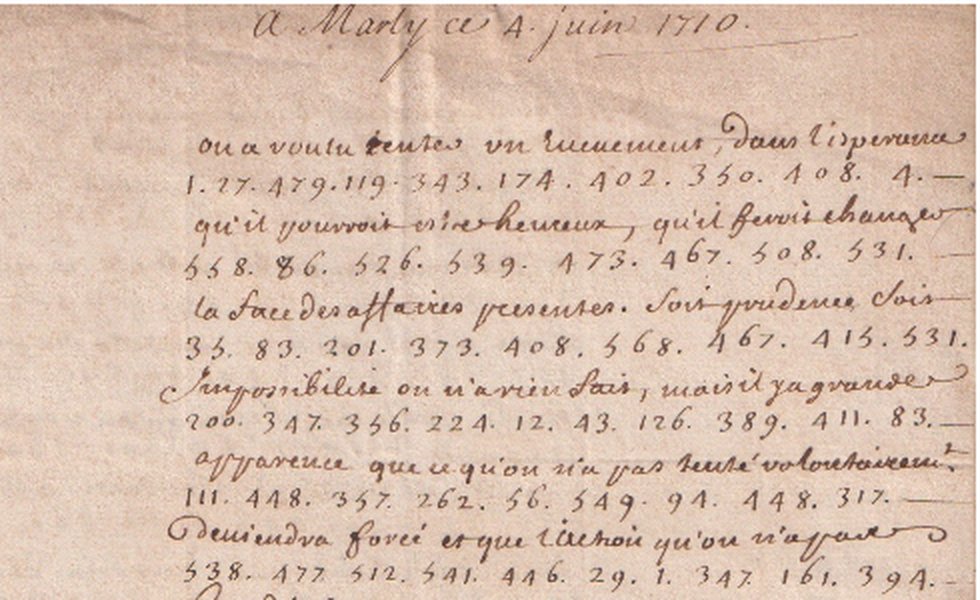
The images on DECODE are only 590 pixels wide, and some digits are uncertain (538 or 558; 115). Pages 2 (lower half) and 3 have ruled lines drawn between the figure lines, as if prepared for a decipherment that was never written. On page 3 the last group, 111, is followed on the same line by “Je suis tres parfaitement Monsieur Votre tres humble et tres obeissant serviteur”, in the same hand as the French lines above. The recipient is not named.
02 What the French lines say
Taken on its own, the prose is one continuous text. It opens: “On a voulu tenter un evenement, dans l’esperance qu’il pourroit estre heureux, qu’il seroit changer la face des affaires presentes. Soit prudence soit impossibilité on n’a rien fait, mais il y a grande apparence que ce qu’on n’a pas tenté volontairement deviendra forcé”. It goes on to the courier held back and the powers now sent, “assez estendu”, though “on ne s’y rendra pas absolument”. It asks for guarantees and explanations about the further demands: “on veut la paix, ou la veut seure, mais on veut encore menager l’honneur de son gouvernement”. It then states the condition. The demands must not go “a des demembrements entiers” and must be held to “peu de chose au dela des preliminaires”. It closes: this is “un relachement qui peut produire la paix, ce qui n’auroit pas esté selon toutes les apparences si l’on estoit demeuré fermes dans les premieres resolutions.” The subject is the French negotiation at Geertruidenberg, March to July 1710.
03 Why the French is not the decipherment
If the French were written over the figures that encode it, each group would stand for a fixed word, syllable or letter run, apart from homophones and nulls. Four models were fitted to the 34 glossed lines:
- per-line EM (expectation-maximisation) alignment, with each group standing for 0–9 letters;
- one global alignment of all the text against all the groups, with a length prior;
- per-line soft EM with bonuses for word boundaries;
- word-level EM, with each group standing for zero, one or two whole words.
None converges on a key. 111 falls under paix, seure, selon, on and apparence, and 231 under toutes, fermes and la. The run 209 92 85 sits under both “vostre courier” and “inevitable, peu”. “Demandes ulterieures” occurs twice, over 128 78 65 343 147 and over 209 64 321 161 27. A line-offset test finds only a weak excess of shared groups between lines that share French words (0.77 against 0.49 for any pair, on 22 pairs).
The numbers are a genuine code. There are 183 distinct groups in 471, where a random fill of the range would give about 320. The commonest are 111 (13 times), 224 (11), 347 and 56 (10 each). The six-group run 119 101 402 49 197 424 occurs twice, first under “dans les premieres resolutions” and again in the unglossed tail. That is the one hint that the coded text may deal with the same matter.
04 What is needed
- A clear copy or minute: Archives des Affaires étrangères, Correspondance politique Hollande for 1710 (the Torcy, Huxelles and Polignac correspondence), or Desmarets’s papers. Boislisle’s Correspondance des contrôleurs généraux III (1897) was not searched here.
- The key held on the recipient’s side, if the recipient can be identified.
- Better images: the 590-pixel scans leave a few digits in doubt.
A ciphertext-only attack on a homophonic code of about 570 values from 471 groups is not realistic.
05 Sources
- DECODE R10198, de-crypt.org/decrypt-web/RecordsView/10198 (images by login; not in the public domain).
- Transcription, alignment scripts and notes:
desmarets1710/.
Files: desmarets1710/ in the repository.