

01 The document
Add MS 4107 keeps the instructions Peterborough actually received, signed by the Queen at the head and the foot. The heading is in clear: Instructions for Our Right Trusty and Right Welbeloved Cousin and Councillor Charles Earl of Peterborow and Monmouth. Given at Our Court at St James’s the Two and Twentieth day of February 1711/2 in the Tenth Year of Our Reign. The date is Old Style, so the year is 1712, and DECODE’s range 1711–1712 refers to this one letter.
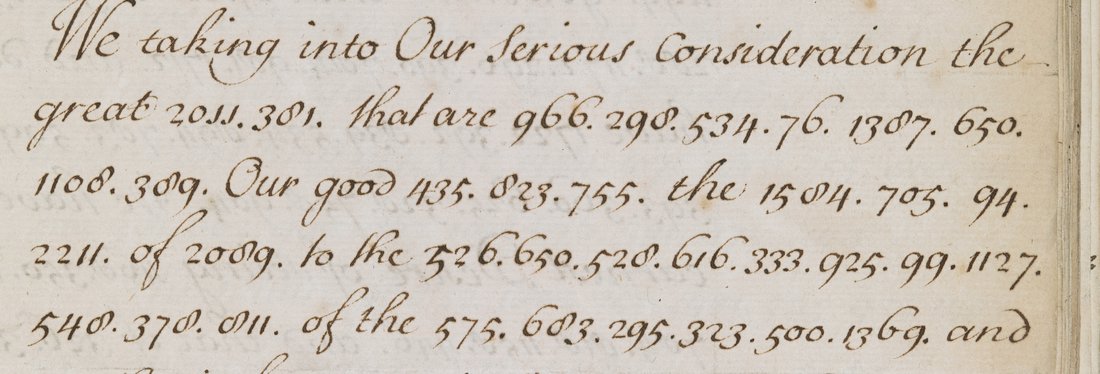
The clerk wrote the body in clear and put the words that mattered into numbers, separated by points: We taking into Our Serious Consideration the great 2011.381. that are 966.298.534.76.1387.650.1108.389. Our good 435.823.755. the 1584.705.94.2211. of 2089. In total there are 61 runs of 1 to 18 groups, 414 groups altogether, of which 242 are different, ranging from 76 to 2269. The clerk wrote 8 as a looped ơ. Two groups at the gutter of f. 184v have lost their last digit. Apart from the crop below, the British Library images are not reproduced here. They can be seen on DECODE after logging in.
02 The printed text and the match
Parke printed Bolingbroke’s papers in 1798 from the Secretary’s office copies. In a note to a letter of St John to the Queen he adds “Lord Peterborough’s instructions was as follow”, followed by the whole text with the same heading, the same date and the same closing A. R. The clear passages of the manuscript read word for word as in the print, and each code run stands where the print has a phrase:
| Run | Code | Printed text |
|---|---|---|
| 1 | 2011.381 | endeavours |
| 4–5 | 1584.705.94.2211 · 2089 | Electoral Prince · Saxony |
| 9 | 724.1604.678.1219.563.393.1893 | dishonour the Protestant interest |
| 17 | 839.534.678.523.412.303.1076.833.179 | you to the said Prince whom |
| 18 | 609.1415.705.564.1369 | his arrival at Rome |
| 43 | 385.97.894.1098 | himself |
| 44 | 422.474.373.900.609.507.1373 | abjuring his religion |
| 50–51 | 1799.900.894 · 465.355.385.466.615.755 | rescuing him · hands he is in |
| 55 | 886.354.839.1053.534.523.308.678.1285.500.1369.738 | given you leave to see the city of Rome |
| 60 | 720.425.295.335.534.2101 | come back to Turin |
The alignment for all 61 runs is in alignment.tsv. The recurring groups confirm it: they mean the same thing wherever they occur. 534 is to at all eight of its places, and 678 the, 839 you, 894 him, 466 he, 609 his, 981 your, 1068 our, 783 on and 820 this are each constant across three to seven places. 1373 is religion in all three places, and 1219.563 is Protestant twice. The same syllable 422 begins both abandon and abjuring. Before the print was found, four of these values (894 him, 466 he, 894.1098 himself, 981 your) had already been guessed from the clear words around them.
The code pads the text heavily with nulls. There are 414 groups for 232 printed words, and a single word can take four or five groups: his is written 328.333.388.467 once, and him 326.332.349.467.2269. Some words have more than one group (Prince is 1076 or 2211; Rome is 1369 or 519.488). The numbers do not follow the alphabet (466 he, 609 his, 894 him, 981 your), so this is not one of the printed one-part forms kept in SP 106/7. Two single groups have no word in the print: 91 after church of Rome and, and 261 in affairs 261 bring him. They are either nulls or small differences between the draft and the fair copy.
03 What the instructions say
The text below is as printed by Parke, with his spelling modernised. The words in bold are the ones in code in the manuscript.
We taking into our serious consideration the great endeavours that are used to pervert our good cousin, the Electoral Prince of Saxony, to the superstitious worship of the church of Rome, and the infinite prejudice and dishonour the Protestant interest would suffer if so considerable a Prince, in whose country the reformation first began, should abandon the principles of our most holy religion, think it a duty incumbent on us to prevent, as far as in us lies, so fatal a blow. For that end, we have taken the resolution of sending you to the said Prince, whom you are to join, if possible, before his arrival at Rome, yet in such a manner that your falling-in with him may appear merely accidental: but whether you meet him on the road, or find him at Rome, you shall take a proper opportunity to deliver our letter to him, accompanying it with expressions of our friendship and real concern for his prosperity. You shall endeavour to insinuate yourself into his good opinion, and, as occasion offers, urge the strongest arguments you can for keeping him steady to the Protestant religion. If you find your representations make any impression upon his mind, you shall then open to him the subject of your commission, and declare that we have dispatched you to him on purpose to let him know that we have still the same earnest desire of seeing him which we have so often expressed; and that if he persists in those good resolutions he formerly had, to adhere firmly to the religion in which he was educated, he may depend upon a friendly and honourable reception in our Court, in case his inclination or the situation of his affairs bring him this way. If, upon discourse with him, you shall discover that he apprehends himself under a necessity of abjuring his religion, to avoid the dangers and difficulties he will otherwise be exposed to, and that he has an inclination to make his escape, you may concert with him the proper measures for rescuing him out of the hands he is in, and bringing him safe to our dominions, or those of any other Protestant Prince or State.
If you should happen to be arrived at Turin when these our instructions are delivered to you, you shall acquaint the Duke of Savoy that, in compliance with your request, we have given you leave to see the city of Rome; for you are by all means to prevent any suspicion of the true intent of your going thither.
The nature of this service in which we now employ you is such, that we can neither enjoin you to correspond with either of our Secretaries of State, nor limit the time of your return; we therefore leave it entirely to your discretion and prudence to come back to Turin when you shall judge your attendance on the Prince of no further use.
The Prince was Frederick Augustus, son of Augustus the Strong and later Augustus III of Poland. Parke’s note explains that, expecting to marry a Catholic archduchess, the Prince “was about to set off for Rome, to abjure the Protestant religion”. The clerk put into code everything that named the Prince, the religion, or the mission and its cover story. The courtesies and the instructions about conduct stayed in clear.
04 What remains uncertain
- The code table. Only about twenty values are established. No key on DECODE fits: all of SP 106 boxes 6–8 and every transcribed British, TNA or Bodleian key dated 1690–1730 were tested against 894 him, 466 he, 1098 self and 981 your. The name list in BL Add MS 61575 ff. 62–65 is Marlborough’s and is not this code.
- Groups 91 and 261, which have no counterpart in the print, and the final digits of the two gutter groups (52?, 33?).
- Small differences in wording between Parke’s office draft and the signed original cannot be excluded inside the code runs. The run lengths do not show any.
05 Sources
- British Library, Add MS 4107 ff. 184r, 184v, 185r, via DECODE R4878 (images by login; not in the public domain).
- Gilbert Parke (ed.), Letters and Correspondence, Public and Private, of the Right Honourable Henry St. John, Lord Visc. Bolingbroke, vol. 1 (London 1798), pp. 310–311 (archive.org).
Transcription, alignment and notes: anne1711/.