
At a glanceExisting decipherment · partial · 29 of 88 cipher signs
- The letters
- Jan Amos Comenius at Leszno to Andreas Klobusiczky, prefect of Sárospatak for George II Rákóczi of Transylvania, 1655. Two letters carry a cipher passage: 24 May (unsigned) and 4 August (unsigned, the sentence after the signature).
- Where
- Originals in the Hungarian National Archives, MNL OL, E 190 (Rákóczi family archive), not seen. Used here in print: Szilágyi, Monumenta Hungariae Historica, Diplomataria XXIII (1874) nos. CIII and CXXIX, and Patera, Jana Amosa Komenského korrespondence (1892) nos. CLII and CLIV. Item 474 of the project’s catalogue of open ciphers.
- The cipher
- A reciprocal letter substitution (a↔m, b↔i, c↔p, s↔t …) inside clear Latin, word division kept. The same table is printed in MHH XXIII p. 740 as the secret script of Rákóczi’s envoys at the Porte.
- How it was deciphered
- The August sentence was deciphered in print by Szilágyi (1890) and Patera (1892). WAINUT transcribed both passages and rebuilt the key from that decipherment; the review found the key printed in 1874: all 12 letter values agree.
- What it says
- Nihil certius quam Poloniam periisse, et papatum in illa: “nothing is more certain than that Poland has perished, and the papacy in it”, written as the Swedes took Great Poland.
- Still open
- The 24 May passage (50 letters and three numbers), the word (iyy), and one letter of the August sentence that the key reads as m where the decipherment has a.
- Credit
- WAINUT (pull request #102, 27 October 2026): transcription, key rebuilt and checked, attacks on the May passage. Adolf Patera (1892) and Sándor Szilágyi (1890) printed the decipherment; Szilágyi printed the key table in 1874.
01 The letters
In 1655 Comenius was at Leszno (Lissa) in Great Poland, bishop of the Unity of Brethren, and a correspondent of the Rákóczi court at Sárospatak, where he had taught from 1650 to 1654. He sent news of Poland, Sweden and England to Andreas Klobusiczky, the prince’s councillor and prefect of Sárospatak, and through him to George II Rákóczi, whom he was urging towards an alliance with Sweden. Constantin Schaum, Rákóczi’s secretary, was then travelling to Sweden, Denmark, Holland and England on the prince’s business, and his letters came back by way of Comenius.
Five letters to Klobusiczky survive from May to September 1655. Szilágyi printed them in Monumenta Hungariae Historica XXIII (1874) and again, with notes, in Erdély és az északkeleti háború I (1890); Patera printed them in his edition of Comenius’s correspondence (1892). Two carry a letter cipher:
| letter | Patera 1892 | MHH XXIII 1874 | secret text |
|---|---|---|---|
| 20 May | CLI, pp. 177–178 | none; the April letters to be read “as the Schaum papers must be, by agreement” | |
| 24 May | CLII, p. 178 | CIII, pp. 178–179 | cipher passage, not deciphered |
| 22 July | CLIII, pp. 179–180 | secret phrases and an invisible-ink page (section 05) | |
| 4 August | CLIV, p. 182 | CXXIX, pp. 217–219 | cipher sentence, deciphered in print |
| 6 September | CLV, pp. 182–183 | secret phrases, printed in clear (section 05) |
The originals are in the Rákóczi family archive of the Hungarian National Archives (MNL OL E 190). They were not seen; everything here rests on the page images of the printed editions, read on archive.org.
02 The sentence of 4 August
The letter of 4 August reports the surrender of Great Poland to the Swedes, the army Comenius saw at Poznań, the flight of the Catholic clergy and the seizure of their goods. It ends Tuus totus, with no signature, and under it, as both editions print it:
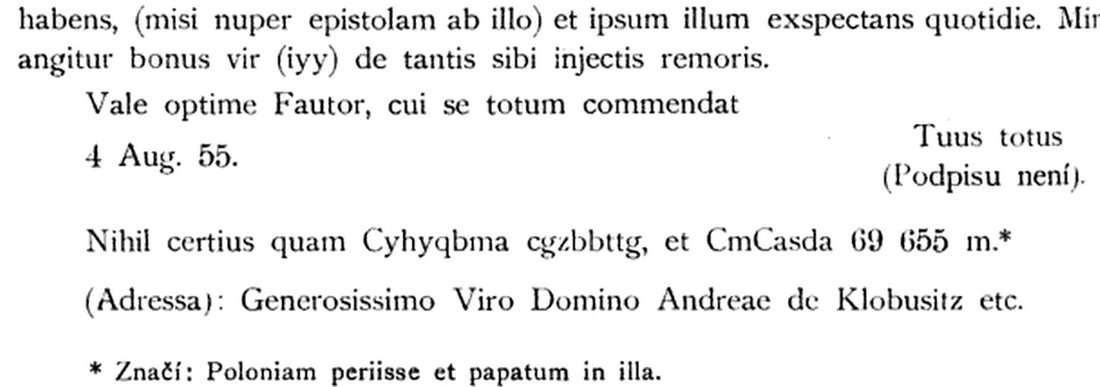
Nihil certius quam Cyhyqbma cgzbbttg, et CmCasda 69 655 m. The first three words and et are clear. Szilágyi’s note of 1890 (p. 393) gives the decipherment first: A titkos jegyekkel írt utóírás így hangzik, “the postscript written in secret signs reads: nihil certius, quam Poloniam periisse, et papatum in illa”. Patera repeats it in 1892. Neither says who deciphered it.
Laid against that decipherment the cipher gives a key sign by sign (check.py):
| cipher | sign by sign | plain |
|---|---|---|
| Cyhyqbma | C=p y=o h=l y=o q=n b=i m=a a=m | poloniam |
| cgzbbttg | c=p g=e z=r b=i b=i t=s t=s g=e | periisse |
| et | clear | et |
| CmCasda | C=p m=a C=p a=m s=t d=u a=m | papmtum, printed papatum |
| 69 | 6=i 9=n | in |
| 655 m | 6=i 5=l 5=l m=a | illa |
One letter does not fit. Cipher a is plain m in poloniam and at the end of papatum, but the fourth letter of CmCasda is also a, so the key gives papmtum. Both editions print a there (checked on the page images). Either the writer slipped into the plain letter, or the printers read an m (cipher m = plain a) in the hand as a. The word can only be papatum, and the printed decipherment has it; the conflict is kept visible in the reveal below.
Two controls show the key is not fitted to noise: a shuffled key gives ltptnman lremmuur et lalnion is illa, and the right key on letters shuffled inside each word gives nolmioap rispeesi et pmautmp in lali.
Nihil certius quam Poloniam periisse, et papatum in illa.
“Nothing is more certain than that Poland has perished, and the papacy in it.”
The cipher hides the one sentence that draws the conclusion from the news above it. Near the end of the same letter the clear text has a single odd word: Mire angitur bonus vir (iyy) de tantis sibi injectis remoris, “the good man (iyy) is wonderfully troubled by the great delays put in his way”, just after news of Schaum. MHH sets iyy in italic, as it sets cipher; under the key it gives boo, which is not Latin. It may be a misprint or a code name, and stays open.
03 The key, printed in 1874
The values above form pairs: a stands for m and m for a, s for t and t for s. WAINUT noted this and called a reciprocal table a guess. It is in print. At the very end of MHH XXIII, after the glossary, Szilágyi printed “the key of the secret script used by Harsányi and Máté Balogh”, Rákóczi’s envoys at Constantinople:
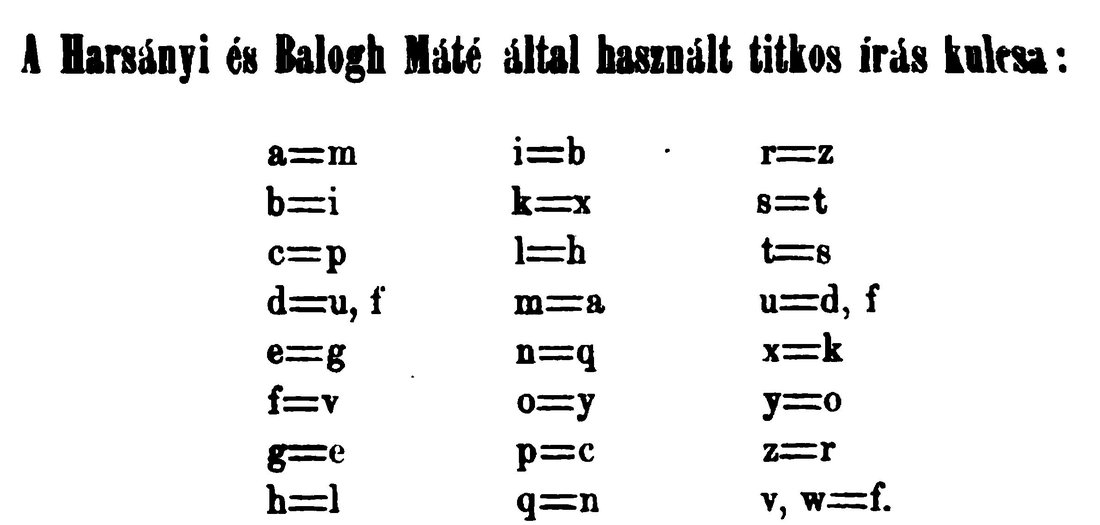
All twelve letter values rebuilt from the August sentence agree with it (check.py: 12 of 12). So Comenius was writing in the Rákóczi court’s own table, which Klobusiczky had at hand, and anyone with the 1874 volume could have deciphered the sentence; Szilágyi, who printed both, may well have done so for his 1890 note.
The digits. The printed table has no digits, yet the printed sentence has 6, 9 and 5 for i, n and l. In the table those letters are b, q and h, and a hand’s b, q and h are easily taken for 6, 9 and 5. 69 655m is very probably bq bhhm as the printer read it, and the cipher a plain reciprocal table without digit homophones. Patera’s text of these letters follows MHH, so one misreading would appear in both; only the original can settle it.
04 The passage of 24 May
On 24 May Comenius quotes, “in these words”, a friend’s letter from England of 23 April: Schaum had not yet arrived; the Polish and Swedish envoys in London; the Waldensians and Cromwell; the fleet in America. Then comes the cipher, in italic in both editions, then a postscript, Tandem appulit, cum has clauderem, dominus Schaum, which answers the English friend’s “not yet” and so seems to belong to the quoted letter. The cipher may therefore stand inside the English letter. MHH printed this letter as by “the Rákóczis’ Polish correspondent”; Szilágyi identified it as Comenius’s in 1890.

Lmqſxmyo. 7. Gpdlmuoyqnotlses: Pnofeyprp 865, ap 73 pyſ: pdyp: Xyopatus etc. etc. Fifty letters of seventeen kinds and three numbers, word lengths 8, 16, 9, 2, 3, 4, 8. It does not decipher:
- The Rákóczi table gives hantkaoy … ecuhadyonqyshtgt cqyvgoczc … cot cuoc koycmsdt. Read with the digit shapes of August, 865 would be ?il, perhaps nil, but the words around it are not Latin. With Caesar shifts added before or after the table, on 23-, 25- and 26-letter alphabets, and scored in Latin, English, German, Hungarian and Polish, the best result is −4.9 per character against −1.7 for the August plaintext.
- Keyword ciphers (Vigenère, Beaufort, Porta with about 10,000 Latin keywords and the names in the letters) and affine and progressive shifts, run by WAINUT: nothing.
- Annealing a simple substitution scored with the shared Latin model: a Latin control of the same length is recovered exactly, the May passage gives nonsense (−3.1 to −3.5 per character). A homophonic version, letters and digits as signs, cannot recover its own control at this length, so its output tells nothing either way.
So the passage is not this table and not a simple substitution of Latin with the word division as printed. It may use another key, perhaps the English correspondent’s, or hide names, numbers or a reference; the colons and the closing etc. etc. look more like a list or a title than a sentence. The language of its plaintext is not known.
05 The other secret texts
The catalogue entry spoke of four letters with ciphered sentences. Two of the others carry secret text of other kinds, and Szilágyi’s 1890 edition prints more of it than Patera:
- 22 July. The phrases et ad principem, non mitto ob securitatem and occultiora pagina sequenti, carbo ostendet were in secret script (“the words in italic were secret”, Szilágyi p. 392). The “more secret things on the following page, which charcoal will show” were in invisible ink, and Szilágyi printed what could still be made out after the page was held to the fire: Londino 4. Junii Constantinus Schaum. Non satis dici potest, quam grata fuerit protectori notitia mea …, Schaum’s report from London that Cromwell had received no more welcome message from any prince. The remaining twenty-five lines or so were already washed out.
- 6 September. A numbered list of questions for the prince, citing Drabík’s revelations by date, with the sensitive words (Quid princeps agat, legatus Svecicus, Bisterfeldius, septentrionalibus jungi, Turcae …) in secret script. Both editions print them only in clear, in italic; the ciphertext is not printed.
06 What remains open
- The 24 May passage, all 50 letters and the numbers 7, 865 and 73: no key in print or in the editions’ notes; the original is needed to check the readings (Xyopatus or Xyoapus, long s or f) and to look for a key.
- papatum (4 August): the fourth letter is a in both prints, m under the key. The letter is taken from the printed decipherment and the sense: grade I for that one letter, H for the rest of the sentence.
- The digits 6, 9, 5 as misread b, q, h: a hypothesis from the printed table, not checked on the original.
- (iyy): three letters, boo under the key; open.
- 22 July: the invisible-ink page beyond its first lines, illegible since at least 1890. 6 September: the secret-script passages exist only as the editors’ plaintext.
Full texts
The transcription and the decryption of every document on this page, so that the reading can be used and checked. Short files are shown here; all are in the repository.
A, 4 Aug 1655 (Patera CLIV p. 182; MHH XXIII no. CXXIX p. 219; Szilágyi 1890 p. 393)
Comenius, writing from Leszno during the Swedish invasion of Poland, ends his report to Rákóczi's councillor Klobusiczky with one ciphered sentence: 'Nothing is more certain than that Poland has perished, and the papacy in it.' The letter around it reports the Swedish advance from Poznań on Warsaw and the flight of the Catholic clergy. Comenius was then pressing George II Rákóczi of Transylvania to side with Sweden (background, not taken from this letter).
Transcription
# Comenius to Andreas Klobusiczky, [Leszno], 4 Aug 1655. Unsigned ("Tuus totus").
# Original: MNL OL (Budapest), E 190 Archivum familiae Rakoczi (Kamarai leveltar), not seen.
# Witness 1: Patera, Jana Amosa Komenskeho korrespondence (Praha 1892) no. CLIV, p. 182
#   archive.org bub_gb_xnVMAAAAYAAJ, leaf n204: https://archive.org/details/bub_gb_xnVMAAAAYAAJ/page/n204
# Witness 2: Szilagyi (ed.), Okmanytar II. Rakoczy Gyorgy diplomacziai osszekottetesehez,
#   Monumenta Hungariae Historica, Diplomataria XXIII (1874) no. CXXIX, p. 219
#   archive.org okmnytriirkczyg01gygoog, leaf n235: https://archive.org/details/okmnytriirkczyg01gygoog/page/n235
# Read from the page images of both prints (the archive.org OCR is wrong in the digits).
# "et" is written in clear. Capital C stands for p as lower-case c does.

## Passage 1: the ciphered sentence after the signature (same in both prints)
Nihil certius quam Cyhyqbma cgzbbttg, et CmCasda 69 655 m.
# MHH prints "655m." without a space and "certiüs".

## Passage 2: one word inside the clear text, near the end of the letter
# Patera: "Mire angitur bonus vir (iyy) de tantis sibi injectis remoris."      (roman type)
# MHH:    "Mire angitur bonus viros (iyy) de tantis sibi injectis remoris."    ("iyy" in italic, as MHH prints the 24 May cipher; the 4 Aug sentence itself is in roman there)
(iyy)
Decryption
# 4 Aug 1655: decryption line by line against ct_1655-08-04.txt, with the key in key_1655-08-04.tsv (python check.py).
# Columns: cipher word | letter by letter | plain word.  "et" is in clear.

Cyhyqbma    C=p y=o h=l y=o q=n b=i m=a a=m          poloniam
cgzbbttg    c=p g=e z=r b=i b=i t=s t=s g=e          periisse
et          (clear)                                  et
CmCasda     C=p m=a C=p a=m(!) s=t d=u a=m           papmtum, read papatum (see note)
69          6=i 9=n                                  in
655 m       6=i 5=l 5=l m=a                          illa
iyy         i=? y=o y=o                              not deciphered

# Note on CmCasda. Everywhere else cipher a = plain m (Cyhyqbm-a, CmCasd-a). The fourth letter of CmCasda is also a,
# so the strict decryption is "papmtum". Patera reads "papatum", the only sensible word. Either the writer put a
# plain a there, or the letter is a slip in the original or in both prints. Both prints clearly have "a".
# Note on iyy. The key gives "?oo" (with the pairs read as a reciprocal table, b/i: "boo"), which is not Latin.
# It may be a code name or a mark; it stays open.

# Plaintext of passage 1, as Patera's footnote gives it (Patera 1892 p. 182 note *):
Nihil certius quam Poloniam periisse, et papatum in illa.
Reading
Nihil certius quam Poloniam periisse, et papatum in illa.

Mire angitur bonus vir [iyy?] de tantis sibi injectis remoris.
Translation
Nothing is more certain than that Poland has perished, and the papacy in it.

The good man [iyy?] is wonderfully troubled by the great delays put in his way.
B, 24 May 1655 (Patera CLII p. 178; MHH XXIII no. CIII p. 178) decoded, not read
The cipher stands in a letter in which Comenius quotes news from a friend in England (23 Apr 1655): Schaum has not yet arrived there, the Polish and Swedish envoys in London, the Waldensian massacre in Piedmont, the fleet in America. The cipher follows this news and comes before a postscript ('Tandem apulit [...] dominus Schaum') that seems to belong to the same English letter; the letter then goes on and closes 'Raptissime 24 Maji 1655'. The cipher itself is not deciphered.
A mechanical decode with holes in most sentences: shown so that the transcription and the key can be checked and improved, not as a reading.
Transcription
# Comenius to Andreas Klobusiczky, [Leszno], 24 May 1655 ("Gratiose Patrone!"). Unsigned.
# Original: MNL OL (Budapest), E 190 Archivum familiae Rakoczi (Kamarai leveltar), not seen.
# Witness 1: Patera 1892 no. CLII, p. 178 (italic type)
#   archive.org bub_gb_xnVMAAAAYAAJ, leaf n200: https://archive.org/details/bub_gb_xnVMAAAAYAAJ/page/n200
# Witness 2: MHH Diplomataria XXIII (1874) no. CIII, p. 178 (italic type)
#   archive.org okmnytriirkczyg01gygoog, leaf n194: https://archive.org/details/okmnytriirkczyg01gygoog/page/n194
# The passage follows news quoted from a friend's letter from England dated 23 Apr 1655. It is not the end of the
# letter: a P.S. that seems to belong to the same English letter ("Tandem apulit [...] dominus Schaum"),
# Comenius's own news and the closing "Raptissime 24 Maji 1655" follow on p. 179 (Patera leaf n201).
# Read from the page images. [?] marks a letter that is uncertain on the page.
# ſ = long s. In "Lmqſxmyo" and "pyſ" the glyph is long s or f; the italic does not separate them: [ſ/f?].
# The archive.org OCR of MHH ("Gpdlmnoyq'nothes") is wrong; the page has "Gpdlmuoyqnotlses".

## Patera 1892
Lmqſxmyo. 7. Gpdlmuoyqnotlses: Pnofeyprp 865, ap 73 pyſ: pdyp: Xyopatus etc. etc.

## MHH XXIII 1874
Lmqſxmyo.7. Gpdlmuoyqnotlses : Pnofeyprp 865, ap 73 pyſ: pdyp : Xyoapus. etc. etc.

# Variant: last word Xyopatus (Patera) / Xyoapus (MHH). Only the original can settle it.
# Word lengths 8 / 16 / 9 / 2 / 3 / 4 / 8 (or 7); numbers 7, 865, 73. 50 letters, 17 distinct.
Decryption
# 24 May 1655: NOT DECIPHERED. This file records the trials, not a reading.
# Transcription: ct_1655-05-24.txt (Patera reading; long s written as s).

cipher            Lmqsxmyo 7 Gpdlmuoyqnotlses Pnofeyprp 865 ap 73 pys pdyp Xyopatus
4 Aug key         ?ant?ao? ? e?u?a??on??s?t?t ?????o??? ?il m? ?? ?ot ?uo? ?o??ms?t
inverse key       ha?t?a?y ? ?c?hady??qyshtgt cqy?g?czc ??? mc ?? c?t c??c ??ycmsdt
pairs reciprocal  hant?aoy ? ecuhadyonqyshtgt cqy?goczc ?il mc ?? cot cuoc ?oycmsdt

# None of these is Latin (python check.py). Caesar, affine and progressive shifts, Vigenere, Beaufort and Porta
# with about 10,000 Latin keywords, and the 4 Aug pairs combined with shifts also gave nothing.
# Annealing of a one-to-one substitution (python anneal.py) gives only nonsense optima, for example
#   empclman stheminapondecrc tongratyt ut tac that lantudic
# while the same annealer recovers two synthetic Latin controls of 50 and 56 letters exactly.
# So the passage is not a simple substitution of Latin with this word division, or its words are names,
# numbers or abbreviations, or it is not in Latin.
[not deciphered]
Key: key_1655-08-04.tsv
07 Sources
- S. Szilágyi (ed.), Okmánytár II. Rákóczy György diplomacziai összeköttetéseihez, Monumenta Hungariae Historica, Diplomataria XXIII (Budapest 1874): no. CIII pp. 178–179 (24 May), no. CXXIX pp. 217–219 (4 August), the key p. 740. Internet Archive, okmnytriirkczyg01gygoog, leaves n194, n235, n724.
- S. Szilágyi (ed.), Erdély és az északkeleti háború I (= Transsylvania et bellum boreo-orientale, Budapest 1890), “Comenius jelentései”, pp. 388–394: the decipherment of 4 August p. 393, the 22 July invisible ink p. 392. Internet Archive, erdlysazsz01sziluoft, leaves n400–n406.
- A. Patera (ed.), Jana Amosa Komenského korrespondence (Praha 1892), nos. CLI–CLV, pp. 177–183; the decipherment p. 182 note *. Internet Archive, bub_gb_xnVMAAAAYAAJ, leaves n199–n205.
- Originals: Hungarian National Archives (MNL OL), E 190 Archivum familiae Rákóczi; EMLO gives the folios (5.t. 788 ff. 389–390v; 6962 ff. 351–354v; 5.t. 800 ff. 414–415v). Not seen.
- WAINUT, pull request #102 (27 October 2026): transcriptions, key rebuild, controls and the attacks on the 24 May passage.
The transcriptions (ct_1655-08-04.txt, ct_1655-05-24.txt), the key (key_1655-08-04.tsv), the decoder and controls (check.py), the annealers (anneal.py, anneal_lm.py) and the notes are in the repository, targets/comenius1655/.