signs.tsv) and the code numbers: 7 is the Queen, 10 the Lord Admiral, 15 Parma and 16 the King of Spain. The system is polyphonic, with one sign for s, t and a, and another for r and y. A small solver (solve.py) therefore gives each sign its set of letters and matches the cipher words against a word list drawn from the Calendar of State Papers Foreign for 1588. Checking the runs line by line against its candidates deciphers about a third of the cipher words: “in all armadas”, “so forwarde in the action that he promised Q[ueen]”, “have promised the haven of Rain”, “Italians arriving … Antonio”, “within France”. The consolidated decipherment, with a grade on every word, is in cobham1588/READING.md. The rest is not deciphered, because its signs could not be resolved from the scans.01 The letters
William Brooke, Lord Cobham, was one of Elizabeth’s commissioners sent to treat with Parma’s deputies in the spring of 1588. The talks moved from Ostend to Bourbourg while the Armada was fitting out. The Calendar of State Papers Foreign (vol. 21 pt 4) calendars his letters in SP 77, but not these Harley copies. No printed decipherment of them was found.
| DECODE | Harley 287 | Date, place | Cipher |
|---|---|---|---|
| R8490 | ff. 80–81 | Ostend, 5 May 1588 | about twelve cipher runs on f. 80r, two lines on f. 81r |
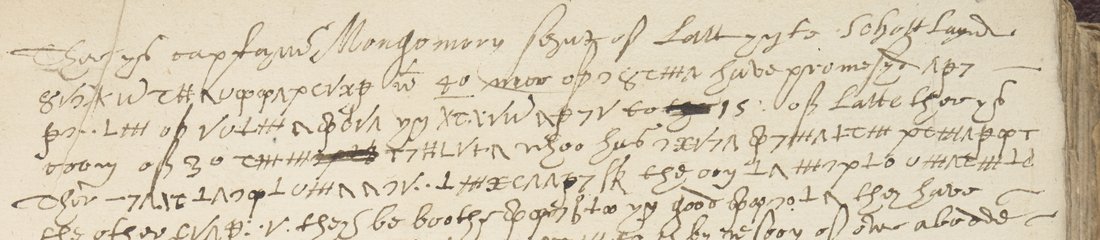
| R8492 | f. 88 | 1588, undated | the densest: some fourteen lines mixed with clear words (“captain Montgomery … of late gone into Scotland … with 40 men of”) |
| R8495 | ff. 92–93 | 27 May 1588 | about eight lines on f. 92r, among news of the Armada at Lisbon and the mariners at Sluys |
| R8496 | ff. 96–97 | Bourbourg, 9 June 1588 | scattered words |
02 The key, from the glossed siblings
On f. 75 (Ostend, 9 April 1588; R8488) the decipherer wrote the plain text over each cipher word: “cardinal is coming”, “upon our arrival”, “willing to harken”, “by the clergy they made means”, “their great desir of”, “the Duke of Parma his bastard son”. On f. 89 (R8493) the glosses give “what may be”, “further hoped for at their hands” and “our abode in this towne is so advantagious”. Aligning them gives the following table. The sign names are descriptive.
| plain | signs | plain | signs |
|---|---|---|---|
| a | U, ∪ | l | circle crossed by a straight stem ϕ |
| b | + | m | horizontal S with a loop |
| c | 8 | n | double-barred cross ‡‡ |
| d | ∞ | o | z-shape, c, d |
| e | 7 | p | ϑ |
| f | H | r | V, γ |
| g | crossed X | s, t | Λ (two near-identical forms) |
| h | loop on a long stem | u, v | “..”, “:” |
| i | ⊥, undotted X | w | dot and stroke |
| k | ω | y | γ |
Not found: j, q, x and z. Several signs on f. 88 (shapes like K, υ, ρ and W) are not in the glosses and may be code signs. A second session working on Cobham’s March letters (R8477–R8487) reached the same values independently from its own cribs, and deciphered most of those letters: see Cobham at Ostend, March 1587/8 (key in harley287/key.tsv). Its table separates s (a narrow ∧) from t (a wide one), which may resolve the s/t ambiguity here.
03 The sign inventory, and what is deciphered
A third pass worked from the scans at full resolution (7,200 pixels wide), aligning about sixty glossed words on ff. 75, 79 and 89 sign by sign. The result is cobham1588/signs.tsv. The families that look alike at normal size separate cleanly. p is a loop with its tail swept down-left (“upon”, “popes”, “perswade”). l is a circle crossed by a straight stem (“arrival”, “holding”). h is a stem with a bowl to the right (“harken”, “thought”). m is a horizontal S with a loop (“made”, “commission”), and w a dot and stroke (“willing”, “sworne”). The glosses also show that several signs are polyphonic. Λ is s and t (and probably a), γ is r and y, c is o and once a, and the l sign once stands for t. The code numbers are glossed too: 7 = her Majesty, 10 = the Lord Admiral, 15 = the Duke of Parma, 16 = the King of Spain.
- f. 80r: “as usuall in all armadas in numbers, that at the armada … which was the 20”. The word ΛV∽ΛŧΛ gives ARMADA with m glossed, if the wide Λ is a and ŧ is d. Also “hoping them in the □pances”, probably “expences”; a run with vertical word dividers ending “to these termes”; and “22 is … in the action … that he promised Q[ueen]”. (M)
- f. 88r: “15:” is the Duke of Parma. The first cipher run probably begins “captain …” before a name, “with 40 men of …, [who] have promised the …”. The rest turns on signs no gloss shows. (M/I)
- f. 92r: “4 sent by …”, perhaps “the Portugals” (I), and “of letters” (M).
04 What stays open
The sign inventory is now fixed, so the images are no longer the obstacle. Several signs are polyphonic and a few (an L-shape and a K-shape on f. 88, the square on f. 80, the codes 4, 22 and 27) are unglossed. The next step is to transcribe the runs sign by sign from the full-resolution crops, give each sign its set of possible letters from signs.tsv, enumerate each cipher word’s possible decryptions against a word list of the 1580s, and let the clear context choose.
05 The decipherment, letter by letter
- f. 80r (5 May): “hoping them in the □pances [expences]”; “it will not be … the haven is …”; “to these termes as usuall in all armadas in numbers”; “22 is so forwarde in the action that he promised Q[ueen] to …”.
- f. 88r: “captain Montgomery of late gone into Scotland … with 40 men of … have promised the haven of Rain … spoil … there to 15 [Parma]”; “deliverd of the … to us”; “Italians arriving … Antonio”; “other Scottishmen, divers … soldiers … away the number of …”.
- f. 92r (27 May): “4 sent by the Portugals(?)”, “imprisoned in Bruges(?)”, “they have charge”, “of letters”.
- f. 96v (9 June): “passed …”, “within France”, “his servants … priests”, “seventy”.
06 Sources
- British Library, Harley MS 287, via DECODE: R8490, R8492, R8495, R8496. The glossed siblings are R8488 and R8493 (also R8481, R8489). Bodley’s 1590 cipher is R8497. The images are not in the public domain and are not reproduced here.
- Calendar of State Papers Foreign, Elizabeth, vol. 21 pt 4 (January–June 1588), British History Online.
Notes, key and profile: cobham1588/ in the repository.