

01 The documents
| DECODE | Folio | What it is |
|---|---|---|
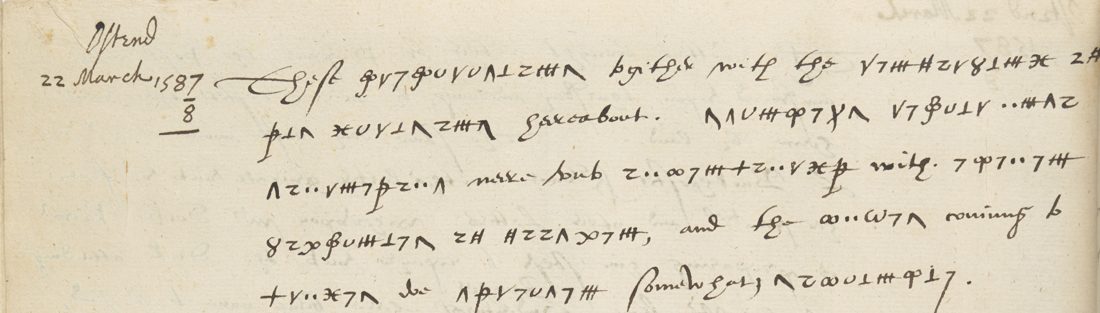
| R8482–R8483 | ff. 70r–70v | Cobham, Ostend, 22 March 1587/8. |
| R8484 | f. 71r | Intelligence “from Middelburgh”, another hand: Grenier’s schemes, a Latin tag, five lines of cipher. |
| R8485–R8487 | ff. 71v–72v | Cobham, Ostend, 20 March 1587/8, signed on f. 72v. |
| R8477 | f. 11 | An undated, unsigned intelligence letter in English about a Spaniard and the Spanish agent, with one line of numeral and letter code groups. A different system; not read. |
The Commission (Derby, Cobham, Croft, Dale, Rogers) reached Ostend in March 1588. The letters name Mr Controller (Croft), “Mr Doctor Rogers” being sent to the Duke at Bruges, and a servant of Lord Burghley, all in clear. The Calendar of State Papers Foreign calendars Cobham’s letters of 22 and 24 March to Burghley, from the State Papers, but not these. The key on f. 187 of the same volume (R8497, Bodley, 1590) is a different system.
02 The cipher
Each run replaces the letters of English words with signs, one sign per letter and the words kept separate. A few letters have two signs (a: ∪ and ⊥; w: two dots and a dotted x; g: a barred x and a 3), and a colon after a letter stands for u. The signs of one family (l, p, h, m, all drawn as a crossed or looped stem) and the two carets for s and t are close on the scans; they were settled word by word.
| a | b | c | d | e | f | g | h | i | l | m | n | o | p | r | s | t | u/v/w | y |
|---|---|---|---|---|---|---|---|---|---|---|---|---|---|---|---|---|---|---|
| ∪ ⊥ | + | 8 | ∞ | 7 | H̅ | Ӽ 3 | ϵ | ⊥ | ϕ | ∝ | †† | z | ϕ | V | ∧ | ∧ | .. ẋ | ɣ |
The key was rebuilt from the clear words on either side of each run. A session working on Cobham’s May–June letters in the same volume then found the same values in the contemporary glosses of f. 89 (R8493).
03 The decipherment
Deciphered words in italics, modern spelling. Grades as in the README: (C) supplied from context, (M) uncertain; the rest is high.
22 March, ff. 70r–70v
What effect this message will work I know not, but doubt the worst, and therefore do wish and think it expedient that some of .7. ships were commaunded to attend on this coast for all events, for I am persuaded 15 will never yield to send 42 hither. Some provision also for vittailes would be necessarily thought upon, for □ have no megasines here, nor mind to have any. That the same here is but from weeke to weeke as the bilanders do voluntarily bring it … there is any money stirring here. The present garrison will be found too weake for the defence of so large a circuit by the half at the least. The last supply of money will not [keep them] from the presentes wantes of the souldiers above five weeks longer, as the governour tells me. … The Duke is expected within a day or two to be at Bruges. The newe ditche from Gaunt by Eecloo unto Sluce is said to be almost ended, and will be within 15 dayes navigable for the float boates and vessels he hath ready prepared, being some of them fraught with stones and fagottes.
This preparation, together with the reinforcing of his garrisons hereabout, Stanley’s repair unto Turnhout (M), make such [at] Oudenburgh with eleven companies of footmen, and the Duke’s coming to Bruges doth threaten somewhat (C). And in mine opinion this town is fit to be stopped (C) through some attempts upon the haven; which being once stopped, the town being already abandoned of succour by land, cannot make resistance against the enemy many days (C) together.
My greatest grief is that in all this town I am not furnished of any one spy to employ abroad for the more certainty of the enemy’s proceedings. And from Flushing I hear very seldom by reason that the passage is dangerous and subject to interception. … By my servant William I wrote in my private letter a special motion for our remove to Flushing (C), where we might better stand on terms for her Majesty’s honour.
Middelburg report, f. 71r
In my opinion the ships would be well guarded (C), and when all ships of charge as well of the [fleet] as merchants be at sea (C), there would be 2 or 3 pinnaces appointed to [watch] and direct the channel (C). [Bastune?] the Jesuite is within these fewe dayes sent post into Italy (surname M). R. tould me in talke with him that 15 ha[th] [in]sted his sonne (being under 17 years of age) in the government of his patrimony in Italy.
20 March, ff. 71v–72v
There are new companies lately added to the old garrison of Oudenburgh, our near neighbours (C), which were very strong before. This drawing of his forces by land so near, and the provision of stone and fagots to come from Eecloo by water (C), make us suspect some attempts against this town and haven: we think it therefore expedient that some of the ships did continue upon this coast, to be ready for service upon occasions. Also we pray your honour (C) would remove us hence or dismiss us to some other place of more surety (C).
This bearer hath laboured his own dispatch and would fain have had instructions, but I, fearing that under colour thereof he would proceed in his charge, did let him understand what we had generally written unto my Lord … As by the [words] of your own hand in your letter of the 16 March I perceive you oppose yourself still against such resolutions; for mine own part I would think myself most unhappy to be a means to conclude an irreligious peace. Touching Pigot and Barney, if they shall be delivered over to the States, I am of another opinion … things standing as they do, □ will ranson them, and then what dishonour and disfavour will it be for her Majesty. Pigot is a martial man, and hath means and will to deserve his prise (C).
04 What stays open
- The two names after “Touching” on f. 72r and the name on the following line; they do not fit Flushing, Brill, Ostend or Bergen.
- About a third of the runs on f. 70r, including what “42” stands for, and the last cipher line of f. 71r.
- There is no symbol-by-symbol transcription. The decipherment was made from the scans, word by word.
- f. 11 (R8477), a different letter and code, not deciphered.
05 Sources
- British Library, Harley MS 287 ff. 11, 70–72, images on DECODE: R8482, R8483, R8484, R8485, R8486, R8487, R8477; key record R8497 (Bodley, 1590).
- Calendar of State Papers Foreign, Elizabeth, vol. 21 part 4 (1931), March 1588, on British History Online: Cobham’s other letters of these days.
Notes, key and profile: harley287/ in the repository.