01 What the six records are
| Record | Folio | Letter | State |
|---|---|---|---|
| R2963 | f. 5 | German, to a “Marquis”, 28 January [1719]; figures for names and words (1203 London, 1439 Theophili) | deciphered interlinear: read |
| R2964 | f. 6 | “A Mr [name struck out]”, Paris, 7 February 1719, Extrait | open; about a dozen glosses |
| R2965 | f. 7 | Paris, 10 February 1719, Extrait, same writer and code | open; the same glosses |
| R2968 | ff. 11–12 | “Anonyme à Monsr Carré en Pellmall à Londres”, March 1742, all figures | transcribed, tested; not read |
| R2970 | ff. 14–17 | “Copie d’une Lettre en Chiffre, sans date”, to Mr Carré in Pall Mall; endorsed “R Aug. 22 1742” (catalogue item 70, folded in here) | transcribed, tested; not read |
| R2972 | ff. 22–23 | “Lond. 19 Janv. 1745”, all figures, the Carré code | transcribed, tested; not read |
| R2974 | ff. 25–28 | “L. 17/28 Nov. 1749”, 2-figure letter cipher | deciphered letter by letter: read |
Around them are R2966 (a 2-figure letter cipher, deciphered), R2967 (London, July 1740, a few code groups glossed, 0813 = le Sr Walpole), R2969 (the Carré frequency count), R2971 (a 4-figure code with a full decipherment, about the Queen of Hungary) and R2973 (6 March 1749, glossed).
02 The Paris letters of February 1719
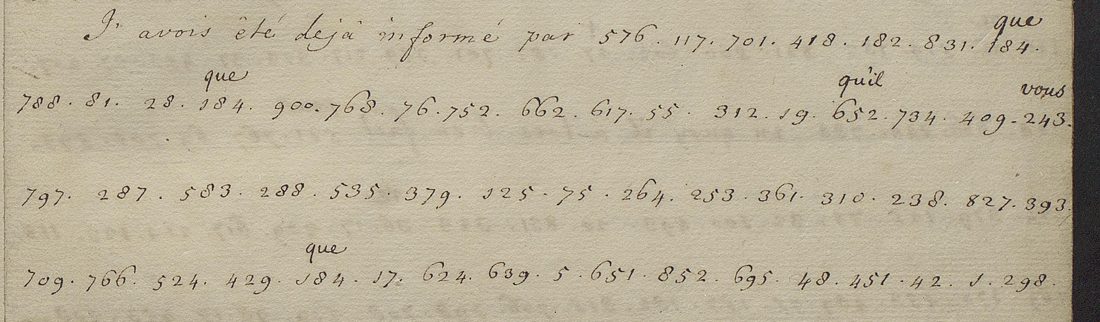
The writer reports Lord Stair’s formal entry into Paris and his audience with the King, and tells his correspondent that he will stay in England “jusqu’au retour de S. M. Brit.” The clear text uses a family cover (“vos Parens”, “votre Cousin”, “le caractère des esprits de votre Famille”), and the second letter opens on the coming war with Spain and Cardinal Alberoni. The persons are figures marked with a cross: 27, 258, 285, 611.
The decipherer glossed 36 = re, 88 = pas, 95 = le, 184 = que, 243 = vous, 347 = a, 531 = pour, 652 = qu’il and 786 = s, the same values in both letters. That is 33 of the 354 groups of the first letter. In a one-part code, where values run in alphabetical order, these would bracket the rest. Here re (36) comes before pas (88), le (95) and que (184), and a comes at 347, so the code is two-part and its order says nothing. With about 700 groups in the two letters for a code of some 900 entries, most values occur once, and the decipherer glossed no more than the recurring values.
03 The Carré letters, 1742–45
Three letters addressed to “Mr Carré in Pall Mall”, entirely in 3-figure groups, with no clear text and no gloss. All three are fair copies made by the intercepting office. R2968 (ff. 11–12) is headed “Anonyme à Monsr Carré en Pellmall à Londres”, March 1742. R2970 (ff. 14–17) is a “Copie d’une Lettre en Chiffre, sans date”, addressed with the writer’s mark ΔΔΔ to Mr Carré “en Palmal” under cover to a Mr Chevening(?), jeweller near Charing Cross, signed “Anonyme” and endorsed “R Aug. 22 1742”: it was received on 22 August 1742, five months after R2968. R2972 (ff. 22–23) is dated London, 19 January 1745.
| Record | Groups | Distinct | Highest |
|---|---|---|---|
| R2968 | 372 | 208 | 796 |
| R2970 | 470 | 219 | 800 |
| R2972 | 481 | 196 | 796 |
| All three | 1,323 | 381 | 800 |
The transcription checked against the decipherer’s tally. R2969 (f. 13, “Carré 1742”) counts the groups of the two 1742 letters together, R2968 and R2970, including a line the copyist of R2968 wrote twice and bracketed. With that line included, the transcription here gives exactly R2969’s figure for 686 (20), 212 (19), 106 (18), 121 and 12 (14), 707 (12), 781 (11), 539 and 621 (10), and fifteen more values down to 7; it differs by one for 573, 27 and 772. So the text is sound to about one group in 300. R2969’s tentative de for 686 and 106 and la for 121 are tentative guesses marked with dots.
Statistics. 147 of the 381 values occur once. Every hundred from 1 to 800 has 36–62 distinct values in use, so the whole range is live. The profile is flat: the commonest value, 212, is 2.3% of the text, then 12, 106 and 686 at 1.8–2.0%. Repeats are short: 94 repeated bigrams, 24 trigrams, 8 four-grams and one five-gram (151 521 330 621 212, in both 1742 letters). A run 95 57 606 451, three times in 1745 and underlined by a later hand, is probably a name spelled out. The 1745 letter uses the same code: 73% of its tokens are values seen in 1742. The intercepting clerk underlined single groups, probably proper names; 135, 204, 785 and 80 are underlined in both 1742 letters.
Not a letter cipher. An assignment of one letter to each group was annealed against a French 4-gram model. It reaches −2.09 and −2.11 per character on the real text, and −2.12 and −2.17 on the same groups in shuffled order: no difference, and the output is not French. With 381 types for 1,323 tokens a homophonic letter cipher would be overfitted in any case; the type–token ratio and the frequency profile are those of a word code.
Not a one-part code. In a one-part French code the mass of le, la, les, que, qui, et, en would pile up in their alphabetical bands. The observed token mass per band of 50 values, set against what an alphabetical list of the 700 commonest French words predicts, correlates at r = −0.26. Placing the 30 commonest values at their proportional alphabetical positions does no better than chance: 86% of 2,000 random placements do as well. The contemporary guess of de for both 686 and 106, two values far apart, points the same way. This is a two-part code of about 800 entries, like the Paris 1719 code in the same volume, whose glosses show the two-part order.
The language is assumed to be French from the headings; nothing in the figures confirms it. 1,323 tokens of a random-order code of about 800 entries allow a handful of guesses for the commonest words and no way to check them, and no crib is known. The decipherer of 1742 stopped at the frequency count and a few pencil letters under R2972. The attack is closed.
04 Catalogue item 79: the Dresden and Hague records
Item 79 put the last two records of the volume together as “Unknown sender (Dresden), 1750–53”. They were viewed on 21 September 2026, and neither is an open cipher. R2978 (f. 32) is a French letter headed “Dresde 25. Janv. 1750” in a 2-figure letter cipher. The decipherer of the time wrote the plaintext letter by letter over every line (“…que l’on ignore pas les dangers auxquels notre position nous expose… les insinuations de Mr de Guydickens…”). R2979 (f. 34), “Hanau to Fer., Hague 9 Aout 1753”, is the decipherer’s own working copy of a letter in a 4-figure syllable and word code. The clear syllables are written out and the groups he decoded are glossed (1688 = si, 1560 = roi, 3227 = Devonshire). The rest are left as figures, and the sheet ends “Ici on parle du mariage de 3245 avec 3263” beside a column of question marks. The first record was deciphered in full at the time, and the second in part. Item 79 has been removed from the catalogue.
05 What is needed
- The key of either code, or a clear copy of any of the letters, in the Newcastle or Carteret papers (BL Add MS 32686–33057) or SP 107/SP 78 at Kew.
- For the Carré code: another letter in it with an interlinear decipherment, or a clear copy or summary of any of the three (the Newcastle papers for August 1742, Add MS 32699–32700; SP 107 intercepts; SP 36 for 1742, with Carré as addressee; the Secret Office decipherers’ letter-books). The identity of Carré and of the jeweller “Chevening” would suggest names for the underlined groups. A search of the rest of the volume (R2971, R2975–R2981) and of the web found none of these; the small marks under groups on R2972 are the decipherer’s cross-references to the sheet where a run recurs, not a reading.
- More letters in the 1719 code: its common values are known, so a few thousand groups would let the syllables be built up from context.
06 Sources
- DECODE records R2963, R2964, R2965, R2968, R2969, R2970, R2972, R2974, R2978, R2979 (images by login; not in the public domain).
- British Library, Add MS 32305, “unidentified cipher keys”, 39 folios.
Transcriptions of R2964 and of the three Carré letters (carre/, with the test scripts), notes and profile: bl32305/ in the repository.