01 The letter and the key
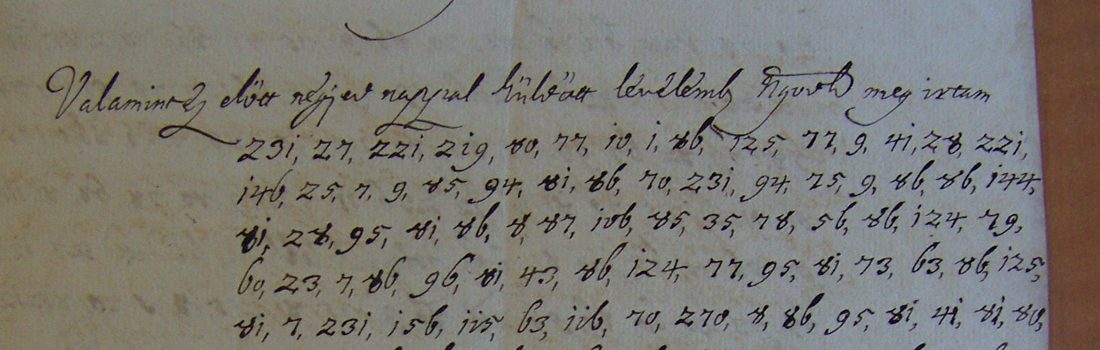
The letter is one sheet written on both sides. Clear Hungarian passages alternate with runs of comma-separated numbers from 1 to 300 and two signs. It is dated at the foot Jászvásár 8. Martii and signed Bay András. The key is DECODE R609, a Rákóczi chancery key of 1703–1711 in the same fonds. Its letters have homophones (A 7/70, E 8/80, I 9/90, O 6/60, U 5/59), and it has two-digit consonant–vowel syllables (30 ba to 148 vu), short words (27 és, 28 az, 13 hogy, 14 mért) and a nomenclator from 149 to 293 (231 Mosqua, 221 Lengyel, 270 Svéd, 285 Vajda, 252 Porta, 236 Nagyságod). The nulls are 15–19, 200, 300, Ψ and +. The letter uses the nulls 16, 18, 19, 200, 300 and Ψ. An earlier issue of the same table, R561, scored second.
02 The decipherment
Normalised Hungarian. Clear passages are in «»; square brackets mark words supplied or doubtful.
«Kegyelmes Uram! Valamint ez előtt negyed nappal küldött levelemben nyilván meg írtam,» Moszkva és lengyel követek jöttek ide; az lengyel viszont ismét [elment], a moszkva még itt vagyon. Az mint expiscálhattam, olyat mondottak mind ketten, hogy a moszkva békességet kéri a svédtől, mindenekelőtt várakat és ezen hadakozásban lött expensáit a svédnek megígérvén, «[ha oly] conditióval, hogy …» ellene a moszkva hadát declarálja-é a svéd «is» colligatióban «légyen». … Az moszkva követ «innét» Constantinápolyba «vagy» Erdélybe megyen, én nem tudhatni; mert csak maga beszéllett az vajdával, görögül. «…» Tegnapi napon az vajda tolmácsával conversatióban lévén, «… in discursu» Pekri uram által olyat izent a vajdának, hogy csak Nagyságod a magyar nemzet dolgát complanálhassa a némettel, … mindenben szándéka Nagyságodnak a török ellen való hadakozás. «…» Az tolmácsot [… ?] tudván az barát az Portának szemének és fülének lenni, még nem mondotta; «nékem is» lelkemre kötötte, hogy ki ne adjam őtet. A svéd Vilnához szállott, mely Litvánia és Moszkva-Oroszország között vagyon. «… Jászvásár 8. Martii … Bay András.»
In English. As I wrote four days ago, Muscovite and Polish envoys have come here; the Pole has gone again, the Muscovite is still here. As far as I could fish it out, both said that the Tsar is asking the Swede for peace. Above all he promises him fortresses and his expenses in this war, on condition that the Swede declare [war?] against… Whether the Muscovite envoy goes on to Constantinople or to Transylvania I cannot tell, because he talked to the voivode alone, in Greek. Yesterday I talked with the voivode’s interpreter. [He told me that] Pekri had sent the voivode word that Your Highness wants only to settle the Hungarian nation’s affairs with the Germans [the Emperor], and that in everything Your Highness intends war against the Turk. Knowing the friar to be the Porte’s eyes and ears, the interpreter has not yet told him, and he made me swear on my soul not to give him away. The Swede has moved to Vilna, between Lithuania and Muscovy.
03 Method
The record, the DECODE transcription (AJ, 2020) and both images were fetched with the project’s DECODE session. The transcriptions of the G15 key records R549–R646 were fetched too. score_keys.py decrypted R478 with each of them and ranked the results by coverage and a Hungarian 4-gram score: R609 came first at −2.57 per letter, well clear of the unrelated keys, which scored below −3.7. The transcription was then compared with the page images, and seven slips were corrected: iv→10 (jöttek), a clear accented é transcribed as 0, 1257→127 (vajdától), l, i, 86, i→6, 1, 86, 5, a dropped 74 (fülének), a dropped 63 (lelkemre) and the crossed-out signs after 300, 16. R609 gives 59 both as U and as ho; ho fits here (Vilnához). decode.py writes the decipherment.
04 What remains uncertain
- Group 50 is not in R609. It occurs once and is taken as ba from context (barát, the friar), grade C.
- Page 2, lines 5–6: tolmácsot ha az ha az tizéntee [s.] asséraltadé [ö], about ten groups. Every group has its key value, but the sense is not clear; possibly a slip by the encipherer (grade I).
- The clear passages are cursive and only partly transcribed here. Their words in brackets above are grade M.
Measured: 414 cipher groups, all with a value (one from context); about 404 decipher as sense (97.6%).
05 Sources
- Magyar Nemzeti Levéltár Országos Levéltára, G15 Caps. D. Fasc. 81. 5; images via DECODE record R478 (not reproduced beyond the lead crop; archive’s permission required).
- Key: G15 Caps. C. Fasc. 43. 56, DECODE R609 (transcription NM, 2020); earlier issue R561.
- Related: Pápai to Rákóczi, 1706–10, deciphered the same way with a G15 key record.
Transcription, key scorer and decoder: bay1706/ in the repository.