01 The document
DECODE imaged four pages. In the order of the leaves they are P1 f. 40r, P3 f. 40v, P4 f. 41r and P2 f. 41v, which carries the end of the letter and the subscription “your most humble and … seruant Thommas Spynelly”. The dating clause reads “Written at Methlyn Bruxells the fyrst day of february M.D.XVJ”. The old foliation 33–34 is the one used by Letters and Papers. So DECODE’s place (London) and recipient (unknown) are wrong: the letter was written in Brussels to the King. The year is 1517.
Spinelly was Henry’s resident agent in the Low Countries. The despatch reports the meetings of Maximilian and Charles with Chièvres, the Chancellor, the Audiencier and Hans Renner, the French embassy, and the cession of Verona to Lautrec under the treaty of Brussels. It also covers Cardinal Schiner’s anger at that cession and the Emperor’s intention to keep his amity with England.
02 The cipher
The cipher is a monoalphabetic substitution. Most signs are Greek or Latin letter forms given other values. Word division is kept, and a few signs stand for whole words.
| plain | sign | plain | sign | plain | sign |
|---|---|---|---|---|---|
| a | φ | i, y | e | r | c |
| b | τ | k | λ | s | ʃ |
| c | 4 | l | triangle v; σ (?) | t | k |
| d | ʒ | m | y | u (w = δδ) | δ |
| e | o | n | b | p | q |
| h | ρ | o | 7 |
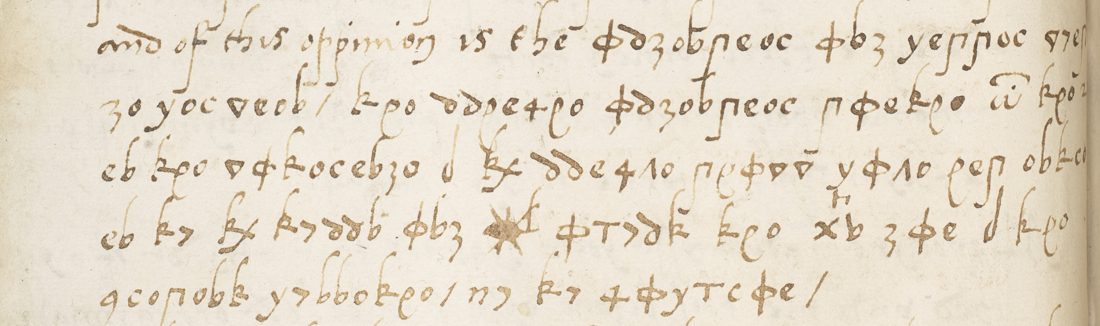
Word signs: ϑ = of; ꝁ = this; w with a bar = that; a star with a superscript = the Emperor; and a small sign after “the” at the end of line 2, probably the King.
03 The text
The clear text runs into the cipher mid-sentence (“and of this opinion is the”):
Audensier and misser Loys de Merlien. The whiche Audensier saythe that the [King] in the laterende of this wicke shall make his entree in to this town, and [the Emperor] about the xv day of the present monethe so to Cambray.
The Audiencier is the head of Charles’s chancery secretariat, named only by office throughout the letter (probably Philippe Haneton). “Misser Loys de Merlien” is Luigi Marliano, Charles’s physician and councillor, later bishop of Tuy. The clear postscript on f. 41v, written after the King came back from Vilvoorde and the Emperor went back to Mechelen, says that the coming of “his magestye” into this town is put off because he “loke[th] for certeyn princes oute of Almayne, the which he wol have at his entree”. “His majesty” there may be the Emperor, which leaves open whose entry the cipher means (see section 05). The Emperor did go to Cambrai, where the treaty with France was signed on 11 March 1517.
04 Method
The nine-sign word φδʒobʃeoc occurs twice, and its fourth and eighth signs are the same. “Audensier”, spelled that way in clear two paragraphs above, fits the pattern. It gives a, u, d, e, n, s, i and r; φbʒ is then and. The frequent kρo is the, and k7 is to. The remaining values follow from the words they complete: present monethe, entree, town, and 4φyτcφe = Cambray. Every value except p and b occurs at least twice. Letters and Papers was checked only after the decipherment, and its summary (“about the 15th of this month the Emperor will go to Cambray”) agrees with it.
05 What remains uncertain
- The star sign = the Emperor: H, from context and the calendar.
- xbʒφe = “xv day”, with b written for the numeral v: H, from the calendar’s “15th”.
- The sign after “the” at the end of line 2 = the King: C. It is the subject of “make his entree” and sits against the gutter. The Emperor has his own sign later in the same sentence, which favours the King.
- σ as a second sign for l in “Loys”: C.
- The Audiencier as Philippe Haneton: C.
06 Sources
- British Library, Cotton MS Galba B V ff. 40–41; images on DECODE, record R8416 (login).
- J. S. Brewer (ed.), Letters and Papers, Foreign and Domestic, Henry VIII, vol. II (1864), no. 2862; British History Online, February 1517, 1–10.
Transcription, reading and notes: spinelly1516/.