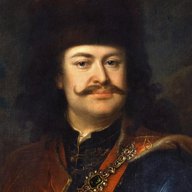
01 Sender and recipient
DECODE R902 describes a ciphered letter of “Pompeio Cesoni (Ferenc Rákóczi II) to unknown recipient”, dated 15 October 1707. The clear third leaf gives the recipient:
A Monsieur
Monsieur Pompeio Cesoni
Cesoni is therefore the addressee. The hidden text also addresses the recipient with the forms expected for Rákóczi and reports work undertaken on his behalf. The catalogue entry has been corrected here to an unsigned report to Rákóczi.
02 The key, in the same archive
The matching table is DECODE R639, MNL OL G15 Caps. C. Fasc. 44/08. It was found by decrypting R902 with each key transcription of the Rákóczi chancery fonds (G15) on DECODE and scoring the output. Its heading reads De Monsieur de Bonac et Graffei. Rare entries as well as common letters match R902: 489 Monsieur, 491 Monseigneur, 497 les Svedois, 506 Svede, 507 Pologne, 526 le Prince Constantin, and 533 Dantzig.
The key is an archival table, applied as it stands, and it can be tested directly on other documents. The remaining uncertainty lies in DECODE’s digit transcription and in the writer’s identity.
03 A one-part French nomenclator
| Range | Function | Examples |
|---|---|---|
| 10–120 | Homophonic letters and common endings | Several values for frequent letters; recurring terminal forms |
| 121–460 | Syllables and common words | ay, aussy, honneur, vous, lettres |
| 461–560 | Titles, peoples, countries, places, names, months and numbers | Monsieur, les Svedois, Pologne, Prince Constantin |
| Nulls | Carry no plaintext | 97, 99, 101, 103, 105, 107, 109, 111, 113, 115, 117, 119 |
The values run from 10 to 560. Word division is only partial. DECODE renders a raised leading digit as 1^.; the decoder must join it to the following one or two digits, while treating other carets as annotations. Without that join many three-digit groups are lost.
04 Two interlinear controls, then R902
The table was first replayed against R852 and R912, same-series letters whose contemporary decipherments give a control independent of R902. Its coverage on R902 is about the same.
| Record | Groups found in R639 | Coverage | Role |
|---|---|---|---|
| R852 | 497 / 513 | 96.9% | Known-plaintext control |
| R912 | 1,473 / 1,596 | 92.3% | Known-plaintext control |
| R902 | 1,020 / 1,108 | 92.1% | Target |
R902 contains 326 distinct parsed groups. Eighty-eight occurrences are not in the transcribed table. Some may be values missing from the table; in the passages that give sense, many are one-digit errors or groups joined in the DECODE transcript.
05 What the report says
DECODE’s transcription gives the subject and argument; it is too noisy for a word-for-word text. The excerpts below distinguish H (value taken directly from the table), C (secure contextual repair of an evident digit slip), and M (meaning recoverable but wording still provisional).
| Grade | Reading | Why it matters |
|---|---|---|
| C | J’ay aussi [eu] l’honneur [de] vous… | The transcript has 142 where 192 gives eu, and 143 where 173 gives de. |
| C | … Monseigneur … les lettres de Monsieur Ráday au général Rehnskiöld … | Identifies the report’s central diplomatic correspondence. |
| C | … à la Cour de Suède … | Locates one field of the writer’s activity. |
| C | sur mon zèle à Votre [Altesse] | Consistent with a report addressed to Rákóczi. |
| H | je me suis donné tous les mouvements | The writer describes exerting himself on the recipient’s behalf. |
| M | … prendre les intérêts de la Pologne autant à cœur … se sacrifier … pour affranchir la liberté … opprimée par les Suédois en faveur du roi Stanislas | States the political burden of the closing discussion; connectors remain vulnerable to transcription error. |
Other names and phrases fixed securely include the king of Poland, the king of Sweden, Russia, Prince Konstanty, Polish grandees and troops, the Emperor and Vienna, and English and Dutch actors. The letter is an intelligence and lobbying report addressed to Rákóczi.
06 The writer, probably Philippe Groffey
R902 has no signature, so the attribution is qualified. Three pieces of evidence point to him:
- The exact key is headed De Monsieur de Bonac et Graffei.
- The letter reports Ráday’s approach to Rehnskiöld and activity at the Swedish and Polish courts.
- Contemporary scholarship identifies Philippe Groffey, also written Grophey or Graffei, as Rákóczi’s representative around those courts and as a contact of Ráday.
No signature confirms it, so the title keeps a question mark.
07 What remains open
- Exact wording: there is no continuous word-for-word text yet. One wrong digit can turn a word value into several plausible syllables.
- Fresh transcription: the two cipher leaves should be re-entered group by group from the manuscript, with raised digits and joins checked visually.
- Writer: Groffey is probable; the unsigned leaf gives no confirmation.
- Prior decipherment: none was found in the sources checked (DECODE, Thaly’s printed correspondence); a decipherment elsewhere in the archive cannot be excluded.
Image rights. No manuscript image or crop is reproduced here. DECODE states: “The image is not in the public domain. Publishing it is only possible with the permission of the archive.”
08 Sources
- DECODE R902, MNL OL G15 Caps. C. Fasc. 39, pp. 277–279: ciphertext, metadata and rights statement.
- DECODE R639, MNL OL G15 Caps. C. Fasc. 44/08: the matching key.
- Kálmán Benda, Le projet d’alliance hungaro-suédo-prussienne de 1704 (1960), on Philippe Grophey’s position and contact with Ráday.
- Études sur François II Rákóczi, prince de Transylvanie, identifying Groffey as a foreign diplomat in Rákóczi’s service, especially at the Swedish and Polish courts.
- Kálmán Thaly, ed., II. Rákóczi Ferencz fejedelem leveleskönyvei, vol. 2 (1873). The accounts name Groffey and his salary through December 1707; the target letter was not found in the printed correspondence.
Decoder, extracted key, transcriptions, controls and research notes: rakoczi1707/ in the repository. Manuscript: Magyar Nemzeti Levéltár. Images not reproduced.