
At a glanceNot solved · 161 of 437 groups have a value, no sentence reads
- The letter
- Joel R. Poinsett, special agent and consul general for Buenos Aires, Chile and Peru, to James Monroe, Secretary of State, Santiago, 20 February 1813: the Carrera government, Lima, the Buenos Aires army before Montevideo, the Portuguese. Manning (1925) prints the clear text and “(undeciphered cipher)” at ten places.
- Where
- NARA RG 59, Despatches from Special Agents vol. 3, microfilm M37 roll 2, frames 0092–0094 (catalogue naId 213803757). Unsolved Catalogue no. 639; the 14 June 1814 letter is no. 651.
- The cipher
- A numbered code of about 1,600 groups: common words are one group (1355 the, 1397 of, 522 and, 1348 in), longer words are spelled from syllable groups; the values are in no alphabetical order; a small circle over a group adds -s.
- How it was tried
- The letter of 14 June 1814 (RC frames 0097–0098, Duplicate 0099–0100) is in the same code and has a clerk's interlinear decipherment, printed by Manning in 1925. Its 95 values were applied to the 1813 groups. The State Department’s own code of 1803–40, Armstrong’s, Pinckney’s and Sumter’s 1813 code do not fit.
- What it says
- Fragments such as “of this country”, “the government”, “protection”, and the place name Lima. The clear text around the passages is about the Carreras, Lima’s blockade of Valparaíso, the Portuguese retiring to their frontier.
- Still open
- 276 of the 437 groups have no value, and the faint first page (frame 0092) is not transcribed. The rest of the code is in Poinsett’s own papers (Historical Society of Pennsylvania), not online.
- Credit
- The 14 June 1814 letter was deciphered at the time by a State Department clerk and printed in Manning, Diplomatic Correspondence … Latin-American Nations vol. 1 (1925), doc. 201.
01 The two letters
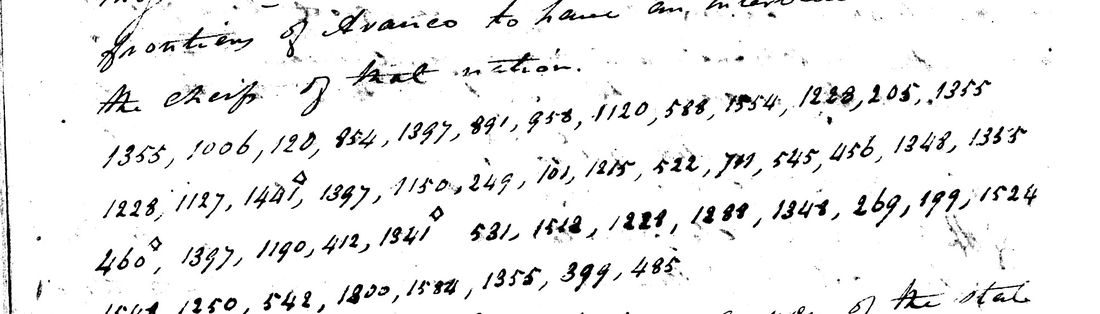
Poinsett’s despatch of 20 February 1813 was written in Santiago, where he had gone to support the Carrera government. Its coded passages are six blocks on the two pages of frame 0093, plus about three lines at the foot of the first page, which the microfilm shows almost black (frame 0092). Nine of them follow the clear words “no dependance can be placed on the”, “You will have seen that”, “enforcing the Spanish colonial laws” and so on, so the code carries the sensitive words of otherwise plain sentences. The transcription has 437 groups, 256 distinct (transcription.tsv, one row per written line).
02 The 14 June 1814 letter
Poinsett to Monroe from Buenos Aires, 14 June 1814, survives twice: the original on frames 0097–0098 and a Duplicate on 0099–0100. On the original a clerk wrote his decipherment over the groups of both coded passages. Manning prints the whole letter with the passages in clear from the Department’s consular file, word for word the clerk’s text, so this letter was deciphered at the time and has been in print since 1925. Both copies were transcribed here line by line (123 groups, 90 distinct) and checked against the clerk and Manning: 122 of 123 groups have a value (0.992), method read from existing decipherment. One group, 39 in “a ship [39] should draw”, is blank in the clerk’s text and in Manning.

The clerk’s passages, reading the groups with the key below: (a mission which has originated from the) prevailing opinion of a rupture between Great Britain and Spain; the present government of this country will endeavour to obtain the protection of the latter at any price; such is however the disposition of the people that the English never can gain a permanent footing in these countries. And: their trade is exposed to a just retaliation of this principle, with seldom more than a single frigate to protect it; two sloops of war better than a frigate, eighteen feet being the utmost a ship [39] should draw.
03 The key from the 1814 letter
The clerk’s words give 95 values (key_1814.tsv). The code is a two-part code: 1000 Spain, 1002 people, 1348 in, 1355 the, 1385 pre-, 1397 of, 1399 foot-, 1407 po-, so there is no alphabetical order to bracket missing values. Words are spelled in syllables (409 1175 1179 765 = pro-te-ct-ion; 1314 413 1166 = per-ma-nent) and a is written 1215, 1315 or 1385. The 1814 transcription also corrected five values the first alignment had wrong: 964 is principle, 1236 it, 1087 two, 737 between, and feet is 108 480.
The key does not come from any other US table in the repository: the Department code of 1803–40 (the = 1385), Armstrong’s (the = 972), the Pinckney legation code (the = 1651), the 1788 legation code, Jefferson 1787, Mountflorence 1801 and Sumter’s Rio code of 1813 (the = 798) were all tried, as were every constant shift of the first five against the 1813 groups (best z-score 4.3 among about 9,000 settings, junk decodes).
04 The 1813 letter with that key
Applied to the 1813 groups the key gives 161 of 437 values (0.368), for the commonest words (the, of, and, in, a, to, this, country, government). The result is a string of fragments, for example “No dependance can be placed on the [1436] of the people the [486][1095] … of this country” and “… of this govern-ment [901] the …”. No sentence reads, so nothing is offered as a reading. A pass over the context fixed only one more value, the place name Lima (249 413, twice in the Lima paragraph); the other unknown groups occur once or twice, in contexts that do not determine them.
05 Where else the code might be
- M37 roll 1 (Higginson, Bayard, Smith 1811, Shaler 1810–15; 753 frames) and roll 2 frames 0025–1057: no other frame in this code, no key table. Anthony Morris, 1813–15 (the = 285) and Jacob Lewis, 1816, are other codes.
- M70 roll 1, Buenos Aires consular despatches 1811–17: clear text; the only Poinsett letter is a clear letter of July 1812. Nothing is filed between April 1814 and January 1815, so Manning’s source for the 14 June 1814 letter is elsewhere.
- M77 vol. 7 (diplomatic instructions 1808–15, sampled) and M84 roll 1 (Lowry, La Guaira 1810–12, who also had a cypher): clear text.
- Manning vols. 1–2: no other Poinsett letter in this code is decoded. His 1811 reports “in cipher” (Unsolved Catalogue no. 640) are not online.
The survey of the rolls was by contact sheet, so a short number line inside a letter could be missed in the 601–1057 range of roll 2.
06 What remains open
- 276 of the 437 groups of 1813 (210 of the 256 distinct values): no value. no-key-material.
- The first page of 1813 (frame 0092, three lines of groups) is nearly black on the film and not transcribed. illegible.
- Group 39 of the 1814 letter. too short.
- Next: Poinsett’s own papers (HSP, Gilpin collection; the Department returned his letters to him in 1818), the HSP calendar of 1941 on HathiTrust, and Weber, United States Diplomatic Codes and Ciphers (1979), neither online.
07 Sources
- NARA RG 59, M37 roll 2 (catalog.archives.gov/id/213803757), frames 0091–0100.
- W. R. Manning, Diplomatic Correspondence of the United States concerning the Independence of the Latin-American Nations (1925), vol. 1 doc. 201 (14 June 1814) and vol. 2 doc. 442 (20 February 1813), on the Internet Archive.
Everything is in targets/poinsett1813/ in the project repository: transcriptions, key_1814.tsv, decode.py, decode_1813.txt and the work log.