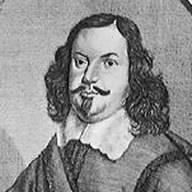
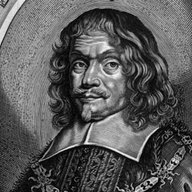
01The letters
| DECODE | Date and place | To | Cipher signs |
|---|---|---|---|
| R3811 | Hamburg, 17 Jan 1639 | Trauttmansdorff | 1,613 (p. 1 glossed) |
| R3813 | Hamburg, 27 Jan 1639 | Trauttmansdorff | 7,799 |
| R3812 | Hamburg, 3 Feb 1639 (DECODE: 1638) | Trauttmansdorff | 5,526 |
| R3815 | Hamburg, 6 Feb 1639 | Ferdinand III | 860 |
| R4625 | endorsed 10 Feb 1639 | Trauttmansdorff | 2,077 |
| R4645 | Hamburg, 13 Feb 1639, with clear copies of two Banér letters | Trauttmansdorff | 1,236 |
| R3814 | undated, 1639 | “Hochedler Herr” | 1,919 |
| R4734 | 8 Apr 1639, copy | Schwarzenberg (per DECODE) | 480 |
| R4736 | Glückstadt, 14 Apr 1639 | Trauttmansdorff | 1,403 |
R3812 is dated 1638 in DECODE, but it opens “Mein jüngstes sub dato 27. January”, which is R3813. It is dated Hamburg 3 Feb. 1639 in its clear postscript and reports Arnim in Hamburg after his escape in late 1638. It belongs to 1639.
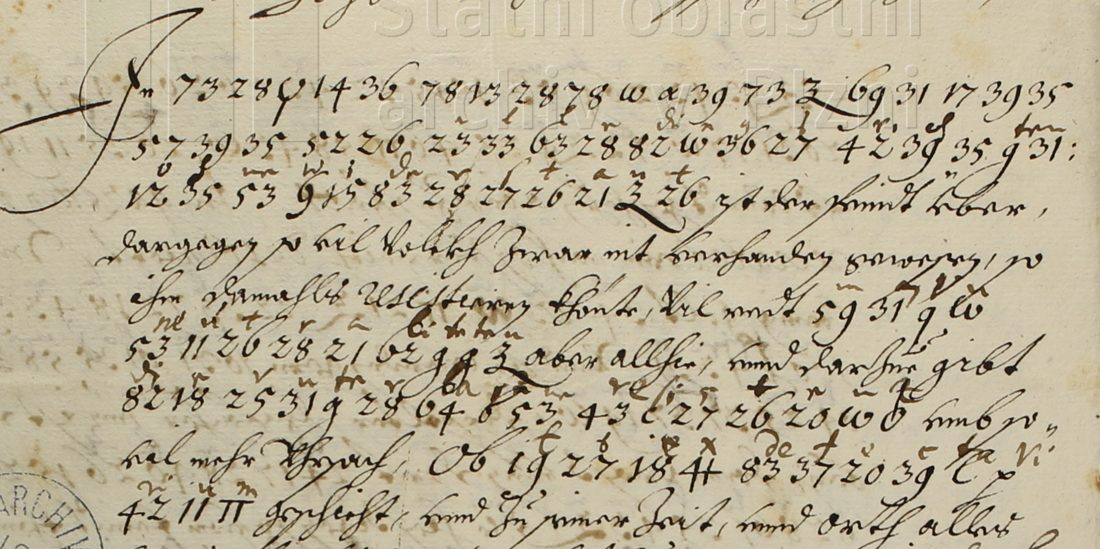
The cipher runs inline with clear German. Kurz writes the harmless words in the clear and enciphers the names, numbers and judgments.
02The key
About 210 glossed signs on the first two pages of R3811 give the pattern directly: 83 de, 82 di, 84 da; 43 re, 42 ri, 44 ra; 51 no, 52 ni; 72 hi, 74 ha; 93 be; 57 mi, 59 ma. Every ten is split into two halves of five. Each half has one consonant, and its first four places run o i e a:
| +1 | +2 | +3 | +4 | +5 | |
|---|---|---|---|---|---|
| 41–45 | ro | ri | re | ra | pu |
| 46–50 | po | pi | pe | pa | lu |
| 51–55 | no | ni | ne | na | mu |
| 56–60 | mo | mi | me | ma | hu |
| 61–65 | lo | li | le | la | ku |
| 66–70 | ko | ki | ke | ka | du |
| 71–75 | ho | hi | he | ha | gu |
| 76–80 | go | gi | ge | ga | bu |
| 81–85 | do | di | de | da | cu |
| 86–90 | co | ci | ce | ca | — |
| 91–95 | bo | bi | be | ba | us |
| 96–100 | — | is | es | e? | ru |
The consonants run backwards through the alphabet from 41: r p n m l k h g d c b. The fifth place of each half is a separate series of -u syllables, and each was fixed from words: Reputation and Graf von Puechheim (45), illustrissimi (50), unmüglich (55), Hunger and Churbrandenburg (60), Ankunft (65), durch (70), Herzog Augustus (75), Magdeburg, Meckelburg (80), pericula (85), Haus Österreich (95), zurück, darüber (100).
The numbers 1–40 and some twenty letter and graphic signs are homophones for single letters. The commonest are 28 r, 31 n, 27 s, 26 t, 39 c, 35 h, 18/19/20 e, 17/15/16 i, 21/22/23 a, 10/11/25 u, 12/13/14 o, 36/38 g, π/α m, ψ/φ z, w/#z-tail n and 29 qu. A few stand for pairs: 9 te, 6 se, c si, n ve, d so, k ti and a looped ℓ tu. A handful of marks are nulls or flourishes. The full table, with counts, is in KEY.md. This is Mírka’s description (“homophonic substitution, bigrams, nulls, no codes”) written out as a table.
03What the letters say
The passages below are word-divided and lightly normalised from the machine decipherment. Where the text is garbled, the summaries say so.
17 January (R3811)
Nothing can be done with Duke Georg of Lüneburg: ohne Widerstand ist der Feindt über [the Elbe]. Recruits are going to Austria and money is short. France, Sweden and Holland im Werck sein, zum König eine ansehnliche Legation zu schicken [are about to send a considerable embassy to the King] of Denmark, to prevent a congress. Herzog Augustus von Sachsen-Lauenburg wolle sich in dennische Protection begeben [Duke August of Saxe-Lauenburg means to place himself under Danish protection]. Arnim, suspected over the Friedland affair, swears he plotted nothing against the Peace of Prague, and Kurz advises a Protectorium in optima forma. These are the points of Mírka’s summary, one by one.
27 January (R3813), a twenty-page memorandum
Der Feindt gehet ganz unverwehrt hieher, zieht sich gegen Waltzwedel [the enemy comes on quite unhindered, heading for Salzwedel]. Kurz writes that it is besser ein ungeschlossener, durch den Feindt zertrennter Craistag als ein geschlossener mit einer expressen Neutralitet [better a Kreistag left unconcluded and broken up by the enemy than one concluded with an express neutrality]. He advises a defensive war to keep Austria, Bohemia and Silesia. He distrusts Salvius, who is “voller Gifft contra Domum Austriacam”, and weighs a secret particular treaty through Denmark or Brandenburg. He calls the universal treaties and safe-conducts “ein teufflisch inventum et ad exclusionem omnium tractatuum”. France wants Lorraine, Alsace and das Kaiserthumb; mit Schweden ist umb ein leichters noch zu accordiren [Sweden is somewhat easier to come to terms with].
3 and 6 February (R3812, R3815)
Banér’s plundering will bring das ganze Stift of Halberstadt zu Grund. Between Denmark and Sweden there are grosse disgusti. Sweden wants half of Pomerania and an amnesty and will not come to a congress while it does not feel the war at home. Arnheim ist gestern Abent bei mir gewesen: Arnim describes Banér’s army as zehentausend Mann, ein ermattetes, armseliges, hungeriges Volck [ten thousand men, worn out, wretched and hungry]. To the Emperor, Kurz reports the King of Denmark ganz perplex and the Danish Reichsrat irresolut und pusillanimes.
10 and 13 February (R4625, R4645)
A plan to keep the Lower Saxon Circle divided and to hold Halberstadt, Magdeburg, Hildesheim and Wolfenbüttel follows. It warns that the imperial army is gar ruinirt, et venter caret auribus. The King’s conditions for his mediation have proved empty, and wir wollen uns dannoch und auch allein wehren [we will defend ourselves nonetheless, even alone]. Count Pentz says the King must drop the mediation and denounce Sweden: ergo ruptura tractatuum hic est principium coniunctionis.
8 and 14 April (R4734, R4736)
Die Interposition ist schon expirirt: the King says he has bound hands and will do nothing per force. From Glückstadt, Christian IV’s residence, Kurz writes von hinnen wolt man mich nit gern dimittiren. He reports the Danish complaint that war in Austria is paid for with peace in Lower Saxony while the Swedes sit in Mecklenburg and Pomerania: für solche Mauren geben wir unser Schweiss und Bluet [for such walls we give our sweat and blood]. A courtier ist der gescheideste in dissimuliren [is the cleverest at dissimulating].
04Method
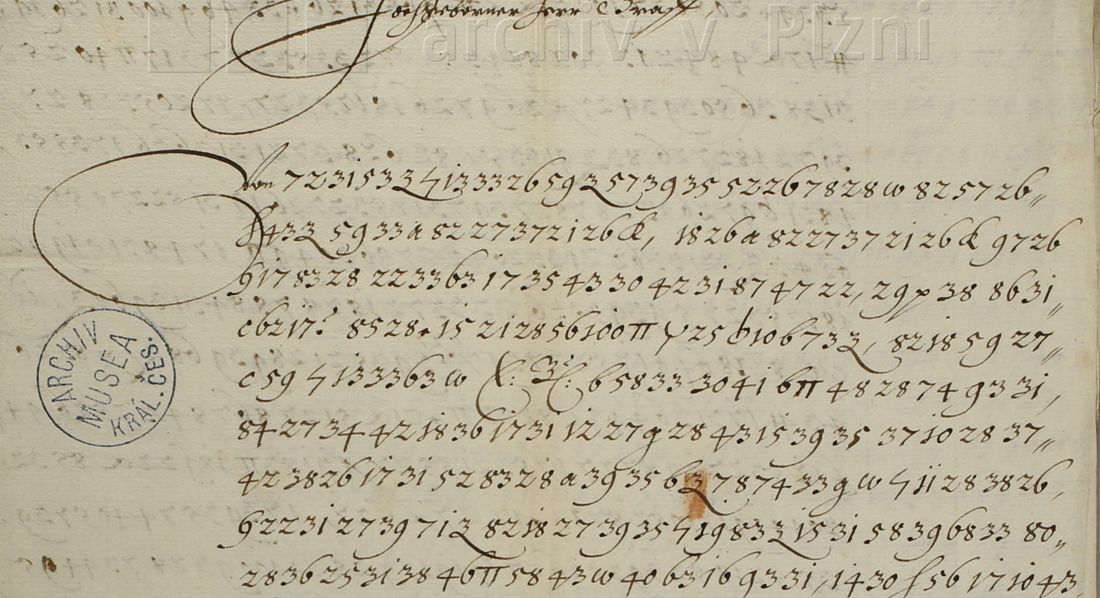
Agents transcribed all 73 DECODE images token by token, two at a time. Clear text went in braces and the glosses were attached to their numbers. Plain homophonic annealing with a German 5-gram model (Grimmelshausen and Gutenberg German, early spelling) collapsed into enenen…, even with a letter-frequency penalty. The glosses turned the problem into a structured one: one consonant per half-ten and one value per single sign, seeded with seventeen glossed values. That solver produced fluent German on the first run (ich müesse die Kranckheit beschreiben, damit man sich den remediis darnach zu richten…). The irregular signs were then fixed by checking them in context and by ranking candidate values with the language model. Of the 22,913 transcribed cipher signs, 98.3 % then had a value.
A checked second pass followed on 21 September 2026. Agents compared every line of the 73 transcriptions with crops of the images, working from a printout of each sign’s value, and changed a sign only where the image showed it. About 360 signs were corrected. The commonest slips were a plain c written for the looped sign worth tu, a bold 9 written for the hooked sign worth w, and 6 written for φ (z). In R3813 a crossed ƒ-like sign worth ta had been merged with another sign. A script fault had also dropped 56 cipher lines that began with a graphic sign. The language-model score of the decipherment improved on eight of the nine letters. Of 23,699 cipher signs, 99.9 % now have a value.
05What remains uncertain
- Transcription. After the checked second pass, the garble that remains sits where the image itself does not decide: digits run together, blots and overwritten figures. The Latin passages are still the weakest.
tr/PASS2_LOG.mdlists the remaining lines file by file. - α was first taken as m, which gave Salv- before l. The images show two signs: the small upright α is sa (Salvius, caesaris, universal-, Sachsen), and a larger looped form is m. In one hand (R3813) the two shapes are hard to tell apart.
- 99 is uncertain (e?), 90 occurs once, and 96 does not occur. The signs 3, 4, 5, 7, m, #s-loop, #dot and p are treated as nulls or are unassigned (grade M).
- The recurring group decrypted as ml in R3812–R3814 is sometimes part of universal- and sometimes a name. It is unresolved.
- The two Banér copies in R4645 are transcribed: to Lüneburg, 10 January 1639, and to the Lower Saxon envoys, 29 January 1639, refusing to leave the Circle. The endorsement on R4734 names the addressee as Count Schwarzenberg. Kurz’s own clear postscript on R4645 is only half legible.
06Sources
- DECODE records R3811, R3812, R3813, R3814, R3815, R4625, R4645, R4734, R4736 (images public). They hold no key record and no transcription.
- Jakub Mírka, “Raně novověká šifrovaná korespondence ve fondech šlechtických rodinných archivů Státního oblastního archivu v Plzni”, Západočeské archivy 3 (2012), 44–73; reprinted in Crypto-World 11–12/2012, 1–2/2013 and 3–4/2013 (part I, pp. 23–25, on Kurz). He describes the system, reports the key rebuilt from R3811 and summarises R3811. He prints no key or text.
Transcriptions, key, solver and decipherments: kurtz1639/ in the repository (tr/, KEY.md, read/, read/SUMMARIES.md).