
01 The three records
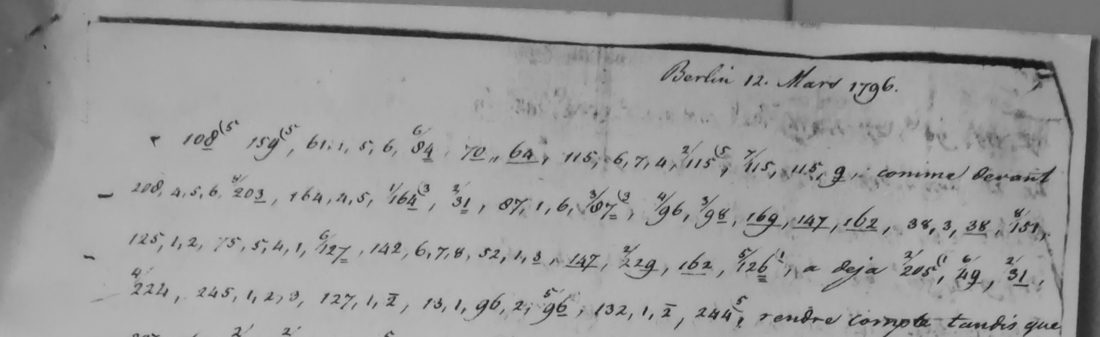
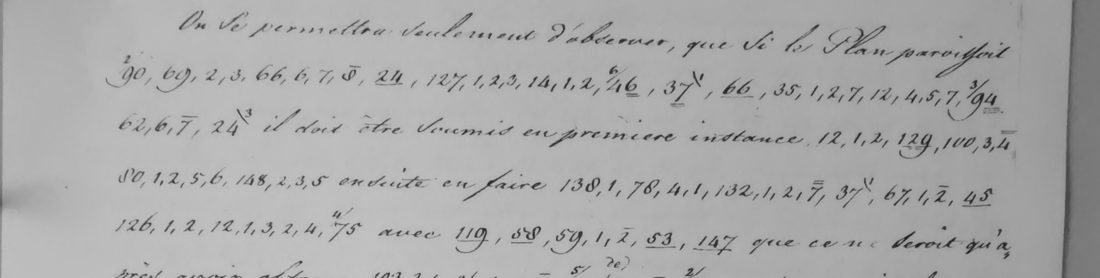
R2237 (7 pages, DECODE “Decrypted”) is a covering letter in clear about Reede’s project for the reunion of the seventeen provinces and “les deux observations chiffrées”, followed by the decipherment (pp. 2–4) and the two ciphered observations (pp. 5–7), which mix clear words with number groups. R2239 (3 pages, headed “Berlin 12. Mars 1796”; page order P2, P3, P1) is written the same way. R2236 holds two Dutch copies (“No 1”, “No 2”) with numbers up to about 390 and a page with numbers up to 2835.
02 The system
A group refers to one entry of a numbered list:
- N underlined: the whole entry (58 = cour, 53 = Vienne, 162 = Elgin).
- N,p,q,…: letters p, q, … of the entry, in that order (12 = certain: 12,1,3,2,4 = cret).
- k/N (small number at the top left): the entry without its first k letters (127 = attachement: 4/127 = chement).
- N(k (small number at the top right): the entry without its last k letters (24 = quelque: 24(3 = quel).
Marks combine (84 = excellence: 2/84(3 = celle). Large parts of the list run alphabetically (10 Angleterre, 11 Berlin, 12 certain, 13 difficile, 14 engager, 15 France … 22 Orange, 23 Prusse, 24 quelque); above 100 it holds common words and phrases (102 le cabinet, 107 le roi, 132 je compte, 133 on dit). The same word can be spelled from many entries, so one plaintext has many encipherments.
03 The decrypted text
The first paragraph is not in Colenbrander’s edition; it is decrypted here with the completed word list:
La conférence que j’ai annoncée comme devant avoir lieu le huit entre Haugwitz et Elgin s’est effectivement tenue, et Lord Elgin m’a déjà communiqué le résultat, dont je [vais?] rendre compte, tandis que le comte Haugwitz me dit avant-hier au bal du Roi qu’il viendroit un de ces jours chez moi pour me parler sur cet objet.
The conference I announced as due to take place on the 8th between Haugwitz and Elgin was indeed held, and Lord Elgin has already told me its outcome, of which I [shall] give account, while Count Haugwitz told me the day before yesterday at the King’s ball that he would come to me one of these days to speak to me about it.
The rest of the letter agrees with the print, with small differences (the cipher has “sur cela” where the print has “à cette demande”, and “avoit” for “jouissait de”):
Et il a fait à Elgin la communication de l’idée dont nous étions convenus ensemble, de faire une démarche en France pour déterminer cette puissance à consentir à rétablir les affaires dans la République sur l’ancien pied, ajoutant que vu le degré d’influence qu’il pensoit avoir à Paris il espéroit qu’une semblable proposition ne seroit point infructueuse … Lord Elgin lui dit n’être pas à même de pouvoir lui répondre … et qu’avant de prendre des nouvelles instructions à cet égard il désiroit savoir si au cas qu’une ouverture faite par le Roi à Paris fût infructueuse, le Roi la soutiendroit par les armes … Je convins avec Milord Elgin que quand Haugwitz me parlera sur cette matière et me rendra compte de sa conversation avec lui, je tâcherai de l’engager à faire une démarche en France sans avoir l’assurance qu’il désire avoir concernant nos colonies, puisqu’elle ne sauroit jamais nuire, et que si elle étoit de quelque fruit l’utilité seroit considérable, en quoi je me flatte de rencontrer les intentions de mon père, étant encore à remarquer que si le premier pas se fait, il est peut-être possible d’amener le second.
The full text is in r2239_reading.txt in the repository. Prussia would sound out France on restoring the Stadholderate; Britain wanted Prussian arms behind it and would not promise the Dutch colonies in advance; the Prince meant to push Haugwitz to try anyway.
04 Method
R2237’s cipher groups were aligned by hand with the clerk’s decipherment, group by group, and each group turned into constraints on its entry (a letter at a position, or a length). A small script (wordtable.py) holds the constraints, reports conflicts and decodes any group file. The rules were worked out from the first lines (90 = même gives 2/90 = me and 1/90 = eme). An attempt to let a search split the plaintext among the groups failed, because a whole-word group can absorb any string; the alignment was done by hand. R2239 was transcribed from the DECODE photographs into the same notation. The R2237 entries decoded 59% of its groups, and context inference 70%. Colenbrander’s volume II was then searched on the Huygens Institute site. Its no. 752 matches R2239 from the second sentence on, and aligning it fixed the entries that only R2239 uses (208 défavorables, 209 désireroient, 219 instructions, 115 abondance, 202 avantageux, 79 cabale…). Those entries decrypt the unprinted opening.
05 What remains uncertain
- “dont je [vais] rendre compte”: entry 244 occurs only here, as 244(5; the word is a guess (I).
- The rest of the opening is graded H: every group decodes, and the entries used there are confirmed by other occurrences.
- The body is H where cipher and print agree. A few groups in the transcription decode wrongly because a mark was misread (e.g. the entry 87 groups where the print has “les”); the print settles those words.
- Addressee: DECODE gives William V (the letter is in his papers); Colenbrander prints the text as to Prince Frederik. The phrase “les intentions de mon père” fits a letter to the brother.
- R2236 is not decrypted, and neither is the line at the foot of R2237 p. 7 after “la proposition”.
06 Sources
- Koninklijk Huisarchief, The Hague, A31 Prins Willem V, inv. 337: DECODE R2239, R2237, R2236 (images by login).
- H. T. Colenbrander, Gedenkstukken der algemeene geschiedenis van Nederland van 1795 tot 1840, II (The Hague 1906), no. 752, pp. 910–911, “De Erfprins aan Prins Frederik, 12 Maart 1796”, on Huygens ING retroboeken.
- Karl de Leeuw, “Johann Friedrich Euler (1741–1800): Mathematician and Cryptologist at the Court of the Dutch Stadholder William V”, Cryptologia 25 (2001), 256–274, cited on the DECODE records for this cipher; not seen.
Transcription, word table, scripts and notes: hereditary1796/ in the repository.