
01 The documents
The BnF notice and the DECODE records give the folios: no. 23 f. 35 (key slip f. 36r), no. 24 f. 37, no. 25 f. 38, no. 60 f. 88, no. 78 f. 111 in fr. 3623; on Gallica canvas = 2 × folio + 9. The two letters bound between them, no. 26 (f. 39, from Sy, 11 January) and no. 27 (f. 41), are entirely in figures with a contemporary decipherment between the lines, but in another key.
02 No. 23: Bienvenut, Paris, 28 February 1590
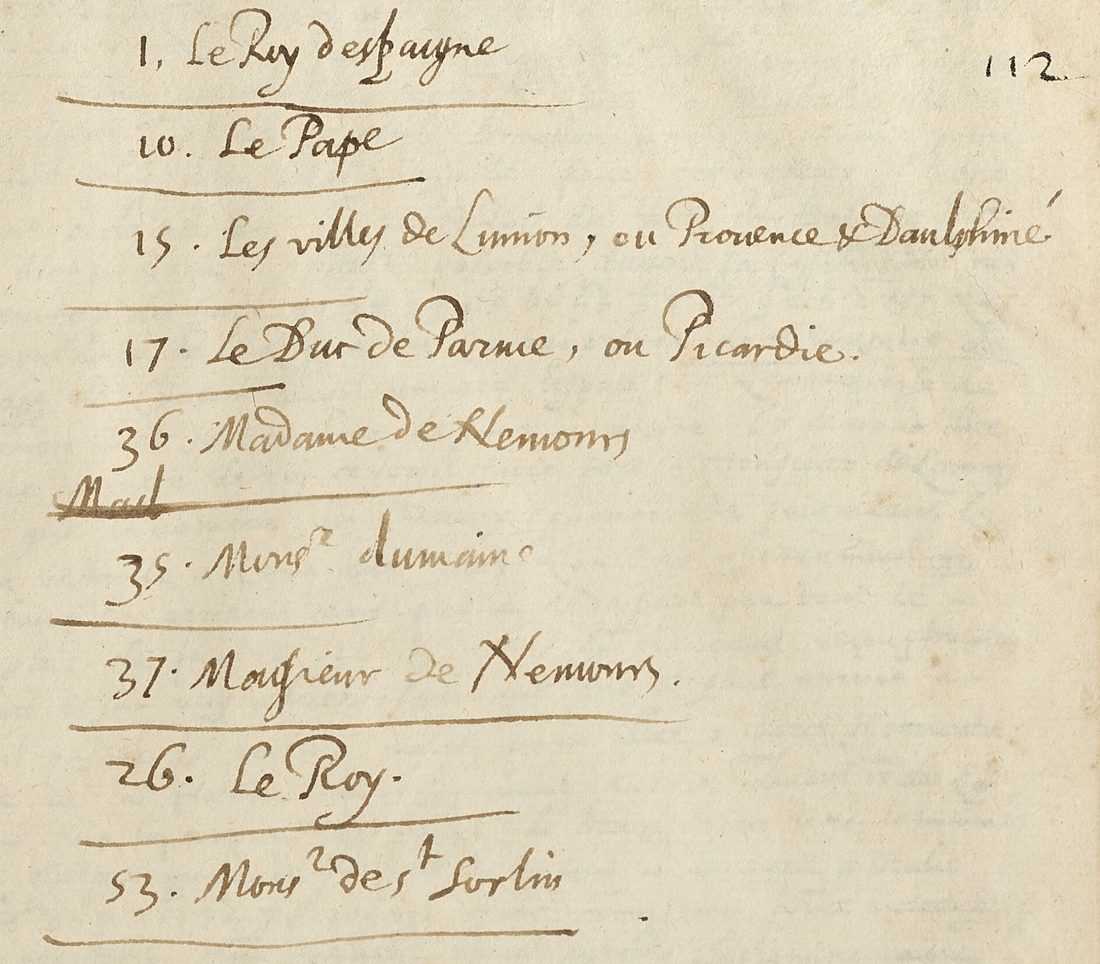
Every number in the letter is on the slip, so the letter decodes end to end (grade H). It is addressed to “Vostre Altesse” and reports the court of the League in Paris:
[Madame de Nemours] me pourmena hyer par la gallerie du logis de la Reyne plus d’une heure… elle me monstra plusieurs avis qu’elle avoit eu de [M. de Saint-Sorlin]… J’ay advis… qu’il y a une tres estroicte intelligence entre [le Pape] & [le Roy d’Espagne]… le courrier que Mr le Legat despescha a Rome… pour entretenir la guerre jusques a ce que [le Pape] puysse envoyer 8 ou 10000 hommes de guerre avec lesquelz il baste l’ame a [Mayenne]…
03 Nos. 24, 25, 60: an alphabetical two-digit key
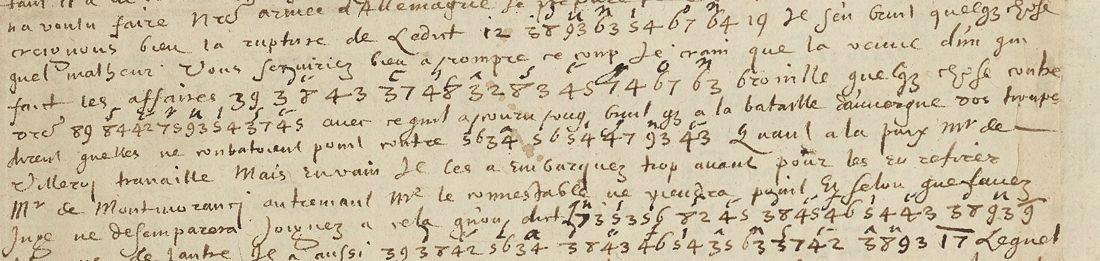
The glosses give d u n i, a, n and, in no. 60, L u d o v i c. Set against the context they place a = 34/35, c = 37, d = 38, i = 53/54, l = 56/58, n = 63/64, o = 67, u = 93. The values rise with the alphabet, so every other figure has a predicted slot: e 42–45, f 46, g 47, h 48, r 74–75, s 82–86, t 92. Decryptions were accepted only when each value fell in its slot.
| Where | Figures | Reading | Grade |
|---|---|---|---|
| 25, “la rupture de l’edict” | 12 58 93 63 54 67 64 19 | [de] l’union [19] | C/I |
| 25, “ne combatroient point contre” | 56 34 56 54 47 93 43 | la ligue | C/I |
| 25, “Je a aussi” | 39 38 42 56 34 38 43 46 54 35 63 37 42 38 93 17 | [39] de la defiance du [17] | I |
| 25, “qu’on dict” | 17 33 53 56 82 45 38 45 46 54 43 38 93 39 | [17] … se defie du [39] | I, first half open |
| 25, “qui faict les affaires” | 39 38 43 37 48 32 83 45 74 67 63 | [39] de Chazeron | I |
| 25, “vostre” | 89 84 42 75 93 54 37 45 | [89] service | I |
| 60, “du sieur” | 19 56 93 38 67 93 53 37 | [19] Ludovic | C |
| 60, “en est aussi” | 39 38 43 56 35 94 62 32 64 | [39] de la V?an | I, name open |
| 24, “du faict” | 99 38 39 45 30 93 38 67 92 52 37 | open | — |
| 24, “mal disposé” | 16 39 56 43 99 95 93 35 92 05 54 86 | open | — |
Chazeron is named in clear in no. 24, which supports the decryption in no. 25. The figures below 30 and 39, 89, 99 behave as word or name codes and have no key.
04 Laurière, Châlons, 9 July 1593 (fr. 3625 no. 55)
The OAI item list of fr. 3625 places no. 55 at f. 66r (canvas 143): Laurière’s letter, “Chalons ce IX juillet 1593”, clear French with eight cipher runs (86 groups). The code mixes figures of one to three digits with letters and signs and is syllabic. Only “come” is written over the first group. His letter of 13 July (no. 10, f. 10r) is in the same code with the office’s decipherment between the lines; its first three runs give ✗ = que, 335 = le Roy, 141 = soit, 346 = volonté, 59 = du, XX = pape, 103 56nΔ = aussitost.
| No. 55 | Reading | Grade |
|---|---|---|
| 347 | come (gloss on the leaf) | H |
| 25 ✗ 335 141 encores | … que le Roy soit encores | C |
| 26.6. 346. 59 XX | … la volonté du pape | C |
| 286 103 56nΔ | … aussitost | C |
All seven glossed runs of no. 10 were then aligned into a code table of twelve entries. The code is syllabic: most words of the decipherment sit over two to five groups whose boundaries are not marked, so only groups that fall under the same word twice, or alone under a one-word gloss, were accepted. With that table 19 of the 86 groups of no. 55 are decoded, e.g. “come […] du que […]”, “[…] que le Roy soit encores […]”, “[…] a la volonté du pape […] aussitost”. The rest stays open; a language model has nothing to score with four groups in five unknown.
05 What stays open
- The two passages of no. 24, the first half of one no. 25 passage, the name in no. 60, and the code numbers 12, 16, 17, 19, 39, 89, 99 (and 22, 44, 51, 84 in no. 24).
- No. 78 (f. 111r, 1591): one group, “traictast de 96 □ 3 9̄ f 3”, too short to decrypt.
- Fr. 3625 no. 55: 67 of 86 groups not decoded with the no. 10 table.
06 Sources
- BnF français 3623, Gallica btv1b525245007, canvases 79–86 (ff. 35–38), 185 (f. 88), 233 (f. 111).
- BnF français 3625, Gallica btv1b52511322v, canvases 31 (f. 10r, no. 10) and 143 (f. 66r, no. 55).
- DECODE records R9453, R9454, R9455, R9459, R9460 (no decipherment on the records).
- S. Tomokiyo, “Ciphers of the Duke of Nevers”, cryptiana.web.fc2.com/code/nevers.htm (keys of BnF fr. 3995; no entry for fr. 3623 or 3625).
Transcriptions, decipherments and the profile are in the repository folder champagne1590/.