At a glanceKey from adjacent plaintext · partial · 264 of 278 tokens
- The letter
- Coenraad van Beuningen, Dutch envoy in London, to Gaspar Fagel, Westminster, 23 May/2 June 1676.
- Where
- Nationaal Archief 3.01.18, inv. 249, scans 131–132. This letter has no contemporary decipherment.
- The cipher
- Homophonic letter numbers, colon-marked word codes and a letter-prefixed alphabetical nomenclator, among clear Dutch passages.
- How it was deciphered
- Key recovered based on adjacent plaintext. The clerks’ interlinear glosses of sibling letters in inv. 248 (1675), 249 (1676) and 250 (1677) provided the key. Extent: partial.
- What it says
- Du Plat and two Frenchmen are to hire bylanders at Bruges. Van Beuningen distrusts his informer and recommends secrecy and possible arrests.
- Still open
- Twelve residual I tokens and unread s439; retaining gemelte adds g121 to the I count. The strict reading is 264/278 (94.96%); the 95.32% result is conditional.
- Credit
- Decipherment by Feyseel Nur, with Claude and Codex. Both Codex reviews are retained with the evidence.
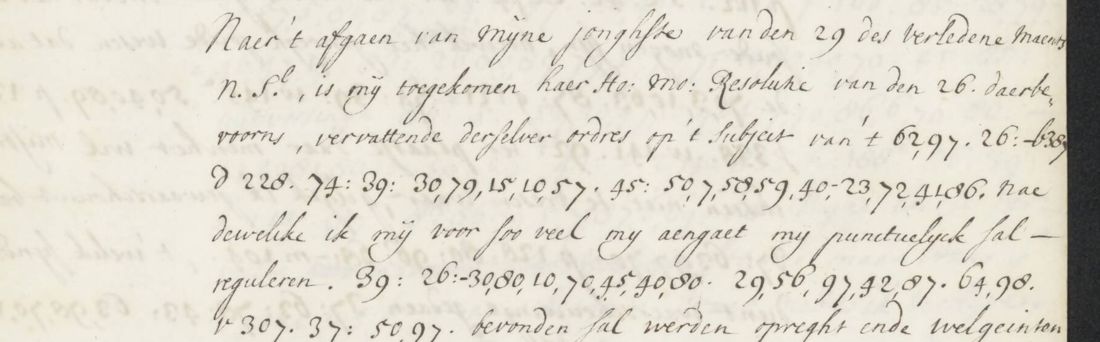
01 The letter and the sibling glosses
The letter occupies scan 131 right and scan 132 left and right. Its 278 cipher tokens are interspersed with clear text. A braced spelling counts once; clear words, insertion brackets and superscript endings add no tokens. The key was rebuilt from thirty transcription files of glossed siblings in the three annual volumes. Some glosses belong to a later hand, which matters to the coverage.
No earlier reading of the June letter was found in the sources checked, and no contemporary decipherment accompanies it. The interlinear plaintext belongs to other letters, and the historical summaries concern earlier correspondence.
02 The plan and the informer
… op ’t Subject van ’t MY aen-gebracht dessein op den BRIEL ende HELLEVOET …
The French dessein concerns Den Briel and Hellevoetsluis. Du Plat and two Frenchmen are to cross to Bruges to hire, or buy, bylanders. A pass names Thomas Straught and a party of men; their number remains uncertain. Most of the English soldiers are to learn of the plan only when they can no longer turn back.
Du PLATT heeft ondertusschen EEN pas voor EENEN THOMAS STRAUGHT … afgehaelt …
Van Beuningen suspects that the informer is seeking a reward. He nevertheless pays a sum through a burgher who must refund it if the information is false. The amount is not established. He recommends secrecy, considers asking Brussels to arrest Du Plat with the two Frenchmen at Bruges, and reports Amsterdam rumours about holding back Bastiaensz’s fleet.
The Dutch reading, line by line
Upper case marks spelled cipher words. Question marks mark inferred values. Brackets retain unresolved readings or editorial explanations; spacing and inflections are editorial.
131R.01  Naer 't afgaen van myne jonghste van den 29 des verledene Maents
131R.02  N.St., is my toegekomen haer Ho: Mo: Resolutie van den 26. daerbe-
131R.03  voorens, vervattende derselver ordres op 't Subject van 't MY aen- gebracht
131R.04  dessein op den BRIEL ende HELLEVOET Nae
131R.05  dewelike ik my voor soo veel my aengaet my punctuelyk sal-
131R.06  reguleren. den aen- BRENGER BLYFT MY
131R.07  verseeckeren dat HY bevonden sal werden opreght ende welgeinten-
131R.08  tioneert te syn, ende heeft my wesen seggen, dat op gisteren [ins DU PLAT ende ]
131R.09  met de twee over gekomen Franschen DE Zee souden passeren ende
131R.10  voorts naer BRUGGE gaen om de BYLANDERS
131R.11  in te HUYREN [ins ofte koopen ] Ik ben niet sonder sterck-
131R.12  mistrouwen van dat men soude mogen uytwesen om my te mis-
131R.13  leyden, ende dat misschien de geprojecteerde toeleg by Vranckryck
131R.14  niet IS op- genomen , maar dat sulcx gefingeert wert om eenige
131R.15  recompense te trecken , ende dat niet alleen om dat sigh veele on-
131R.16  waerschynelyckheden aen my in T aen- gebrachte VERtoonen
131R.17  ALS OM dat den MAN seer IMPORTUNE
131R.18  aen- HOUT op DE recompense Ik heb geweygert YETS
131R.19  te geven voor dat ick mede PROVEN souden hebben
131R.20  ALS woorden(?) ende parolen(?) DIE men kan [...] doch heb
131R.21  eyndelyck aen een bekent Burger, die HY participant(?) heeft gemaeckt
131R.22  van syn secreet [t218: som onzeker; tweehondert?] STEERLS uyt- [ins GE ] REICKT
131R.23  om aen den voorschreven aen- BRENGER GETELT te
131R.24  werden obligerende sigh den voorschreven BURGER die aen MY
132L.01  te restitueren indien DE Waerachtigheit van T aen- brengen
132L.02  niet nader consteert(?) Du PLATT heeft ondertusschen EEN
132L.03  pas voor EENEN THOMAS STRAUGHT
132L.04  ende dertigh(?) mannen afgehaelt, dat ick op sodanigh groot
132L.05  papier hebbe doen engrosseren(?) als hiernevens gaat om dat het bekent
132L.06  soude mogen syn, hoewel het genoegh soude wesen dat alleen
132L.07  de NAEM vande gemelte(?) op den welcken HET pas
132L.08  Staet geweten(?) worden ter plaatse daar men het wil misbruyken,
132L.09  indien niet te vresen waar, gelyk ik gewaarschouwt ben,
132L.10  dat MYN paspoort sullen werden naer- gemaeckt , 't welk synde soo
132L.11  dient waerschouwinge gedaen dat men sigh door MYNE
132L.12  paspoort niet laet abuseren
132L.13  'T is niet sonder grote reden (myns oordeels) dat haar Ho: Mo:
132L.14  in bedenken nemen of men de saecke dient secreet te houden
132L.15  OM DE toeleger te ATTRAPPEREN Want
132L.16  die men in vaertuyg(en)(?) souden brengen sullen ENGELSCHEN
132L.17  syn , ende uytgeset weenigh officieren die in 't COMPLOT
132L.18  PART hebben sullen SE bestaen uyt soldaten die men
132L.19  niet onderrechten(?) sal voor dat- SE soo verre sullen syn dat- SE
132L.20  niet sullen connen te RUGH keeren
132L.21  Ook verneem ik uyt schryven van Luyden buyten de Regieringe
132L.22  tot Amsterdam dat alrede daer sterck gerught is van aen-
132L.23  schryvinge by haar Ho: Mo: gedaen tot voorkominge van EEN
132L.24  toeleg op den BRIEL ende onder anderen dat
132L.25  DE VLOTE tot HET CRUYSEN
132L.26  GEDESTINEERT onder den Luytenant Admirael
132L.27  BASTIAENSE ten dien aensien souden op- GEHOUWDEN
132L.28  syn dat ik echter niet wil hopen.
132R.01  Indien aldaar de ordres tot voorkominge van T voorschreven dessein
132R.02  gestelt niet secreet GEHOUDEN connen werden Soo laat
132R.03  ik UWelEd. Gestr.e in bedenken, ofte niet naer BRUSSEL
132R.04  DIENT geschreven OM den voorschreven DU PLATT
132R.05  MET DE twee Franschen tot BR[U]GGE te [ins soecken(?) te ] ATTRAPPEREN ende tot
132R.06  uytvorsinge van haer LOGEMENTEN van- VERRE daer naer doen vernemen(?) ten huyse van den
132R.07  koopman vanden STRAETEN in Myne laatse vermelt; [struck through: ...] soo het maar waar is 't geene my soo is aengebraght. Waer mede ik verblyve.
03 What the key supports
The homophonic alphabet spells names and other words. Colon-marked numbers carry common words; letter-prefixed groups form a partly alphabetical nomenclator. The interlinear glosses supply direct values, while context and alphabetical position suggest others. These forms of evidence are kept separate.
| Scenario | Strict H+C+M |
|---|---|
| All gloss sources and our gemelte | 264/278 (94.96%) |
| Excluding later-hand glosses | 263/278 (94.60%) |
| Only if g121 is read as the glossed selve and the later-hand genomen is accepted | 265/278 (95.32%) |
Same-code direct gloss support is 241/278 (86.7%). The figures are the Codex re-measure. H+C+M refers to the historical evidence bands, where H meant a sibling gloss and C included contextual spelling. In the repository convention H means a primary key, C known plaintext, M uncertain and I inferred. There is no primary key sheet here, and no aggregate repository-grade count is claimed.
The twelve residual I tokens and one unread token remain even under the conditional 95.32% scenario. Some are clustered; the mede clause remains awkward. Coverage therefore does not establish that 95% reads as coherent Dutch. The extent remains PARTIAL.
The blind-test accounting is corrected to M 10/10, I 3/6, with one near match and two misses among the I predictions. The key was not cleanly blind: files already cited scan-128 glosses, and s250 was later revised to s258. In the recorded shuffle control, 93% of spelled words of four or more letters are Dutch, against a 1.2% mean over 1,000 shuffled keys, maximum 11.6%. This tests the spelling layer, with a fixed names and historical-spellings list; it does not validate inferred codes or syntax. The control was not rerun for this addition.
04 Corrections and remaining gaps
- o177 = ondertusschen, not onder anderen; n155 = genomen gives op-genomen, with a later-hand witness.
- z108 is z103 = Zee, after the digit correction. b386 = brengen; the 272L bylegginge attribution was a misread.
- m161 = mede is attested, but “mede proeven … als woorden ende parolen” remains awkward.
- g121 = gemelte remains I; the alternative gloss selve is M. “Den selven” would add editorial inflection.
- v274, proposed as vernemen in June, conflicts with verwondert in another letter. It remains I.
- t218, the sum paid, remains I. Tweehondert is uncertain; hundreds elsewhere use a number plus h165 = hondert.
- The twelve residual I tokens are c324, d210, e274, o211, p113, p122, s254, t218, v111, v274, w141 and w204. Their proposals are marked in the reading. Retaining gemelte adds g121 as a thirteenth I token.
- s439 remains unread in the sup- range. Sweeren is not retained. The conflicting men/can glosses for 63: also remain unresolved.
These are open-codes gaps. The unglossed siblings at 1676 scans 118, 218–219, 1677 scan 86, and 1675 scans 190, 238–239 remain workable. No complete reading of them is claimed. The earlier upgrade report and both reviews remain in the evidence; the second review supersedes the unconditional 265/278 claim.
05 Sources and corroboration
- Nationaal Archief, 3.01.18 inv. 249, scans 131–132; sibling glosses also in inv. 248 and inv. 250. Individual scan and line references accompany the transcription files.
- States General, secret resolution of 26 May 1676, summarising Van Beuningen’s cipher letter of 19 May. This is an earlier letter, not a decipherment of the June text.
- Calendar of State Papers Domestic, 1676–7, SP 29/381 no. 168: “Capt. Plat ... against whom the States have published a placart”. This corroborates the setting, not the uncertain code values.
The repository folder contains the key tables, thirty glossed transcriptions, corrected reading, inventory, controls and both Codex reviews.