An AI engineering department, overnight
One Claude Code manager session and four specialist agents (CAD/FEM, CFD, PCB, Blender) took a product from market research to CAD, structural FEM, OpenFOAM airflow, a routed KiCad board, renders and a report. They did it twice: once for a serious product and once for a deliberately ridiculous one.
Unofficial concepts, not affiliated with or endorsed by SharkNinja, Inc. "Shark" and "Ninja" are SharkNinja trademarks and are used here only to describe the portfolio these concepts imagine. These are digital demonstrators: simulations are not tests, and nothing here makes a product safe.
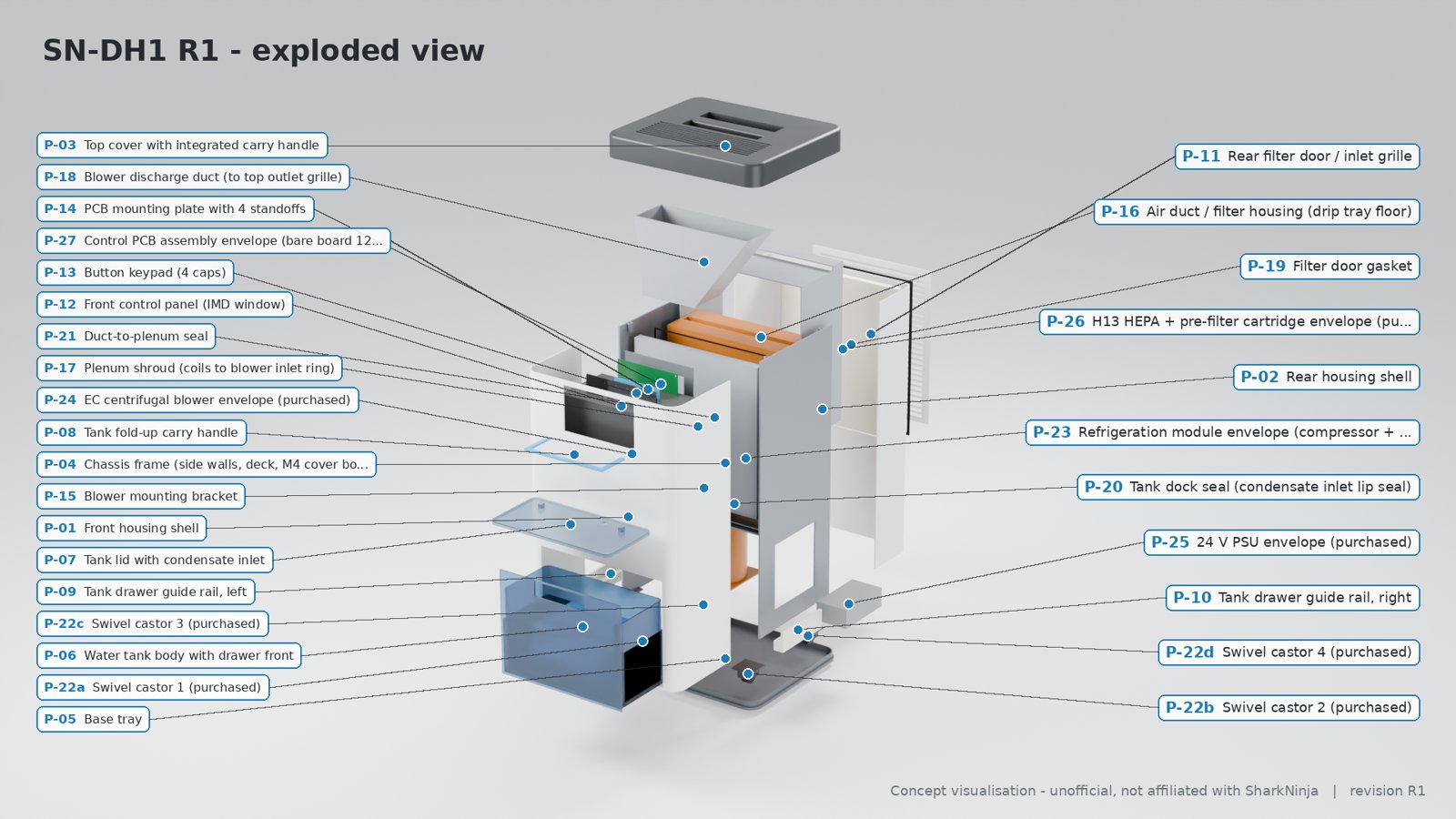
SN-DH1: compact dehumidifier with HEPA purification
Why: Home Environment is SharkNinja's fastest-growing segment (+65% in Q2 2026). Shark sells purifiers and fans but no dehumidifier, and the category is loud, ugly and awkward to empty.
What the agents found (honest results)
| Check | Result | Detail |
|---|---|---|
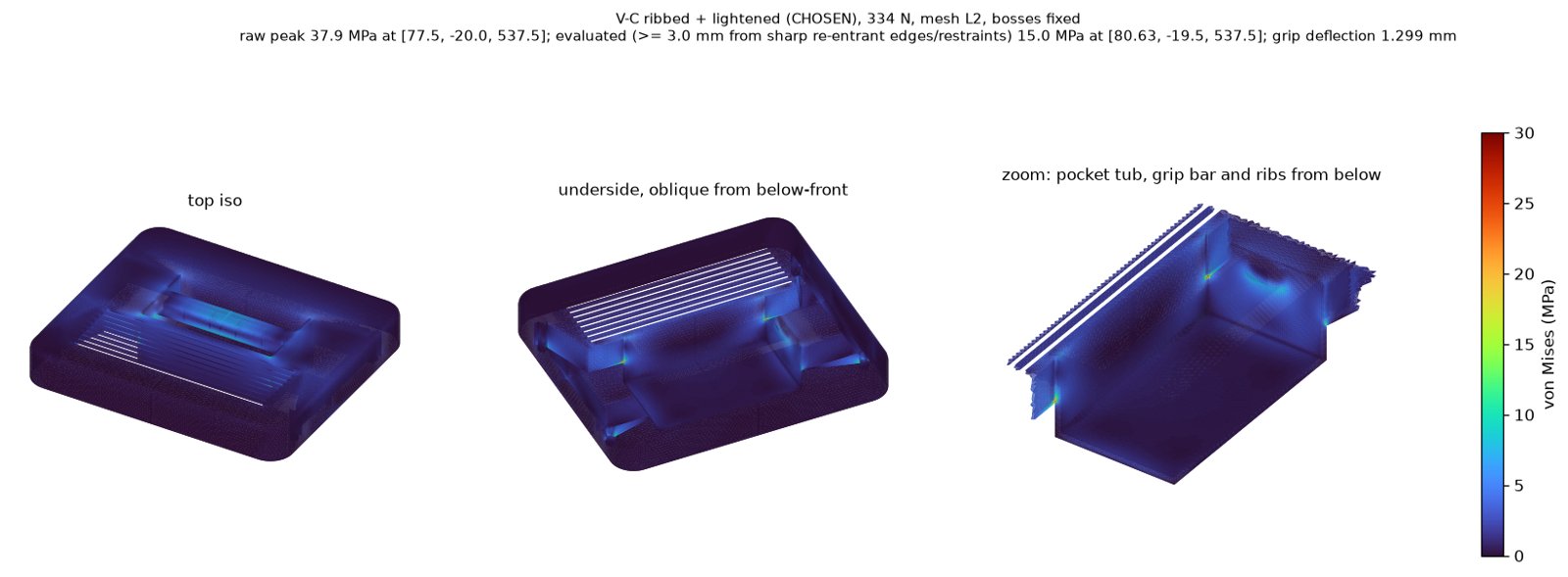
| Carry handle, R1 cover | FAIL | 12.2 mm deflection against a 2.0 mm limit under 334 N. The FEM caught it before any part was made. |
| Carry handle, ribbed variant V-C | PASS | 1.30 mm and 15 MPa at the same mass; 6% margin with the chassis included. Adopted in R2. |
| Airflow pressure budget | FAIL | Real H13 HEPA data alone is about 339 Pa against a 150 Pa total budget. The agents did not tune the assumptions to pass. |
| CAD–CFD iteration (deeper plenum) | PARTIAL | The plenum behind the coils was deepened 17.5 → 27.5 mm at the CFD engineer's request; the rerun confirmed −12.9 Pa and condenser flow uniformity 2.35 → 1.31, but the total is still 399 Pa. The filter is now a product decision. |
| Top-cover screw access | FAIL → fixed in R2 | The Blender access check found the screws unreachable; R2 drives them from above. |
| MCP integration | BLOCKED | Needs a Claude Code restart, so tools were driven through their CLI and Python APIs instead. |
Ninja Toast-Vac 3000: it vacuums your crumbs and toasts them into croutons
The same department, tools and honesty rules, applied to an obviously dumb idea. The joke is the product, never the numbers.
Revision 2: "vacuum first, then toast" (engineering change CR-001)
| CR-001 result | Status | Detail |
|---|---|---|
| Two-step cycle + toast flap | PASS (design) | The flap seals the chamber; Blender confirms the closed position matches the CAD. |
| Motor/heater hardware interlock | PASS (design) | Heaters are forced off while the motor drive is active (0.18–0.25 s release). Not tested. |
| Airflow pressure loss | FAIL by 2 Pa | 2160 → 1502 Pa against a 1500 Pa limit, within the mesh uncertainty, so it is not claimed as a pass. |
| Toasting (135 °C crumbs) | FAIL | 0 of 48 cases. With safe heaters the crumbs settle at 134.8 °C; unconstrained, the PEI wall hits 372 °C (it softens at 217 °C). |
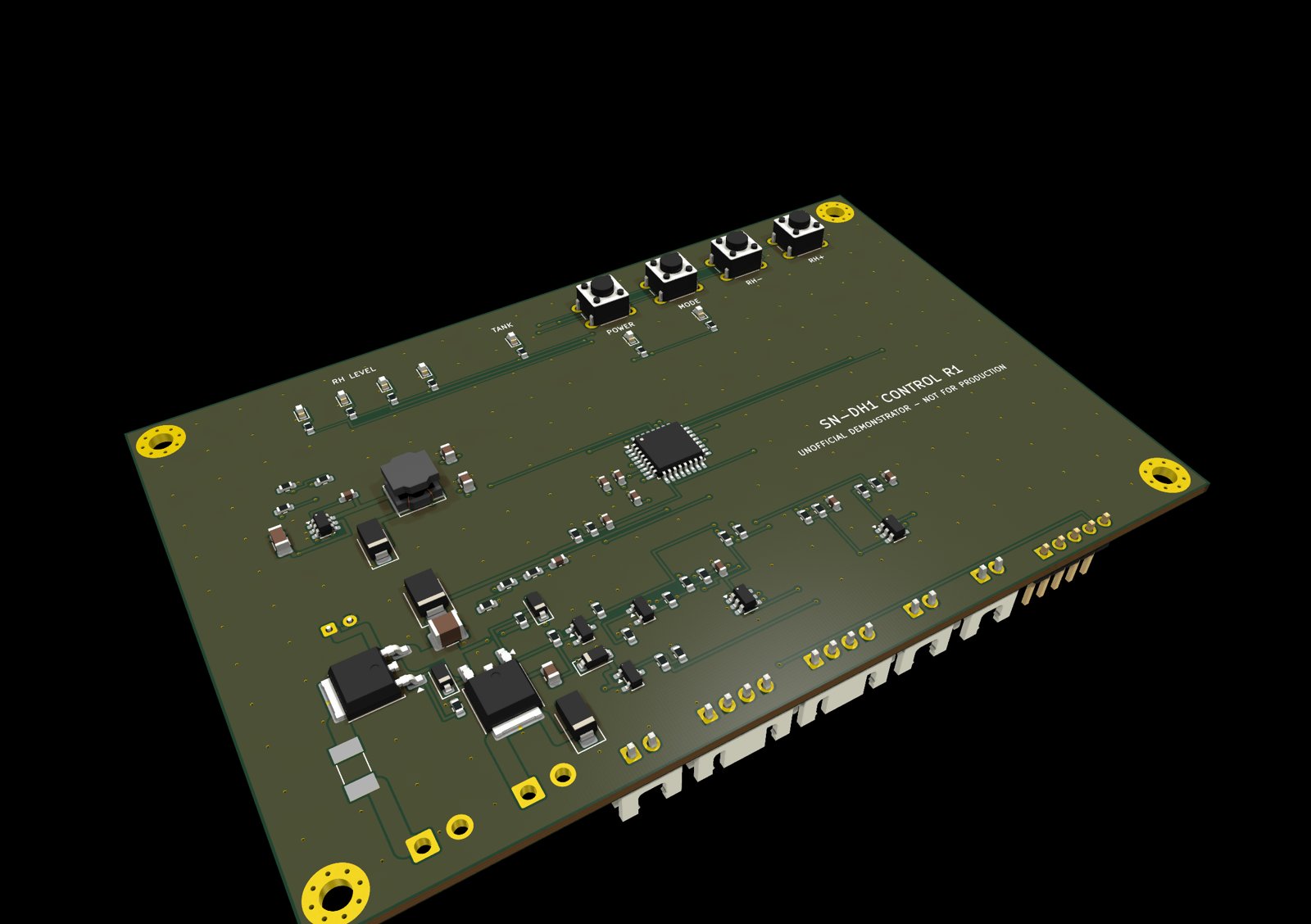
| Control board | PARTIAL | ERC 0 and DRC 0 violations, but 2 nets are unconnected (the fuse-sense feed and heater 1). |
Proposed next (CR-002, not run): an aluminium liner as a heat spreader, a toaster-style radiant element above the crumbs, and 10 g batches. Or just buy croutons.
Version 1
The fix the engineers proposed: stop vacuuming while toasting. That gives 3.6 crouton batches per charge. Please do not build it: heaters, crumbs and Li-ion cells are a fire risk.
How it was made
- Market research and product choice from public SharkNinja filings and press releases.
- The manager wrote requirements (with IDs and verification methods), interfaces, agent definitions and skills.
- Each specialist ran a mandatory smoke test (for example a cantilever FEM within 0.5% of the hand formula, and OpenFOAM pitzDaily) before any product work.
- CAD released R1. FEM, CFD, PCB and Blender worked in parallel, and their findings were fed back into R2.
- Every number is labelled SOURCE, CALCULATION, SIMULATION, MEASUREMENT or ASSUMPTION, with PASS, PARTIAL, FAIL, BLOCKED or NOT RUN status.
Tools: FreeCAD 1.1.4 + CalculiX, OpenFOAM v1912, KiCad 10.0.6, Blender 5.2.3 (Cycles, RTX 3060), Tectonic LaTeX, and Claude Code with Claude Opus 5.5. The process follows the "Master Prompt: Your own AI engineering department" by The 203X Uplink.
Token cost, measured from the session logs
| Run | Tokens processed | Tokens generated | API-equivalent cost |
|---|---|---|---|
| SN-DH1 dehumidifier (V1 baseline, R1 + R2) | 133.8 M | 0.86 M | $107.20 |
| Toast-Vac 3000 (V1 + CR-001) | 52.5 M | 0.46 M | $39.24 |
| Total | 186.3 M | 1.32 M | $146.44 |
Costs are API-equivalent at Anthropic first-party list prices for Claude Opus 5.5 ($4 / $20 per million input/output tokens, $0.20 cache reads, 1.25× / 2× cache writes). The run itself used a Claude subscription. Most tokens are cached context re-reads.